

AI CERTS
2 hours ago
Agricultural Robot Navigation Powers 24-Hour Field Robots
This article explores technology breakthroughs, economics, and risk factors shaping round-the-clock agricultural autonomy. Additionally, it maps a future roadmap for investors, engineers, and growers evaluating capital deployments.
Market Shift After Dark
Global analysts now estimate agricultural robotics revenue between USD 8 and 21 billion by 2026. Moreover, vendors like Verdant Robotics and Carbon Robotics promote continuous night service on their product pages. Verdant claims its SharpShooter treats up to seven acres per hour, day or night. In contrast, Kverneland and AgXeed jointly demonstrated 51 acres ploughed during a monitored 24-hour trial. Therefore, a clear market narrative positions night capability as the next competitive differentiator. Additionally, continuous crop monitoring improves early disease detection.
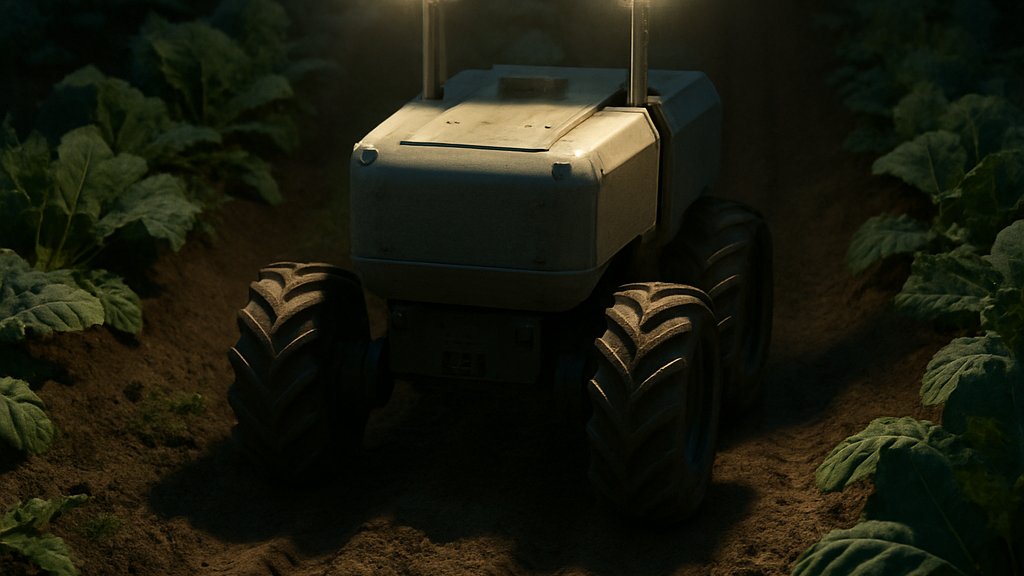
Nevertheless, adoption remains uneven because only 27 percent of U.S. farms use precision practices. GAO identifies cost, interoperability, and data ownership as persistent blockers. Consequently, Agricultural Robot Navigation providers must prove measurable return on investment across multi-shift schedules. Robust nighttime navigation metrics will strengthen those business cases. Continuous operation promises higher asset utilization yet raises new technical requirements. However, those requirements begin with advanced sensor fusion, examined next.
Core Sensor Fusion Tech
Effective night driving demands perception beyond visible light. Therefore, developers fuse thermal cameras, LiDAR, radar, and precision GNSS/INS inside edge computers. Tightly coupled positioning maintains centimeter accuracy even under dense canopies. Meanwhile, deep networks merge range and temperature data to track rows and obstacles. Cross-modal translation models further transform thermal features into daylight-like representations that simplify downstream detection.
An orchard study improved object detector mAP by 18 percent after cross-modal translation pre-processing. Moreover, CLIP robotics researchers leverage vision-language embeddings to refine label efficiency across modalities. Such techniques allow Agricultural Robot Navigation systems to recognise weeds, fruit, and animals despite darkness. Consequently, compute footprints once limited to datacenters now fit rugged field enclosures with embedded GPUs. Multimodal fusion upgrades resilience against dust, fog, and glare. Subsequently, active illumination tactics complement those passive sensors.
Active Illumination Design Tactics
Even best sensors struggle without photons. Therefore, engineers mount synchronized LED arrays that strobe in microsecond windows between camera exposures. This approach standardizes lighting and suppresses motion blur while minimizing energy draw. Carbon Robotics integrates 20 LEDs per module around dual 240-watt lasers for precise targeting. Meanwhile, algorithms adjust intensity based on reflectance feedback to avoid crop damage.
Active illumination also simplifies cross-modal translation by stabilizing color histograms across day and night. Additionally, stable lighting helps CLIP robotics pipelines maintain consistent feature alignment. Verdant’s retrofit kits pair LED bars with stereo cameras, enabling accurate Agricultural Robot Navigation in dusty twilight. Consequently, growers gain uniform weed elimination throughout entire diurnal cycles. Controlled light closes critical perception gaps. However, economics finally decide adoption, as the following section details.
Economics And Adoption Barriers
Hardware costs per acre still anchor purchasing decisions. Fortune Business Insights projects an USD 9.2 billion market by 2026 under moderate growth. Grand View Research foresees even steeper trajectories toward USD 17 billion. Moreover, multi-shift operation reduces labor overtime, improving ROI calculations. However, GAO notes that capital expense, uncertain standards, and data privacy deter smaller growers.
Subscription models now appear, bundling hardware, updates, and service into predictable fees. Consequently, Agricultural Robot Navigation suppliers mirror SaaS economics familiar to tech investors. Nighttime navigation performance metrics, such as acres per hour, become contractual service-level objectives. Additionally, professionals may deepen skills through certification programs. They can enroll in the AI Robotics Specialist™ course for structured learning.
- Market value projected between USD 9–17 billion by 2026.
- Only 27% of U.S. farms use precision agriculture today.
- Verdant SharpShooter covers up to seven acres each hour.
- AgXeed ploughed 51 acres in a single 24-hour run.
Financial models must align technology, service, and agronomy outcomes. Subsequently, safety compliance emerges as the parallel hurdle.
Safety And Compliance Hurdles
High-power lasers demand strict eye protection zones. Furthermore, 24-hour machines must detect and avoid unexpected workers or wildlife. ISO 18497 outlines general safety for mobile agricultural robots, yet laser specifics vary locally. Therefore, vendors integrate multi-layer emergency stops, geofencing, and remote override channels.
Light pollution ordinances can restrict strobe brightness near residential fields. Nevertheless, precision aiming reduces unnecessary skyward light scatter. Regulators also assess electromagnetic emissions from dense clustering of GPUs and radios. Nighttime navigation testing protocols remain under development within ASTM committees. Meeting safety rules preserves public trust and investment momentum. Consequently, future roadmaps incorporate proactive compliance engineering.
Future Roadmap And Insights
Roadmaps converge on higher autonomy levels and broader crop categories. Moreover, dataset sharing will accelerate cross-modal translation model training across climates. CLIP robotics frameworks promise few-shot learning that reduces annotation costs for niche crops. Meanwhile, thermal imagers keep falling in price, enabling fleet retrofits.
Edge AI chips may soon handle 50 tera-operations within 10-watt budgets. Consequently, Agricultural Robot Navigation will expand to smallholder farms operating off-grid. Autonomous farming ecosystems will link robot telemetry with predictive supply chain analytics. Additionally, nighttime navigation data will feed insurance pricing and carbon accounting models. Technological curves suggest constant night readiness within three product cycles. Finally, stakeholders must align strategy with those trajectories.
Conclusion And Action
Round-the-clock robots have moved from prototype to profit. However, sustained success depends on rigorous Agricultural Robot Navigation built for variable lighting. Consequently, growers will pair that navigation with advanced crop monitoring to unlock richer decision loops. Moreover, combining nighttime navigation and cross-modal translation secures reliable perception across seasons. Autonomous farming strategies will then optimize labor distribution and post-harvest logistics. Additionally, Agricultural Robot Navigation integrations will drive safer laser weeding and gentler spraying routines. In contrast, farms delaying investment may struggle against rising wage pressures.
Therefore, professionals should study standards, pilot solutions, and pursue targeted credentials before the next planting cycle. One practical step is enrolling in the cited certification to master autonomous farming fundamentals. Act now, and daylight will no longer bound your fields. Robust Agricultural Robot Navigation also strengthens disaster resilience during smoke or heavy fog. Ultimately, Agricultural Robot Navigation marks the gateway to truly continuous, data-driven food production.
Disclaimer: Some content may be AI-generated or assisted and is provided ‘as is’ for informational purposes only, without warranties of accuracy or completeness, and does not imply endorsement or affiliation.


