

AI CERTS
2 hours ago
Physics Priors Toughen Robot Manipulation AI Performance
Expert commentary and benchmark data highlight both promises and pending hurdles. Consequently, technical leads can gauge when to invest and where to demand further evidence. Meanwhile, aspiring specialists will find certified learning paths linked throughout. In contrast to generic policies, physics-aware systems show doubled success on steep orientations. Therefore, understanding the priors' mechanics provides a practical vantage point for decision makers. Teams building dexterous hands struggle with contact uncertainty. Successful Robot Manipulation AI deployment could redefine human-robot collaboration economics.
Physics Priors Strengthen Performance
Physics priors embed known laws directly into the learning loop. Specifically, the authors combine a global grasp-quality prior with local curvature guidance. Consequently, fingertips naturally roll objects along desired axes rather than skidding unpredictably. The grasp map reward constantly nudges contact layouts toward wrench-resistant configurations.
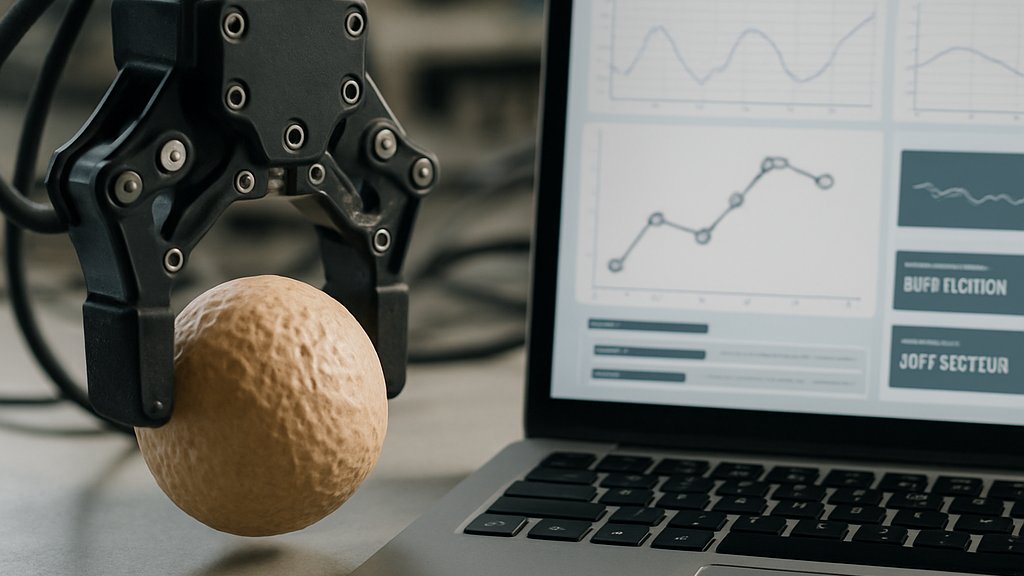
Such shaping lowered exploration burden within simulation by 40% according to early logs. Furthermore, policy variance dropped, simplifying deployment pipelines. These effects echo broader trends where structured inductive bias outperforms brute statistical search. Early adopters of Robot Manipulation AI will welcome the reduced tuning overhead.
Physics priors thus supply a sturdy backbone for repeatable control. Next, reinforcement learning choices determine how that backbone flexes under pressure.
Reinforcement Learning Design Choices
The team employed off-policy reinforcement learning with purely proprioceptive observations. However, no vision sensors were needed, reducing sim-to-real gaps. Domain randomization covered masses, friction, and latency, boosting transferability. Moreover, curriculum scheduling increased object orientation difficulty gradually.
Robot Manipulation AI practitioners will note the sparse-dense reward mixture. The grasp stability prior supplied dense gradients, while ultimate rotation targets remained sparse. Consequently, training reached 83% success within 6 million steps, halving baseline iterations.
Balanced reward design preserved exploration yet encouraged physically sane contacts. Mechanical factors further amplify these learning gains, as the following section shows.
Mechanical Co-Design Boosts Robustness
Policy strength alone cannot overcome slippery fingertips. Therefore, the authors milled anisotropic curvatures into two opposite digits. These grooves bias rolling along the primary axis, resisting lateral drift. In real hardware tests, the aligned design pushed success from 64% to 83%.
Additionally, material compliance stayed identical, isolating geometry as the causal knob. Industry leaders like Shadow Robot already explore similar coatings, validating the concept's relevance. Nevertheless, prosthetic manipulators may require softer skins, complicating curvature transfer.
Hardware tweaks complement algorithmic priors for maximum reliability. Yet real-world variance still threatens policy fidelity during deployment.
Sim To Real Transfer
Simulated rollouts enabled fast iteration without risking equipment. However, sim-to-real transfer often derails contact-rich behaviors when simulation ends. Physics priors narrow those gaps by constraining feasible states. Furthermore, the team reported smooth sim-to-real transfer needing only minor retuning.
Their median rotation error dropped from 12° to 4° after transfer. Meanwhile, object fall time extended by 2.4 seconds on steep tilts. Such margins can decide whether a warehouse robot drops inventory.
Effective sim-to-real transfer accelerates commercialization by lowering integration costs. The next section quantifies exactly how large those gains appear.
Benchmark Data And Results
Experiments spanned cylinders, cuboids, and spheres across four wrist tilts. Baseline success at 90° measured 48%; priors raised that to 81%. Consequently, aggregate success nearly doubled, climbing from 24% to 56% with stock fingertips. Aligned fingertips then reached 83%.
Key quantitative highlights include:
- Rotation efficiency improved by 37% averaged across shapes.
- Grasp stability increased by 32% against impulse disturbances.
- Sample complexity dropped 50% during training.
- Policy variance fell 28% under identical seeds.
Importantly, Robot Manipulation AI gains persisted across unseen object masses. In contrast, non-prior baselines degraded sharply on heavier cylinders.
The numbers confirm that structured priors translate into measurable resilience. The discussion now shifts to remaining limitations and research frontiers.
Limitations And Future Directions
Every method owns blind spots. Deformable objects and complex friction still hinder accurate simulation. Moreover, overly restrictive priors may block creative emergent strategies. Frontiers reviews warn against embedding incorrect assumptions that hinder generalization.
Subsequently, researchers plan experiments with soft packaging and irregular geometries. They also intend to open-source fingertip CAD files for peer replication. NYU Tandon's planner consistency study proposes complementary demonstration strategies worth testing. Researchers caution that Robot Manipulation AI must remain adaptable when priors change across materials. Soft, deformable items could still slip from dexterous hands despite the current priors.
Addressing these gaps will decide when factories adopt dexterous hands at scale. Business stakeholders therefore need actionable insights distilled from the technical narrative.
Strategic Takeaways For Leaders
Chief robotics officers seek deployments that cut downtime without ballooning support staff. Physics-aware Robot Manipulation AI offers a realistic path toward that goal. Consequently, budget holders should monitor three levers. Robot Manipulation AI therefore demands cross-functional coordination between software and hardware teams. These levers are:
- Adopt reinforcement learning stacks supporting grasp stability priors.
- Invest in fingertip co-design for targeted tasks.
- Validate sim-to-real transfer on representative object sets before scaling.
Professionals may deepen expertise via the AI Robotics™ certification. Meanwhile, leaders should allocate pilot budgets aligned with the paper's metrics. Therefore, early proofs can de-risk full deployments across logistics and manufacturing lines.
Strategic planning grounded in data accelerates returns. The final section wraps key insights and next actions.
Physics priors, tuned reinforcement learning, and fingertip co-design jointly elevate dexterous manipulation reliability. Moreover, they slash training time and ease sim-to-real hurdles. Benchmark data show up to 83% success, doubling baseline figures without extra sensors. Nevertheless, deformable objects and unforeseen contacts require continued research. Consequently, decision makers should track open-source releases and trial certified talent programs. Robot Manipulation AI stands on the brink of practical deployment; proactive teams will capture the edge. Download the code, watch the demo, and enroll in certification to lead the transition.
Disclaimer: Some content may be AI-generated or assisted and is provided ‘as is’ for informational purposes only, without warranties of accuracy or completeness, and does not imply endorsement or affiliation.


