

AI CERTS
4 hours ago
Spectrum AI Advances AI Telecom Networks With CBRS Capacity Gains
Moreover, field trials already report 50% more usable spectrum and faster planning cycles. These headline claims excite operators, yet they demand careful scrutiny from technical buyers. Therefore, this article unpacks Spectrum AI, documents early evidence, and evaluates strategic impacts. Meanwhile, we examine market context, deployment risks, and skills required for sustained advantage. Readers gain actionable insight aligned with boardroom planning and engineering reality.
Physical AI Market Disruption
Physical AI models radio behavior directly. Consequently, the approach differs from higher-layer traffic analytics that dominate legacy planning. Federated Wireless trains neural networks on millions of CBRS network propagation measurements. Subsequently, the model predicts path loss within 0.5 dB accuracy, surpassing classical tools. Furthermore, runtime optimization runs a thousand times faster than previous Monte-Carlo simulations. These gains let AI Telecom Networks schedule spectrum in near-real time for dynamic environments. Meanwhile, the system feeds decisions back to the SAS for compliant coordination. Moreover, continuous reinforcement learning improves predictions as more deployment data arrives. Such feedback loops anchor a virtuous cycle of performance and regulatory alignment. To date, early adopters report 90% planning time reductions, accelerating commercial rollout timelines.
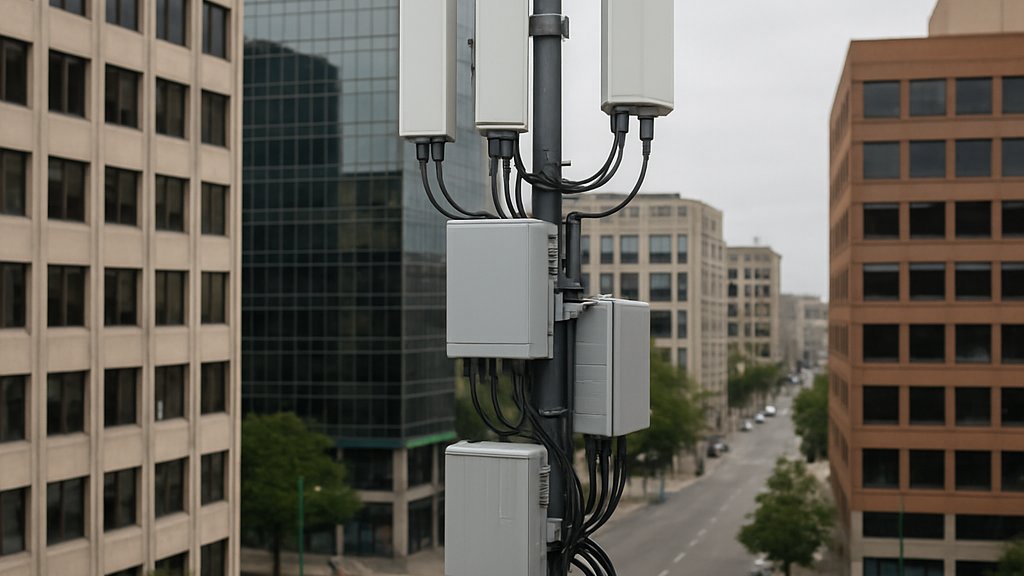
Physical AI shifts capacity planning from static prediction to autonomous control. Consequently, market structures could change as automation reaches production scale. Next, we explore why CBRS momentum matters for that shift.
CBRS Private Market Momentum
CBRS remains the leading mid-band for US private 5G. Many observers rank CBRS as the cornerstone of emerging AI Telecom Networks across industries. Analysys Mason estimates 75% of operational private systems run on a CBRS network today. Moreover, the study projects 85% penetration in manufacturing by 2032. Approximately 442,000 base stations already serve ten million locations, illustrating impressive network scaling. Charter, WWT, and various neutral-host integrators continue aggressive commercial rollout programs. Meanwhile, Federal spectrum policy favors the shared model, bolstering investor confidence. However, operators still chase higher telecom capacity without expensive new licenses. Therefore, Spectrum AI arrives at an opportune moment for enterprises considering incremental expansions.
These trends underline CBRS relevance beyond early experimentation. Consequently, any tool that extracts extra bandwidth from the band could gain rapid adoption. Such context informs the technical performance claims examined in the next section. CBRS adoption already defines the private 5G landscape. Subsequently, attention shifts to tangible capacity results delivered by Spectrum AI.
Spectrum Capacity Gains Explained
Federated’s launch materials quantify several headline improvements. Firstly, simulations predict up to fivefold telecom capacity increases in dense indoor deployments. Secondly, field measurements indicate 50% more usable CBRS spectrum across mixed license tiers. Moreover, 90% propagation accuracy minimizes site overlap, shrinking infrastructure footprints by half. Consequently, capital expenses may drop around 40%, a significant benefit for cash-constrained enterprise wireless teams. However, numbers resonate more clearly in list form.
- Up to 5× telecom capacity in live trials.
- 50% more usable spectrum within existing CBRS network tiers.
- 100-1,000× faster RF simulations accelerate network scaling decisions.
- Up to 50% fewer sites, reducing commercial rollout costs 40%.
Such improvements establish a performance baseline for competitive AI Telecom Networks. Nevertheless, all figures remain vendor-reported and lack independent validation. Therefore, prudent teams will seek third-party audits before embedding Spectrum AI into mission-critical AI Telecom Networks. Next, we calculate cost implications for enterprise implementers.
Federated’s metrics promise dramatic efficiency. However, cost impact merits deeper analysis, tackled in the following section.
Enterprise Wireless Cost Impact
Private 5G budgets often hinge on site count and fiber backhaul. Consequently, halving radio nodes can unlock fresh capital for analytics or security. Moreover, AI-driven spectrum reuse lifts telecom capacity without additional spectrum fees. Analysts model a 500-site manufacturing CBRS network converting to Spectrum AI. The approach might cut 250 radios, save $6 million in equipment, and trim power by 30%. Meanwhile, maintenance contracts would shrink proportionally, easing operational cash flow.
Enterprise wireless procurement teams also value faster planning cycles. Faster models shorten design iterations from weeks to hours, accelerating network scaling roadmaps. Therefore, product time-to-market could improve when connectivity becomes predictable early in projects. Reduced hardware and time together boost ROI. In contrast, unforeseen propagation errors previously delayed many commercial rollout schedules.
These financial levers influence risk assessments. Subsequently, we evaluate deployment challenges that may offset projected savings.
Deployment Challenges And Risks
Cutting-edge algorithms rarely operate perfectly on day one. Therefore, independent validation must confirm capacity claims across varied topologies. Field heterogeneity spans factories, campuses, and rural energy sites within the CBRS network. Moreover, SAS interoperability tests remain essential because Spectrum AI adjusts grant requests dynamically. Any protocol misstep could erode telecom capacity or trigger regulatory violations. Nevertheless, Federated reports rigorous lab certifications with multiple SAS peers.
Policy volatility introduces additional risk. FCC debates on power limits or tier definitions could devalue investments overnight. Consequently, enterprises should monitor docket proceedings and lobby for stable rules. Security also warrants scrutiny because AI agents now influence RF parameters directly. In contrast, legacy planners allowed longer human review cycles. Therefore, explainability dashboards and override mechanisms must accompany any AI Telecom Networks rollout. Unresolved risks could stall AI Telecom Networks ambitions before value materializes.
Operational and policy issues may dilute projected gains. However, sound governance and testing can mitigate most risks, enabling confident deployment. With challenges mapped, strategic outlook becomes clearer.
Strategic Private Market Outlook
Market analysts view Spectrum AI as an accelerant rather than a disruptor. Moreover, higher telecom capacity within existing mid-band unlocks new industrial IoT revenues without auctions. System integrators can bundle the engine with Wi-Fi 7, MEC, and security services for holistic enterprise wireless solutions. Consequently, project margins improve while customers gain predictable performance.
From an investment standpoint, operators welcome anything that slows tower proliferation yet sustains network scaling. Meanwhile, neutral-host vendors anticipate expanded addressable markets, especially in regions lacking fiber backhaul. CBRS network leadership also reinforces US manufacturing competitiveness amid global spectrum scarcity. Therefore, policymakers may support continued shared-spectrum regimes to maintain innovation momentum.
Rising capacity, lower costs, and policy alignment create favorable conditions. Subsequently, talent requirements become the final piece of the puzzle. Sustained policy support will determine whether AI Telecom Networks deliver projected productivity dividends.
Skills And Key Certifications
Advanced spectrum automation demands staff skilled in RF physics and machine learning. Additionally, enterprises require professionals who understand CBRS rules, SAS APIs, and security controls. Engineers already fluent in AI Telecom Networks can upskill further with recognized programs.
Professionals can enhance expertise through industry certifications. They can pursue the AI Telecommunications Specialist™ credential for structured learning. Such training covers CBRS operations, model governance, and DevOps workflows. Furthermore, curricula include network scaling strategies, performance benchmarking, and compliance documentation.
Consequently, teams can execute smoother commercial rollout phases while maintaining enterprise wireless SLAs. Skill gaps threaten ROI even when technology excels. Therefore, certifications align workforce capability with evolving deployment models. Finally, we consolidate key insights and outline next steps.
Conclusion And Next Steps
Spectrum AI represents a bold stride toward spectrum-aware automation. Moreover, field data suggest tangible efficiency, though verification remains essential. Enterprises could harvest greater capacity, fewer sites, and faster deployment cycles. However, policy volatility, interoperability gaps, and security demands still challenge decision makers. Consequently, success will depend on disciplined testing, clear governance, and skilled personnel. Additionally, investments in advanced certifications ensure teams can exploit novel AI tools responsibly. Interested readers should review product briefs, follow FCC proceedings, and pursue the highlighted credential to stay competitive.
Disclaimer: Some content may be AI-generated or assisted and is provided ‘as is’ for informational purposes only, without warranties of accuracy or completeness, and does not imply endorsement or affiliation.


