

AI CERTS
1 hour ago
Humanoid Robot Workforce Reshapes Global Factory Floors
Additionally, it highlights new skills and certifications that professionals will need. Prepare for a concise tour through the unfolding industrial revolution. Unlike fixed industrial robotics, humanoids navigate human spaces without expensive retooling.
Factory Adoption Surge Now
Figure AI ramped its BotQ line from one robot daily to one hourly. That leap positions the Humanoid Robot Workforce for mainstream manufacturing automation. Consequently, more than 350 Figure 03 units already work packing or kitting parts in pilot sites. Hyundai and Boston Dynamics revealed a production Atlas and plan 30,000 units yearly by 2028. Meanwhile, Humanoid signed to supply up to 2,000 robots for Schaeffler’s European plants starting 2026. Toyota adopted seven Agility Digit robots to unload parts after a year long Canadian pilot. Moreover, semiconductor maker STMicroelectronics will trial hundreds of units in legacy fabs.
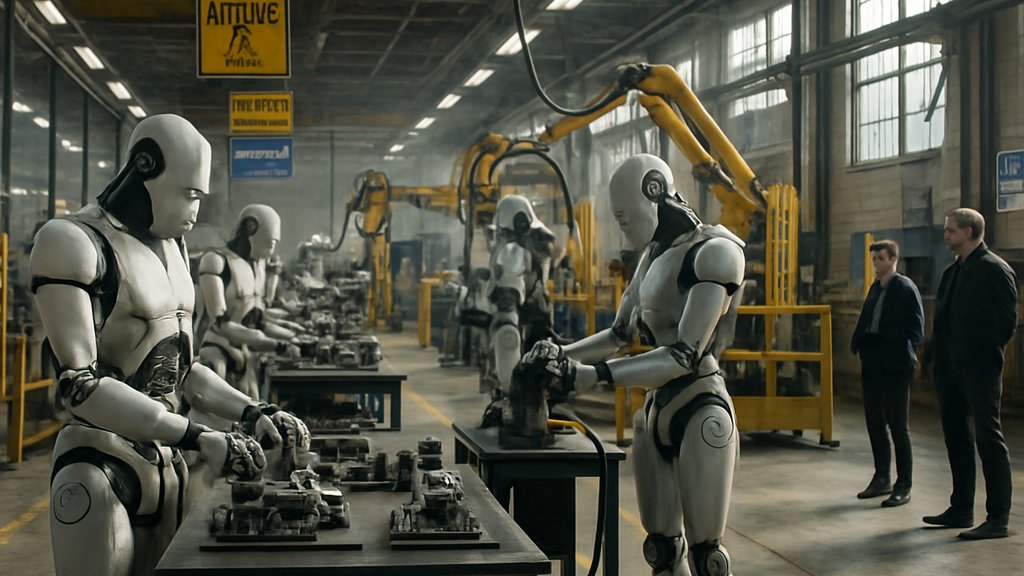
- Figure: 24x throughput, 350+ robots built.
- Hyundai/Boston Dynamics: Atlas factory targeting 30,000 units annually.
- Humanoid: 1,000–2,000 units for Schaeffler between 2026 and 2032.
- Toyota: Seven Digit robots unloading parts in Canada.
- STMicroelectronics: Hundreds of humanoids planned for European fabs.
Overall, the Humanoid Robot Workforce movement is shifting from curiosity to commitment. Nevertheless, capacity constraints still dictate rollout speed. The next section examines those capacity constraints in detail.
Production Capacity Milestones Rise
Scaling humanoids demands automotive-style throughput, not artisan workshops. Consequently, vendors are building dedicated lines similar to traditional industrial robotics plants. Figure’s BotQ claims 12,000 annual capacity, solidifying the Humanoid Robot Workforce supply chain. In contrast, Hyundai targets 30,000 Atlas units yearly, leveraging existing stamping, battery, and painting lines. Moreover, Nvidia is supplying reference designs to Unitree and Sharpa to standardize compute modules.
Helix control software leverages physical AI to coordinate perception, planning, and grasping. Component agreements covering batteries, motors, and sensors aim to reduce costs below today’s steep premiums. These milestones suggest a clear trajectory toward mass Humanoid Robot Workforce economics. Capacity expansion underpins credible roadmaps. Therefore, analysts next look at market demand and macro impact.
Economic Impact Forecasts Grow
Market estimates remain volatile for manufacturing automation’s newest frontier. Roland Berger pegs the Humanoid Robot Workforce market near two billion dollars with high-teens CAGR. Meanwhile, Grand View Research projects similar scale but forecasts 30-plus percent growth through 2030. Morgan Stanley’s Humanoid 100 paints a multi-decade trillion-dollar opportunity, though assumptions remain aggressive. Moreover, economists model labor disruption scenarios showing downward pressure on entry-level wages for repetitive factory tasks.
However, new service roles in fleet maintenance, cloud monitoring, and physical AI training could offset losses. Therefore, net employment effects hinge on reskilling speed and policy support. Forecasts clearly anticipate disruption. Nevertheless, technical reality still places several hurdles in the way. Those hurdles, ranging from safety to reliability, shape the next discussion.
Challenges Facing Deployment Today
McKinsey identifies four bridges: safety, uptime, dexterity, and cost reduction. Consequently, regulators and industry groups still draft ISO standards for fenceless humanoid operation. Battery life averages only a few untethered hours, limiting continuous shifts. Additionally, mean time between failure metrics remain unpublished for many units. Integration also requires connectivity, edge compute, and cybersecurity alignment with existing industrial robotics cells. In contrast, traditional automation enjoys decades of proven reliability data.
Nevertheless, unresolved safety questions could magnify labor disruption fears among shopfloor teams. Therefore, buyers demand service-level agreements or robots-as-a-service pricing to mitigate risk. Technical barriers persist, yet solutions are progressing. Subsequently, attention turns to workforce adaptation strategies.
Workforce Transition Strategies Emerging
Manufacturers claim humanoids relieve workers from strain rather than erase headcount. Toyota framed its Digit rollout as ergonomic support, not layoffs. However, history shows manufacturing automation can cause localized labor disruption without preparation. Consequently, unions and HR teams design reskilling programs for robot supervision, data labeling, and maintenance. Professionals can upskill through the AI+ Robotics Specialist™ certification. Moreover, government incentives now fund micro-credentials in physical AI safety and repair. These measures aim to protect wages while keeping productivity gains local. Upskilling efforts offer a buffer. However, the strategic horizon remains uncertain.
Outlook And Next Steps
Analysts expect limited humanoid penetration before 2028, focused on logistics and inspection. Subsequently, capacity gains could accelerate adoption across automotive, electronics, and food industries. Furthermore, component price curves suggest unit costs could halve once cumulative volume passes 50,000 units. Consultants estimate that threshold unlocks break-even payback periods under two years for mid-size plants. Subsequently, adoption may snowball as word-of-mouth proofs accumulate across supply networks. Therefore, the Humanoid Robot Workforce might scale from hundreds today to tens of thousands within six years.
Nevertheless, true parity with human flexibility remains distant. In contrast, supplementary physical AI tools such as gripper swaps will expand task coverage quickly. Moreover, diverse form factors could emerge, blending humanoid cores with specialized end-effectors for niche operations. Momentum is undeniable. Consequently, stakeholders must prepare technical standards and ethical guardrails now.
Humanoid adoption has shifted from hype to factory hustle for manufacturing automation. Capacity investments, component alliances, and robots-as-a-service models indicate durable Humanoid Robot Workforce momentum. However, safety certifications, cost declines, and stable uptime will dictate the slope of rollout. Meanwhile, proactive upskilling can soften labor disruption and safeguard wages. Consequently, leaders should audit workflows now and pilot targeted humanoid cells. Explore emerging standards and strengthen your profile through the AI+ Robotics Specialist™ certification today.
Disclaimer: Some content may be AI-generated or assisted and is provided ‘as is’ for informational purposes only, without warranties of accuracy or completeness, and does not imply endorsement or affiliation.


