

AI CERTS
7 hours ago
Supermicro Speeds AI Data Servers With Xeon 6+
Furthermore, early specifications hint at substantial rack consolidation and serious energy savings. However, buyers still weigh cooling, software tuning, and competitive pricing before green-lighting rollouts. In contrast, legacy architectures struggle to keep pace with modern parallel workloads. Therefore, decision makers must evaluate new silicon generations now, not later. Subsequently, procurement teams will map benefits to budget realities before signing purchase agreements.
Market Demand Drivers
Cloud operators feel mounting pressure to deliver low-latency intelligence globally. Consequently, cloud data centers refresh server fleets more often than traditional enterprises. Emerging large-scale AI applications, including agentic assistants and real-time analytics, demand vast parallel compute. Moreover, regulators push for greener infrastructure, tightening power limits in many regions.
Supermicro and Intel respond with densely packed systems promising higher performance-per-watt. The companies tout potential TCO reduction through server consolidation ratios as high as nine-to-one. Therefore, executives see a path to curb capital expenditure while improving client experience. However, meeting those goals requires balanced memory, I/O, and accelerator integration.
AI Data Servers now sit at the center of strategic discussions across procurement, operations, and finance. In contrast, generic x86 boxes risk becoming stranded assets when workloads shift. These market forces set the stage for Supermicro's latest announcement. Balanced AI Data Servers also simplify licensing audits.
Demand trends underscore urgent needs for efficient compute. Consequently, we now analyze Supermicro's X14 response.
Supermicro X14 Overview
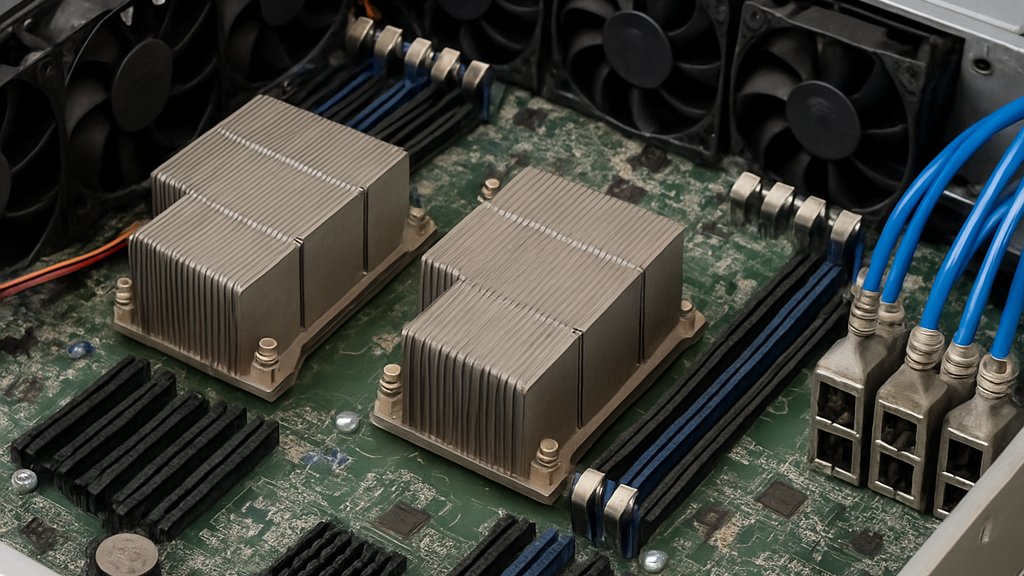
Supermicro unveiled twelve X14 platforms spanning Hyper, SuperBlade, FlexTwin, and GrandTwin families. Additionally, each platform supports dual Xeon 6+ CPUs, enabling up to 576 efficiency cores per chassis. Rack density improves without exotic form factors, easing integration inside existing cloud data centers. Furthermore, optional direct liquid cooling targets edge sites with limited airflow.
The vendor's Building Block Solutions framework lets operators mix blades, GPU trays, and storage sleds. Therefore, architects can tailor AI Data Servers to inference, training, or content delivery tasks. Moreover, consistent BIOS and management firmware shorten validation time. Supermicro claims shipments are already underway for pilot customers.
Charles Liang highlighted accelerated deployment timelines and aggressive TCO reduction during the launch briefing. Nevertheless, he acknowledged that real savings depend on software optimization. Professionals can enhance their expertise with the AI Architect™ certification. Such training helps teams exploit core counts efficiently. Deploying AI Data Servers at scale still demands rigorous testing.
Supermicro's modular X14 line positions the company well for heterogeneous workloads. Subsequently, understanding underlying silicon becomes vital.
Inside Xeon 6+ Architecture
Intel built Xeon 6+ on its advanced 18A process and multi-chip modules. Consequently, each CPU houses up to 288 efficient cores with shared massive last-level cache. Direct 12-channel DDR5-8000 memory sustains bandwidth for large-scale AI inference. Meanwhile, 96 lanes of PCIe Gen5, including 64 CXL lanes, unlock fast accelerator interconnects.
Core Technical Specs List
- Up to 2.5× performance over prior Xeon generation
- Server consolidation ratios reaching 9:1 in vendor testing
- Native support for large-scale AI models
- On-die AMX, QAT, and vRAN Boost accelerators
- TDP range from 250W to 500W per socket
Moreover, Foveros and EMIB packaging stacks compute tiles vertically, shrinking board footprint. In contrast, monolithic die designs often hit reticle limits before reaching similar core counts. Therefore, AI Data Servers gain higher node density without sacrificing memory channels.
However, E-core heavy designs favor throughput over single-thread velocity. Consequently, latency-sensitive jobs may still require P-core SKUs or discrete GPUs. Software schedulers must adapt to avoid thread thrashing across hundreds of cores.
Xeon 6+ brings unprecedented core density using novel packaging. Nevertheless, effective usage hinges on updated software, which impacts economics explored next.
Impact On Cloud Economics
Finance teams prioritize watts, racks, and license costs when assessing refresh cycles. Supermicro cites internal models showing 40% TCO reduction for virtualized workloads after consolidation. Additionally, fewer racks lower networking gear counts, trimming capital and operational expenses. Therefore, cloud data centers can redirect savings toward strategic AI services.
Independent analysts still want broader benchmarks against AMD EPYC and specialized accelerators. Nevertheless, early numbers indicate solid parity on vector math while excelling at parallel microservices. Furthermore, higher memory speed reduces stall cycles, supporting large-scale AI datasets. License-based software often prices per socket, so consolidation multiplies value.
AI Data Servers using Xeon 6+ may also unlock carbon accounting credits under emerging regulations. Consequently, corporate sustainability officers join capacity planning meetings. However, cooling density rises, demanding liquid or rear-door heat exchangers.
Initial economics appear favorable, yet verification through field data remains crucial. The following section confronts deployment hurdles threatening those gains.
Deployment Challenges Ahead
Higher thermal envelopes up to 500W per socket strain many legacy power trunks. Similarly, airflow within retrofitted cloud data centers can prove insufficient. Moreover, not every workload scales neatly across hundreds of E-cores. Developers need updated compilers, schedulers, and observability tools.
Large-scale AI frameworks usually adapt quickly, yet traditional databases may lag. Consequently, capacity planners must profile applications before migration. In contrast, leaving stranded sockets idle negates promised TCO reduction. The vendor recommends mixed P-core and E-core nodes for blended workloads. Edge AI Data Servers must respect stricter acoustic limits.
Security teams also evaluate microcode maturity and firmware update cadence. Moreover, supply chain diversification remains a board-level concern after recent shortages. Therefore, procurement schedules include buffer time for validation.
Technical and operational hurdles can erode projected savings. Yet, strategic planning unlocks the architecture's full potential, as the outlook shows.
Future Outlook And Steps
Intel plans broader Xeon 6+ availability later this year, extending choice across performance tiers. Meanwhile, the X14 ecosystem will integrate CXL memory devices for disaggregated pools.
Furthermore, edge deployments are expected to rise as 5G drives micro-data-center growth. AI Data Servers positioned near users slash latency for immersive applications. Consequently, operators evaluate liquid cooling options designed for constrained footprints. Professionals armed with vendor-neutral skills and the earlier linked AI Architect certification gain career leverage.
Analysts forecast continued price competition as AMD and Arm vendors counter Intel advances. Nevertheless, the current launch rekindles focus on general-purpose CPU roadmaps. Subsequently, buyers will monitor third-party benchmarks before scaling orders.
Roadmaps suggest rapid iteration and expanding feature sets. Therefore, a clear action plan helps organizations capture first-mover benefits.
Intel's Xeon 6+ launch marks a pivotal moment for enterprise compute. Consequently, organizations can pursue aggressive consolidation without sacrificing throughput. AI Data Servers promise stronger performance per watt and measurable TCO reduction in real deployments. However, success depends on software readiness, thermal planning, and benchmark validation. Moreover, edge and cloud data centers must upgrade power and cooling infrastructure. Professionals should develop cross-domain skills and pursue the linked AI Architect certification. Act now, evaluate pilot nodes, and lead your organization toward scalable, sustainable intelligence.
Disclaimer: Some content may be AI-generated or assisted and is provided ‘as is’ for informational purposes only, without warranties of accuracy or completeness, and does not imply endorsement or affiliation.


