

AI CERTS
6 hours ago
Nvidia Bets Big On Unitree Humanoid Robots
Nvidia Unitree Alliance Explained
Nvidia packaged its Isaac GR00T software, Jetson AGX Thor compute, and a validated chassis. The body comes from the Unitree H2 Plus model, while dexterity arrives through Sharpa hands. Furthermore, the bundle offers 75 degrees of freedom, three-hour battery life, and 2,070 FP4 TFLOPS on-robot compute. In contrast, previous humanoid efforts demanded bespoke integration. Therefore, the new kit forms a standardized humanoid platform for academics and startups.
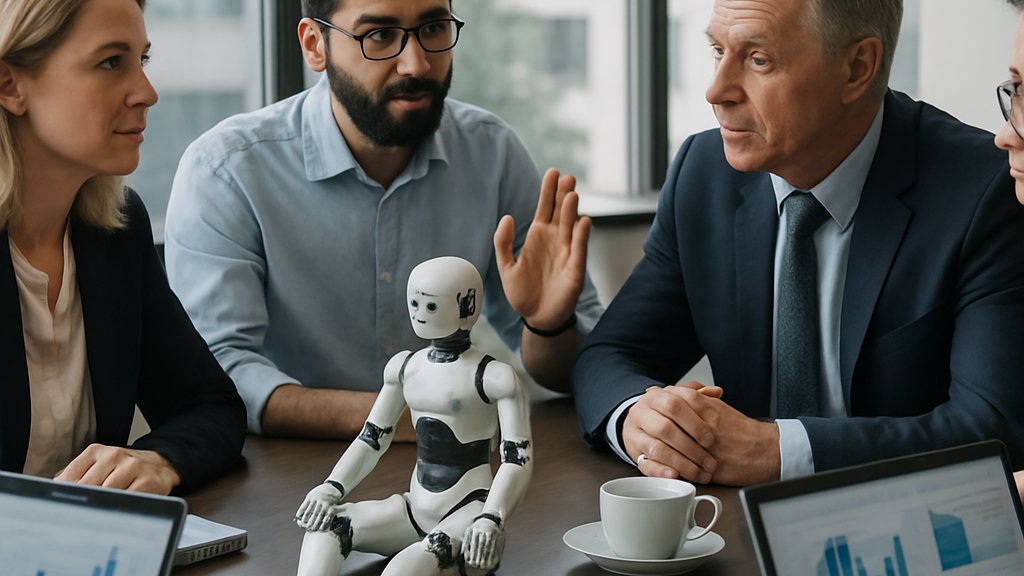
Jensen Huang called the approach “an open brain-and-body stack.” Meanwhile, Unitree CEO Xingxing Wang said teams gain “a validated starting point.” These statements highlight how the partners intend to accelerate skill sharing. Consequently, developers can focus on applications rather than hardware plumbing.
The alliance frames Nvidia’s shift toward full-stack robotics. These moves strengthen the firm’s ecosystem leverage and extend its GPU dominance into physical AI. Thus, the partnership sets the stage for large-scale humanoid rollouts.
Humanoid Market Stakes Rise
Market analysts see vast upside. Morgan Stanley projects a US$5 trillion humanoid market by 2050. Moreover, RBC places total addressable value near US$9 trillion. Roland Berger supplies a mid-range view of US$2–4 trillion in 2050 revenue.
Several factors drive the optimism:
- Demographics push aging economies toward automation.
- Warehouse and retail operators face persistent labor gaps.
- Edge AI hardware costs keep falling.
- Open stacks shorten developer ramp-up times.
Consequently, investors track every major announcement for IPO buzz signals. Unitree’s March filing to raise US$610 million underscores this trend. Additionally, Nvidia’s endorsement may support a higher valuation once shares list. Nevertheless, commercial reality still lags glossy demos.
These forecasts paint an enticing picture. However, execution speed and reliability will decide whether revenue meets projections. The next section dissects the hardware specifics that underpin those hopes.
Technical Specs In Focus
The Unitree H2 Plus stands nearly six feet tall yet weighs roughly 150 pounds. Each leg produces 360 N·m peak torque, enabling agile locomotion. Furthermore, arms deliver 120 N·m, lifting seven kilograms continuously and fifteen kilograms momentarily. Battery capacity reaches 0.972 kWh, translating to about three hours mixed operation.
Meanwhile, Sharpa Wave five-finger modules provide 22 extra degrees of freedom. These Sharpa hands allow pinching, twisting, and compliant grip adjustment. Consequently, researchers can test complex manipulation tasks without designing custom end-effectors.
Jetson Thor integrates a Blackwell GPU, 14-core Arm CPU, and 128 GB unified memory. Therefore, the system runs GR00T vision-language-action models locally, even while streaming sensor data over Wi-Fi 6 or Ethernet. Moreover, developers can mirror experiments inside Isaac Sim and then deploy policies in real robots, preserving reproducibility across the humanoid platform.
These capabilities shorten iteration loops. However, endurance, cost, and maintenance logistics still require validation at scale. Understanding potential pitfalls demands a closer look at risk factors.
Security And Policy Risks
September 2025 disclosures revealed UniPwn, a wormable Bluetooth flaw inside earlier Unitree firmware. Although patches arrived, researchers fear lingering exposure. Additionally, Nvidia’s reliance on a Chinese manufacturer raises export-control concerns for Western buyers. In contrast, Beijing may see strategic advantage in domestic ownership of production capacity.
Cybersecurity experts urge operators to sandbox network traffic and enforce encryption. Furthermore, supply-chain auditors press Nvidia for transparency regarding component sourcing. Consequently, some enterprises adopt a wait-and-see stance despite mounting IPO buzz around Unitree.
Regulators will likely demand rigorous safety certification before humanoids enter public environments. Meanwhile, ongoing standards work in ISO 5349 serves as a framework for evaluating physical AI systems.
These hurdles could slow adoption. Nevertheless, proactive governance and open disclosure can mitigate many threats. The following section reviews how academia already benefits from early access.
Research Impact And Roadmap
Stanford, ETH Zurich, and UC San Diego received pre-production units for evaluation. Consequently, shared baselines allow side-by-side comparison of locomotion, manipulation, and perception algorithms. Moreover, the open humanoid platform stimulates community benchmarks similar to ImageNet’s historic role for vision.
Early feedback highlights two strengths. Firstly, modular firmware lets teams insert custom control stacks. Secondly, simulation parity accelerates transfer learning. However, professors still cite battery limitations during field trials.
Nvidia plans quarterly GR00T model updates, adding multimodal reasoning and self-improvement loops. Meanwhile, Unitree’s manufacturing roadmap targets double-digit yield growth each quarter through 2027. Therefore, academic milestones should translate into commercial pilots within three years.
These collaborative efforts indicate steady progress. The next section explores the financial backdrop fueling that momentum.
Investment Angle And IPO
The robotics sector saw US$4.3 billion in venture inflows during 2025, according to PitchBook. Furthermore, IPO buzz intensified after Figure and Agility signaled listing ambitions. Unitree now leads the queue with its Shanghai STAR Market prospectus.
Proceeds will expand assembly lines and finance global support centers. Moreover, Nvidia’s endorsement offers validation for skeptical fund managers. Consequently, underwriters project strong retail demand inside mainland exchanges.
Nevertheless, macro headwinds persist. Geopolitical frictions could restrict chip exports, crimping margins. Additionally, investors recall previous robotics hype cycles that ended in write-downs.
The capital raise remains pivotal. Success would bankroll volume production of Unitree Humanoid Robots and reinforce pricing power. A miss might slow manufacturing scale-up. The subsequent section outlines talent considerations for enterprises evaluating deployments.
Skills For Robotics Teams
Adopting the new stack requires multidisciplinary expertise. Engineers must integrate perception, control, and fleet orchestration. Meanwhile, product managers translate operational pain points into viable robot workflows.
Professionals can strengthen credentials through targeted programs. For example, organizations can upskill staff with the AI Robotics Specialist™ certification. Furthermore, courses emphasize safety, compliance, and continuous learning pipelines—essential themes within physical AI development.
Recommended skill areas include:
- Sim-to-real reinforcement learning.
- Edge deployment of foundation models.
- Cyber-physical threat mitigation.
- Lifecycle cost analysis.
Consequently, cross-functional competencies will influence return on investment. Moreover, early movers can shape best practices across the broader humanoid platform ecosystem.
These talent strategies close the preparation loop. The final section recaps the partnership’s significance and outlines next steps.
Conclusion
Nvidia and Unitree joined forces to democratize Unitree Humanoid Robots research. The alliance merges powerful Jetson Thor compute, GR00T software, the Unitree H2 Plus chassis, and dexterous Sharpa hands. Consequently, developers gain a turnkey humanoid platform that accelerates physical AI innovation. Market forecasts signal multitrillion-dollar potential, and IPO buzz around Unitree amplifies attention. Nevertheless, cybersecurity, policy, and operational hurdles demand vigilance. Professionals should therefore build relevant skills and pursue trusted credentials. Explore the linked certification to position your team at the forefront of humanoid robotics.
Disclaimer: Some content may be AI-generated or assisted and is provided ‘as is’ for informational purposes only, without warranties of accuracy or completeness, and does not imply endorsement or affiliation.


