

AI CERTS
2 hours ago
Bindra Sounds Alarm on Education Digital Divide and AI Literacy
Consequently, India’s new YUVA AI for ALL programme democratises knowledge through a mobile-first, zero-coding course. However, analysts fear infrastructure, teacher readiness, and labor disruption could still intensify existing socio-economic divides. This article unpacks Bindra’s critique, programme details, and global research to map pressing challenges and emerging solutions. Moreover, professionals will find certified pathways to strengthen their own instructional impact. In contrast, doing nothing risks leaving millions unemployable in an AI-first economy. The stakes for closing the Education Digital Divide have never been higher.
Urgent AI Literacy Push
For Jaspreet Bindra, co-founder of AI & Beyond, AI literacy equals a survival skill, not a luxury.
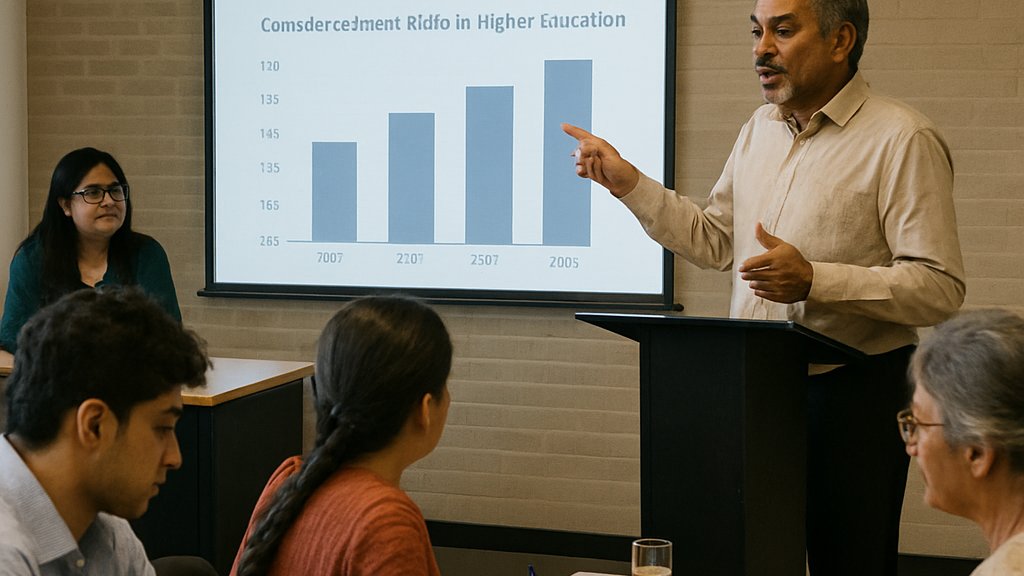
During multiple interviews, he warned that an unchecked Education Digital Divide will eclipse the earlier computer gap.
Furthermore, Bindra argues entry-level roles vanish first because algorithmic assistants boost experienced staff productivity immediately.
Consequently, he champions multidisciplinary curricula that emphasise critical judgment over tool memorisation.
These warnings frame AI literacy as societal infrastructure. However, turning rhetoric into reach demands massive programme design. Subsequently, India’s YUVA rollout offers a live test of scale.
National YUVA Course Rollout
Launched nationally in February 2026, YUVA AI for ALL compresses foundational concepts into six self-paced modules.
Moreover, each module requires no coding and runs smoothly on low-cost smartphones.
- 4-hour total learning time
- Coursera update logged January 2026
- 10-million learner target via Simplilearn
- Kaushal Rath vans bring devices to villages
Consequently, government planners describe the van network as the programme’s “moving computer lab.”
Meanwhile, Coursera, TCS iON, and FutureSkillsPrime integrate completion certificates into talent marketplaces, enhancing employability.
Additionally, professionals can validate skills through the AI Educator™ certification, aligning personal growth with national goals.
The rollout shows impressive ambition and creative delivery. Nevertheless, access alone cannot guarantee equal outcomes. In contrast, infrastructure deficits remain stubborn obstacles.
Infrastructure Barriers Still Persist
Roughly 2.6 billion people still live offline, according to recent ITU data.
Therefore, any mobile-first strategy must pair bandwidth subsidies, device grants, and community hubs.
Meanwhile, analysts warn that regions lacking reliable electricity cannot even download the YUVA app consistently.
Moreover, patchy electricity forces many learners to rely on shared battery banks, increasing friction and dropout rates.
Bindra acknowledges the physical divide yet argues curriculum design should not wait for perfect networks.
Infrastructure gaps threaten to widen the Education Digital Divide across rural populations. However, coordinated telecom and energy policy could mitigate that risk. Subsequently, teacher capacity becomes the next decisive factor.
Teacher Training Roadmap Needed
Surveys from the Tony Blair Institute reveal many teachers lack confidence with generative AI tools.
Furthermore, only limited professional development materials currently address ethics, provenance checks, or agentic workflows.
AI & Beyond has begun pilot workshops, yet coverage remains a fraction of national demand.
A pilot in Maharashtra trained 500 teachers within eight weeks, yet national totals exceed nine million instructors.
Therefore, policy experts urge mandatory AI literacy modules within pre-service and in-service programmes.
Robust teacher support ensures classroom integration rather than superficial exposure. Nevertheless, workforce anxieties require parallel attention. Consequently, evaluating labour impacts clarifies urgency for reskilling.
Workforce Risks And Responses
Generative AI now drafts emails, analyses data, and even writes code in seconds.
Consequently, entry-level clerks, analysts, and junior coders face faster displacement pressures.
Jaspreet Bindra repeats his mantra: “A human using AI will replace a human not using AI.”
Moreover, he suggests focusing on judgment, context, and creativity—qualities machines still approximate imperfectly.
Professionals seeking structured upskilling can pair YUVA fundamentals with the earlier linked AI Educator™ credential for career resilience.
The labour outlook reinforces the need for lifelong learning ecosystems. In contrast, policy clarity on metrics remains limited. Subsequently, transparent data reporting becomes the next frontier.
Policy And Metric Transparency
Government releases spotlight launch events yet publish few enrolment or completion numbers.
Additionally, no public dashboard tracks learner demographics, outcomes, or regional divide indicators.
Therefore, civil society groups request quarterly metrics to monitor the Education Digital Divide trajectory.
AI & Beyond executives support disclosure, arguing it sharpens programme design and donor alignment.
Public dashboards could mirror pandemic vaccination trackers, providing color-coded district maps for citizens and funders.
Data openness underpins trust and iterative improvement. Nevertheless, stakeholders also need clear next actions. Hence, collaborative steps must follow quickly.
Next Steps For Stakeholders
Firstly, officials should publish baseline statistics within the coming quarter.
Secondly, telecom partners can pilot zero-rating for course content in underserved districts.
Thirdly, universities could embed YUVA assessments into credit-bearing programmes, boosting credibility.
Moreover, corporations should sponsor rural device libraries, narrowing the persistent divide.
- Release open data APIs.
- Fund teacher fellowships focusing on ethics.
- Establish rural connectivity task forces.
Finally, every educator should complete the YUVA course and pursue the AI Educator™ certification for deeper classroom impact.
These coordinated moves attack structural barriers head-on. Consequently, the Education Digital Divide can contract rather than expand.
Conclusion
In summary, India’s experiment offers a live blueprint for bridging the Education Digital Divide. However, even bold blueprints fail without infrastructure, teacher capacity, and transparent metrics shielding against an Education Digital Divide relapse. Jaspreet Bindra and AI & Beyond propose clear remedies anchored in practical Literacy and agile pedagogy. Moreover, synergistic corporate and civic investments could finally shrink the stubborn Education Digital Divide. Nevertheless, individual educators must also act by completing YUVA and securing the linked AI Educator™ certificate. Ready to lead responsibly? Explore YUVA today and earn your credential to narrow the Education Digital Divide tomorrow.
Disclaimer: Some content may be AI-generated or assisted and is provided ‘as is’ for informational purposes only, without warranties of accuracy or completeness, and does not imply endorsement or affiliation.


