

AI CERTS
1 week ago
AI Robotics Advance: Neya Systems’ Autonomous Breaching Demo
Moreover, it highlights how sophisticated mission planning tools can coordinate ground vehicles, drones, and swarms in seconds. This article unpacks the market drivers, technology stack, benefits, and open questions for defense stakeholders. Readers will also find links to certifications that build critical skills for this emerging niche.
Meanwhile, the global market for unmanned systems is expanding quickly. Grand View Research predicts annual spending will more than double by 2033. Therefore, autonomous breaching could become a showcase capability for vendors competing in that surge.
Global Market Growth Outlook
Analysts value the combined defense and commercial unmanned systems market at roughly USD 29.3 billion for 2025. Moreover, Grand View Research forecasts the figure will hit USD 67.6 billion by 2033, reflecting an 11.1 percent CAGR. Consequently, investors now chase segments that deliver full autonomy, precise mission planning, and resilient ground vehicles. AI Robotics promises higher speed, lower risk, and modular integration across those growth pockets. These market trends frame Neya Systems’ upcoming demonstration. In contrast, budget pressure means new solutions must show measurable operator savings.
Demand is strong yet competitive. However, success will favor platforms that scale autonomy without escalating cost. Let’s examine how the upcoming demo addresses those expectations.
Demo Showcases Key Capability
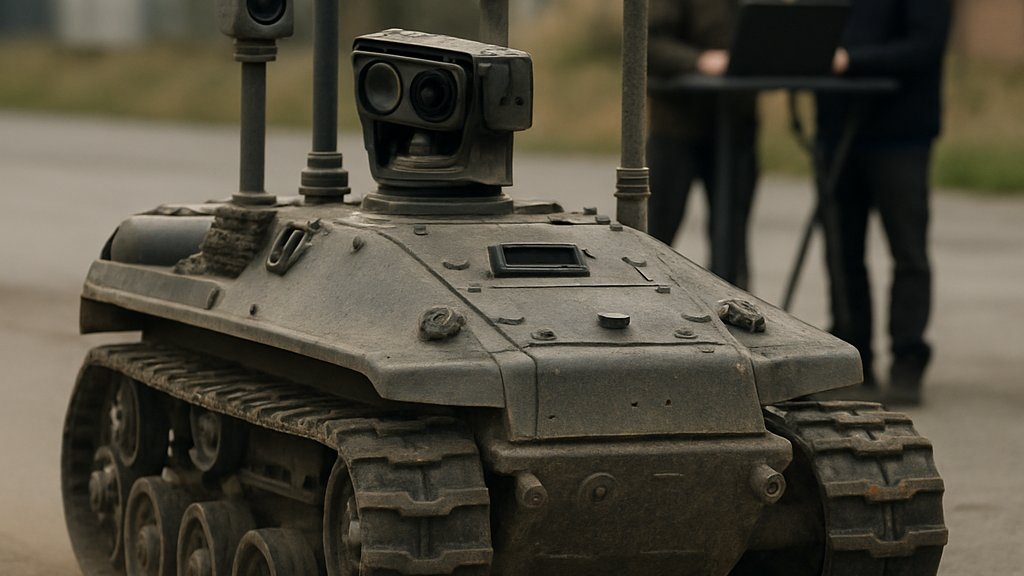
At XPONENTIAL 2026, Neya Systems will orchestrate heterogeneous unmanned assets in a live breaching scenario. Persistent mesh radios connect American Rheinmetall Komodo ground vehicles, Swarmbotics AI FireAnt drones, and other platforms. Meanwhile, the N-Drive autonomy stack guides each robot, while MPMS handles mission planning and real-time tasking. One operator will oversee the formation from a tablet, demonstrating the company’s vision for soldier-robot teaming.
AI Robotics underpins the entire workflow, fusing sensor data, navigation logic, and engagement rules. Moreover, the route will be cleared by attritable scouts that mark safe lanes before heavier machines advance. Such choreography intends to satisfy defense requirements for speed, precision, and force protection.
The demo compresses many tasks into minutes. Nevertheless, performance data must confirm that promise. Next, we unpack the software and hardware making that compression possible.
Core Technology Stack Explained
N-Drive provides guarded teleoperation, waypoint navigation, obstacle avoidance, and off-road behaviors across multiple chassis. Additionally, MPMS delivers drag-and-drop mission planning, asset health monitoring, and AI-assisted re-tasking. The stack remains platform agnostic, allowing quick porting to light ground vehicles or quadrotor swarms. Moreover, VISE simulation tools generate digital twins for pre-mission rehearsal, reducing field trial costs. Cybersecurity modules, including CARRS and autonomous cyber agents, seek to harden links against jamming and spoofing. AI Robotics here functions as the connective tissue, ingesting terrain maps, threat libraries, and operator intent.
Together, these modules target open, modular, and secure control. Consequently, integrators can mix vendors without rewriting autonomy. We now explore the operational payoffs vendors claim.
Operational Benefits And Claims
Neya argues the system speeds breaching while shielding soldiers from the initial blast zone. Furthermore, single-operator orchestration cuts manpower, a perennial defense budget constraint. Attritable FireAnt units take the first risk, preserving premium ground vehicles for sustained tasks. Meanwhile, AI Robotics promises data-driven after-action reviews that refine tactics over time.
- Lane clearance time potentially reduced by 50 percent
- Operator workload lowered through intuitive mission planning
- Ground vehicles remain outside direct line of fire until safe
These benefits sound compelling on slides. However, field testing must validate every metric. Potential pitfalls illustrate why caution remains prudent.
Risks, Limits, Challenges Ahead
Urban rubble, subterranean passages, and GPS denial still confound autonomous perception. In contrast, cyber adversaries can jam links, forcing graceful degradation strategies. Legal analysts warn that breaching systems touching use-of-force decisions raise significant defense policy debate. Nevertheless, Neya emphasizes continued human control for kinetic actions, aligning with emerging NATO doctrine. AI Robotics must therefore demonstrate transparency, audit logs, and secure fail-safes before large-scale adoption.
Technical and ethical hurdles remain substantial. Consequently, stakeholders will demand repeatable evidence under operational conditions. Those demands shape the adoption roadmap now emerging.
Path To Field Adoption
Applied Research Associates seeks program-of-record status to secure predictable funding. Meanwhile, early user trials with combat engineer units could surface data on clearance rates and planning overhead. Consequently, acquisition officials will monitor cost per cleared meter and cyber resilience scores. AI Robotics adoption will likely start with limited objective experiments on test ranges before migration to contested theaters. Moreover, tight integration with existing vehicle fleets simplifies logistics, a prime contractor concern. Success stories could trigger NATO interoperability standards within three years.
Procurement hinges on proof, not promise. Therefore, industry outreach must couple demos with transparent metrics. Professionals must prepare for that skills gap now.
Skills, Training, Certifications Needed
The shift toward autonomous breaching creates demand for robotics software, cyber resilience, and safety analysis expertise. Furthermore, planners need competence in swarm tactics and multi-domain coordination. Engineers can enhance expertise through the AI Robotics Professional™ certification. Additionally, operators must master human-machine teaming ethics as future policies evolve. AI Robotics skills will also attract commercial logistics and public-safety employers, broadening career options.
- Autonomy software debugging
- Resilient communications architecture
- Safety assurance and test design
Skill shortages could slow adoption despite technical progress. Hence, early training investments pay strategic dividends. We finish with final observations on outlook.
Overall, autonomous breaching integrates swarming drones, rugged vehicles, and orchestration software into one cohesive package. However, buyers still need quantitative proof under battlefield stress. Market momentum, rising budgets, and maturing AI Robotics indicate a tipping point during the next acquisition cycle. Consequently, vendors that pair open architectures with verified metrics will dominate the competition. Meanwhile, professionals who earn advanced certifications position themselves to guide these programs toward safe, effective deployment. Act now, explore training options, and stay ahead of the robotic revolution.
Disclaimer: Some content may be AI-generated or assisted and is provided ‘as is’ for informational purposes only, without warranties of accuracy or completeness, and does not imply endorsement or affiliation.


