

AI CERTS
2 months ago
TeachBetter AI 5.0 Launch Signals a New Era in Classrooms and Why AI Training Is Now Essential for Educators
For decades, classrooms followed a familiar pattern: teach first, test later. The problem was that by the time results came in, learning gaps were already too wide to fix. Now, AI is stepping in to change that dynamic completely.
From Passive Learning to Real-Time Intelligence
The most powerful aspect of this innovation is not the technology itself, but what it enables.
TeachBetter AI’s PaperQR system allows teachers to assess every student instantly during the lesson, without requiring devices. Students respond using QR cards, and teachers capture responses in real time, generating immediate insights and feedback.
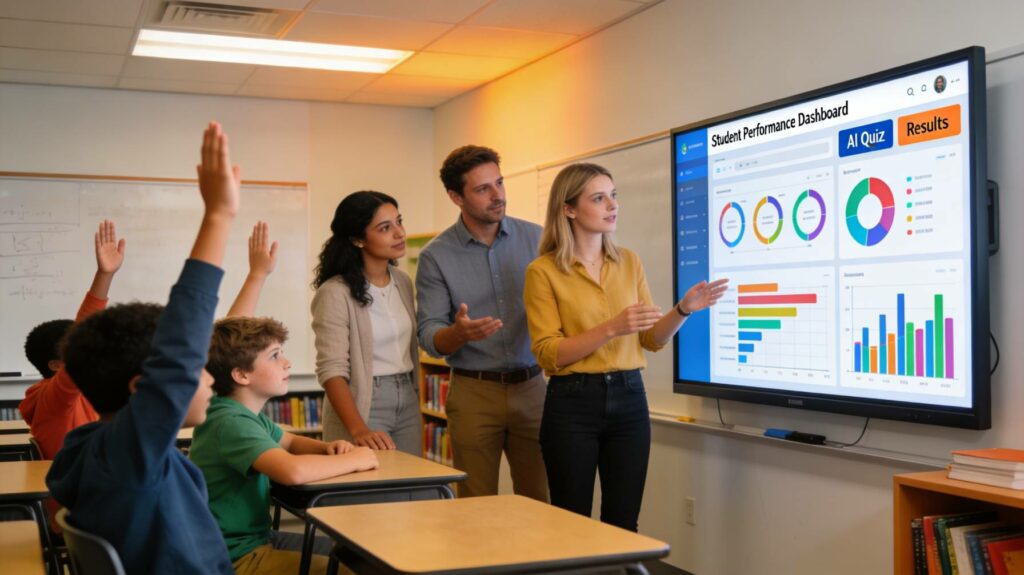
This transforms the classroom from a passive environment into an interactive, responsive ecosystem. Teachers no longer have to assume whether students understood a concept. They can see it instantly.
Research and policy frameworks like NEP 2020 have long emphasized the importance of continuous assessment and real-time feedback. This tool finally makes that vision practical and scalable.
But here’s the real question:
If AI can already do this, are educators fully prepared to use it effectively?
The Hidden Gap: Technology vs. Capability
While tools like TeachBetter AI are becoming more advanced, their success depends entirely on how well educators understand and use them.
This is where the gap becomes clear.
Many teachers are still navigating basic digital tools, while AI-powered platforms now offer lesson planning, simulations, assessments, and analytics in one place.
Without proper AI training, even the most powerful tools risk being underutilized.
The challenge is no longer access to technology. It is the ability to integrate AI into teaching strategies, classroom workflows, and decision-making processes.
In simple terms, AI is ready. The question is whether educators are.
Why AI Training Is No Longer Optional
The launch of TeachBetter AI 5.0 highlights a broader shift happening across industries, especially in education.
AI is moving from being a support tool to becoming core infrastructure.
It is helping teachers plan lessons, personalize content, analyze student performance, and now even conduct real-time assessments without additional hardware.
This level of integration requires a new skill set.
Educators need to understand how AI works, how to interpret data insights, how to design AI-supported learning experiences, and how to maintain ethical and unbiased use of these tools.
Without training, there is a risk of over-reliance, misuse, or simply missed opportunities.
With training, however, educators can transform classrooms into dynamic, student-centered environments that improve outcomes at scale.
The Bigger Picture: AI as Classroom Infrastructure
What makes this development truly significant is that it is not just about one feature or platform.
It represents the evolution of AI as foundational infrastructure in education.
TeachBetter AI is designed to be accessible across regions, languages, and resource levels, making advanced learning tools available even in underserved classrooms.
This democratization of AI means that the future of education will not be defined by access to devices, but by access to knowledge and skills.
And that brings us back to the core issue.
If AI is becoming the backbone of education, then AI literacy must become the backbone of teaching.
Bridging the Gap Between Innovation and Impact
The real opportunity lies in bridging the gap between innovation and implementation.
Tools like PaperQR Live Quiz solve operational challenges. They make real-time assessment possible without adding complexity or cost.
But to fully unlock their potential, educators and institutions need structured AI training.
They need to move from simply using tools to understanding systems.
From following instructions to designing experiences.
From reacting to data to making informed decisions based on it.
This shift is what will define the next generation of education.
As AI continues to reshape classrooms, organizations need a structured, scalable way to equip educators with the right skills. This is where the AI CERTs Authorized Training Partner (ATP) program plays a critical role.
Through globally recognized certifications, updated curriculum, and practical learning frameworks, ATP enables institutions to train educators, professionals, and teams in real-world AI applications. It bridges the gap between emerging AI tools and the ability to use them effectively, ensuring that innovation translates into measurable impact.
FAQs
1. What is TeachBetter AI’s PaperQR Live Quiz?
It is an AI-powered classroom assessment tool that allows teachers to conduct real-time quizzes without requiring devices for students, using QR-based response cards.
2. Why is real-time assessment important in education?
Real-time assessment helps identify learning gaps instantly, improves student engagement, and enables immediate feedback, leading to better learning outcomes.
3. Do teachers need technical expertise to use AI tools like this?
Basic usage may be simple, but to fully leverage AI tools effectively, structured AI training is highly recommended.
4. How does AI improve classroom learning?
AI enhances personalization, automates repetitive tasks, provides data-driven insights, and enables interactive learning experiences.
5. What is the AI CERTs ATP program?
It is a global training partnership program that provides organizations with AI certification programs, helping professionals and educators build practical AI skills for real-world applications.
Disclaimer: Some content may be AI-generated or assisted and is provided ‘as is’ for informational purposes only, without warranties of accuracy or completeness, and does not imply endorsement or affiliation.


