

AI CERTs
2 months ago
Mediahuis Suspension Exposes AI Quote Fabrication Risks
Brussels woke to a newsroom shock.
On Monday, Mediahuis confirmed a senior columnist’s suspension.
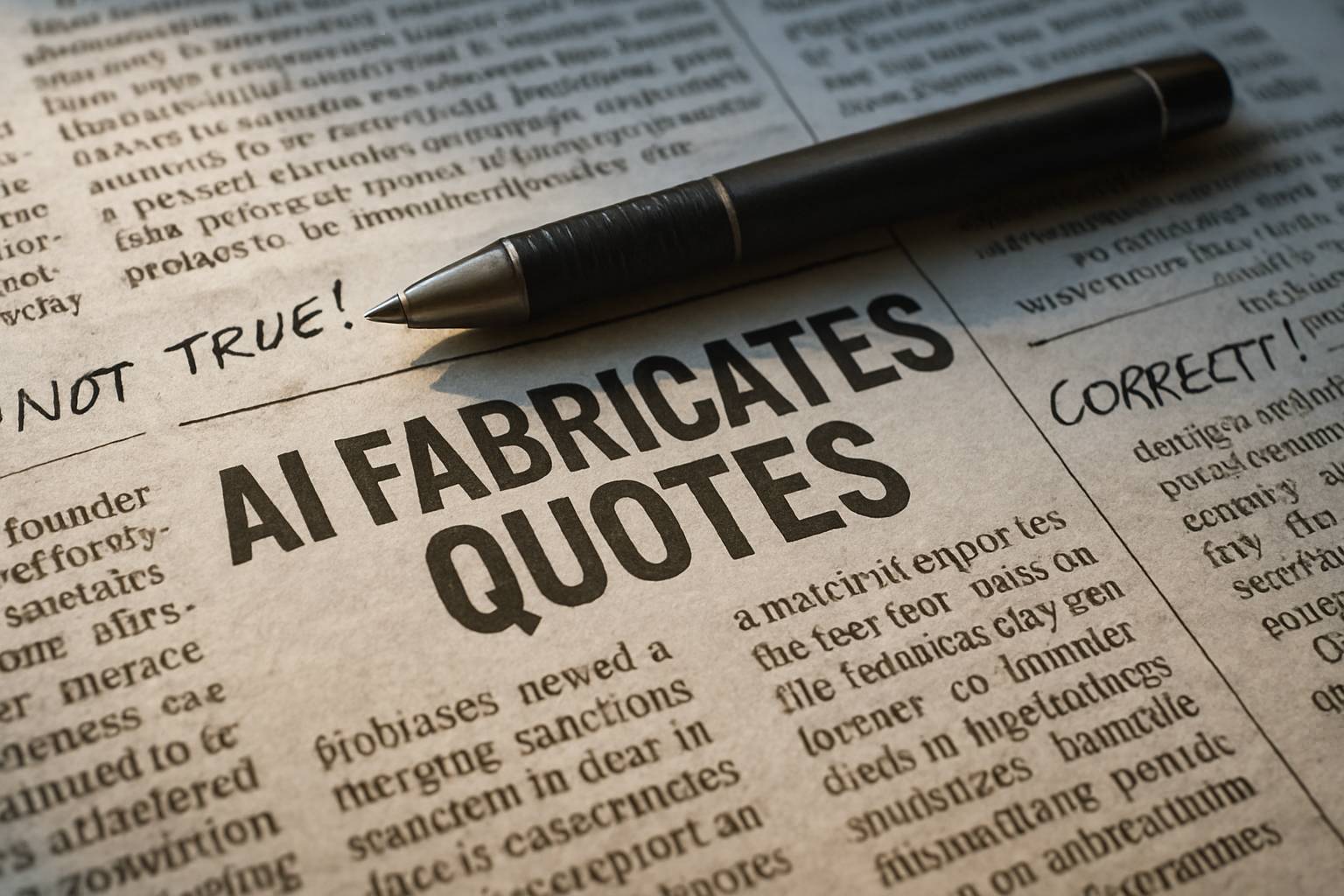
Editors alleged AI Quote Fabrication in several high-profile interviews.
The discovery immediately rattled European journalism circles.
However, the incident stretches beyond one newspaper.
Many newsrooms now rely on generative tools for speed.
Consequently, fabricated quotes slip through traditional fact-check routines.
The public record suffers.
Industry leaders demand urgent guardrails.
Moreover, regulators advance new AI disclosure rules.
Professionals can enhance their expertise with the AI Ethics Business Certification™.
Such training supports sound Ethics and transparent workflows.
Meanwhile, the suspended writer remains unnamed pending review.
Internal auditors examine six months of copy.
Some staff had trusted summaries generated through ChatGPT, unaware of latent AI Quote Fabrication pitfalls.
Each flagged article shows similar language patterns.
In contrast, earlier work displayed distinct stylistic choices.
Crisis Hits Mediahuis Newsroom
Mediahuis launched an immediate internal probe.
Furthermore, external ombudsmen were invited to ensure transparency.
Forensic linguists applied stylometry on forty stories.
Results showed synthetic phrasing characteristic of large language models.
Importantly, not every questionable line was generated.
Nevertheless, several key quotes lacked verifiable sources.
That pattern signaled a potential AI Quote Fabrication scheme masked in routine reporting.
Legal teams assessed defamation exposure.
Additionally, advertisers questioned brand safety.
Consequently, the newspaper faced a reputational Trap threatening audience loyalty.
Early findings underline severe operational risk.
However, systematic responses can still protect Integrity.
The next section explores root causes.
Unpacking Quote Fabrication Causes
Several converging pressures drove the lapse.
Firstly, tight deadlines incentivised shortcut scripting.
Moreover, cost cutting reduced editorial gatekeepers.
Junior copy editors trusted senior bylines blindly.
Therefore, attribution checks occasionally stalled.
Second, tool design encouraged reliance on auto-complete answers.
In contrast, training data held outdated transcripts.
That mismatch created hallucinated passages, a classic AI Quote Fabrication output.
Third, cultural factors mattered.
Subsequently, experimentation with new software appeared attractive.
Yet the Ethics guidelines were vague.
- Accelerated publishing cycles overwhelming fact-checkers
- Limited AI policy awareness among reporters
- Inadequate tool transparency increasing the hallucination Trap
- Performance metrics favoring clicks over Integrity
Collectively, these factors formed an invisible Trap that ensnared even experienced staff.
Root causes mix technology and culture.
Consequently, targeted reforms must address both sides.
The upcoming policy review reveals critical gaps.
Policy Gaps Exposed Publicly
Mediahuis maintained a basic AI policy.
However, the document lacked enforcement clauses.
Editors assumed goodwill would ensure Integrity.
Meanwhile, peer outlets adopted stricter frameworks.
For example, The Guardian mandates disclosure of any synthetic text.
Moreover, Reuters reserves AI for background tasks only.
Comparative audits revealed Mediahuis had no real-time verification queue.
Therefore, suspicious quotes travelled straight to print.
Yet supervisors lacked dashboards flagging AI Quote Fabrication patterns.
That loophole enabled repeated AI Quote Fabrication without alarm.
Oversight boards highlighted missing escalation paths.
Additionally, whistleblower protections were minimal.
Journalists feared reputational damage if they reported peers.
Loopholes magnified systemic weakness.
Nevertheless, external benchmarks can inspire stronger rules.
Global incidents further illuminate best practices.
Global Cases Compared Carefully
In the United States, a financial reporter fabricated earnings quotes.
Investigators traced snippets to ChatGPT.
Consequently, the publisher retracted three features.
Japan’s Nikkei faced a similar scandal.
Moreover, an anonymous staffer inserted invented CEO remarks.
Subsequent corrections cited AI Quote Fabrication as root error.
In contrast, Germany’s Der Spiegel suspended Claas Relotius years before mainstream AI.
That precedent shows fabrication predates algorithms.
However, automation amplifies scale and speed.
Across regions, consistent themes emerge.
Ethics compliance, audit rigor, and cultural openness decide outcomes.
Cross-border parallels stress shared vulnerabilities.
Therefore, international coordination seems essential.
Newsrooms now test concrete remedies.
Restoring Audience Trust Measures
Mediahuis outlined a five-point recovery roadmap.
Firstly, a freeze on sensitive interviews allows full validation.
Secondly, mandatory tool logs will accompany drafts.
Additionally, chain-of-custody tags will mark AI contributions.
An internal memo labels zero tolerance for AI Quote Fabrication moving forward.
Thirdly, continuous training will align staff with evolving Ethics standards.
Professionals can enhance their expertise with the AI Ethics Business Certification™.
Fourth, an independent Integrity council will oversee compliance.
Fifth, a public dashboard will report correction metrics.
Consequently, transparency counters the perception Trap.
Structured interventions rebuild confidence gradually.
Nevertheless, sustainable progress requires future-oriented guardrails.
The next section explores those safeguards.
Future-Proof Reporting Guardrails
Emerging tools embed source linking into language outputs.
Moreover, blockchain stamps verify quote provenance.
Meanwhile, machine Ethics frameworks guide design.
The IEEE proposal mandates explainability at every inference.
Consequently, journalists gain early warnings of potential AI Quote Fabrication before publication.
Additionally, newsroom culture must evolve.
Peer reviews, cross beats, and rotational edits limit complacency.
Integrity champions will monitor red flags using dashboards.
Robust guardrails blend technology and culture.
Therefore, disciplined adoption promises resilience.
A final reflection underscores the stakes.
Final Thoughts And Actions
Mediahuis may weather this storm.
Nevertheless, the lesson spans every newsroom.
AI Quote Fabrication threatens the core journalistic contract with readers.
Publishers must blend strong policies, technical audits, and ethical training.
Furthermore, transparent correction processes will restore Integrity.
Stakeholders should act now.
Consequently, professionals can deepen oversight skills through the AI Ethics Business Certification™.
That pathway reduces the hallucination Trap before reputations suffer further.
Industry progress appears feasible.
However, collective vigilance remains essential.
Journalists who embrace responsible AI will safeguard democracy’s information lifeline.
Disclaimer: Some content may be AI-generated or assisted and is provided ‘as is’ for informational purposes only, without warranties of accuracy or completeness, and does not imply endorsement or affiliation.


