

AI CERTs
4 months ago
Chinese Robots at CES Raise Security and Policy Alarms
Bright humanoids and nimble robot dogs wowed visitors at CES 2026. However, behind the dazzling choreography, security researchers noticed familiar Chinese branding. Chinese Robots from Unitree and AgiBot left show floors and entered U.S. warehouses, hospitals, and police departments. Consequently, Washington policymakers started asking urgent questions about unseen code running inside imported machines. The growing unease now frames a larger contest over who supplies the physical layer of artificial intelligence.
Moreover, industry analysts reported record shipments last year. Omdia counted 13,000 humanoids, with Chinese makers holding 70 percent share. Meanwhile, the International Federation of Robotics confirmed that China installed more than half of newly deployed industrial arms worldwide. Therefore, scale is tilting market economics toward Shenzhen and Shanghai factories. Nevertheless, security disclosures in March 2025 exposed an undocumented CloudSail tunnel on popular Unitree models. Researchers showed remote video streams and shell access reachable with default credentials. Subsequently, a bipartisan House committee demanded that Defense, Commerce, and the FCC investigate potential military links. These opening moves set the stage for an intense policy battle explored below.
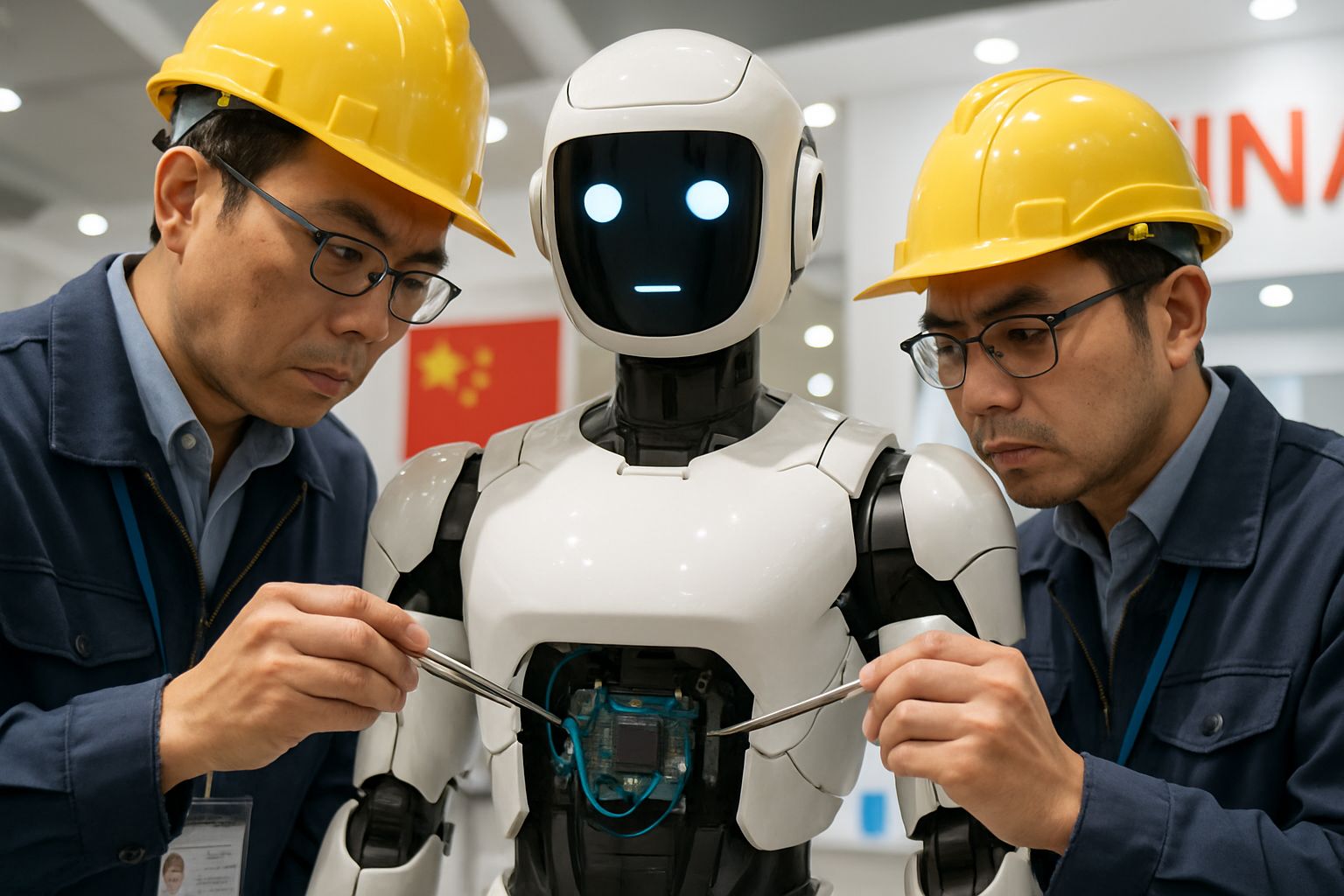
Chinese Robots Dominate CES
CES 2026 visitors could hardly avoid sleek bipedal prototypes lined near the NVIDIA pavilion. Furthermore, wireless quadrupeds from Unitree patrolled aisles while AgiBot’s humanoids folded towels on stage. In contrast, Western rivals presented fewer production units, choosing controlled lab demos instead. Analysts noted that lower component costs let Chinese vendors upgrade motors and batteries ahead of schedule. Consequently, buyers from logistics and healthcare sectors placed on-site orders for hundreds of units. These scenes confirmed that Chinese Robots now shape commercial expectations, not merely tech headlines. However, shipment numbers offer a clearer picture, as the next section explains.
Global Shipment Data Snapshot
Omdia’s January report placed 2025 humanoid shipments at 13,000 units worldwide. Moreover, AgiBot captured 39 percent share with more than 5,100 deliveries. Meanwhile, Unitree and UBTech split most remaining volumes. IFR data added crucial context by showing 542,000 industrial arms installed during 2024, more than half inside China. Therefore, the nation enjoys unmatched supply-chain scale from servo motors to lithium packs.
- 13,000 humanoids shipped globally in 2025
- 5,100 units from AgiBot alone
- 542,000 industrial robots installed in 2024
- China held 54% of those installations
- CloudSail tunnel seen on 1,900 devices
Consequently, many procurement officers view Chinese Robots as the fastest route to pilot autonomous labor. Nevertheless, raw volume conceals lurking cyber risks discussed next.
Security Risks Now Exposed
Independent researchers at two European universities published alarming findings in March 2025. Additionally, their scan uncovered an undocumented CloudSail tunnel active on live Unitree Go2 robots. Attackers with a shared API key could stream video from Chinese Robots, map environments, and open SSH shells. In contrast, legitimate IoT maintenance tools normally require explicit opt-in and unique credentials. Consequently, the researchers logged 1,900 distinct serial numbers on the exposed network. Rep. John Moolenaar called the discovery a "wake-up call" because some devices already served inside U.S. prisons. Therefore, technical evidence linked Chinese firmware decisions to real operational exposures. These vulnerabilities shatter any illusion of benign autonomy. Subsequently, lawmakers intensified scrutiny, as outlined below.
Congressional Pressure Quickly Builds
On May 6, 2025, the House Select Committee on the CCP dispatched a letter to three federal agencies. Moreover, the bipartisan note urged Commerce to consider adding Unitree to the Entity List. The letter asked Defense to tag the firm under Section 1260H and urged the FCC to block telecom use. Consequently, committee leaders warned that Chinese Robots might act as 'Trojan horses' inside critical infrastructure. Raja Krishnamoorthi stressed that dual-use capabilities were already being weaponized by adversaries. Meanwhile, local police procurements, such as Pullman’s "MIKE" robot dog, illustrated procurement gaps. Nevertheless, agencies have not publicly announced formal designations as of January 2026. These political signals increase compliance uncertainty for buyers and distributors. Therefore, industry reaction becomes the next decisive factor.
Industry Responses Rapidly Emerge
Vendor statements started arriving within days of the committee letter. Additionally, Unitree promised firmware patches to disable CloudSail by default and to rotate unique keys. AgiBot emphasized that its CES 2026 product line uses on-premise control servers for North American clients. In contrast, several European distributors paused new orders pending compliance reviews. NVIDIA’s Jensen Huang nevertheless repeated that robotics marks a 'ChatGPT moment' for physical AI. Consequently, companies launched transparency dashboards showing server locations and data retention policies for Chinese Robots they export. Moreover, professionals can enhance their expertise with the AI Learning & Development™ certification to audit such systems. Manufacturers also began courting regulators by hosting secure firmware walkthroughs. These corporate moves aim to prevent harsh restrictions. Subsequently, market forecasts started shifting, as the following analysis shows.
Strategic Market Impacts Ahead
Analysts warn that export controls could reshape the competitive map within months. Furthermore, European retailers already redirect inventory toward Latin America to offset possible U.S. bans. In contrast, domestic American startups like Figure and Agility could gain breathing room to mature their platforms. However, their prototypes remain expensive compared with Chinese Robots selling below $25,000. Consequently, buyers may delay automation projects while awaiting clarity. These forces highlight a delicate balance between cost, innovation, and sovereignty. Nevertheless, the decisive policies will likely arrive within the next year, as the conclusion discusses.
Ultimately, policymakers, engineers, and buyers face a decisive crossroads. Moreover, CES 2026 revealed both the promise and the peril in vivid detail. If Chinese Robots remain affordable yet insecure, agencies may impose heavy trade barriers. In contrast, transparent designs could keep markets open while protecting sensitive sites. Consequently, industry professionals should track agency dockets, firmware updates, and emerging standards. Finally, readers seeking deeper audit skills should explore the linked certification and stay ahead of regulatory curves for Chinese Robots.
Disclaimer: Some content may be AI-generated or assisted and is provided ‘as is’ for informational purposes only, without warranties of accuracy or completeness, and does not imply endorsement or affiliation.


