

AI CERTs
6 months ago
Integration Middleware Solutions Boost AI Software Scalability
Enterprises see AI adoption surge, yet production success still lags. Consequently, teams now examine the connective tissue that joins models, data, and business systems. Integration Middleware Solutions provide that vital layer. These platforms route events, govern APIs, and orchestrate models at scale. Moreover, their maturation during 2025 has shifted board-level roadmaps toward middleware-first strategies.
This article dissects why the approach matters, how vendors respond, and which practical patterns unlock massive Software Scalability. Readers will gain actionable insights, statistics, and a roadmap for next-step execution.
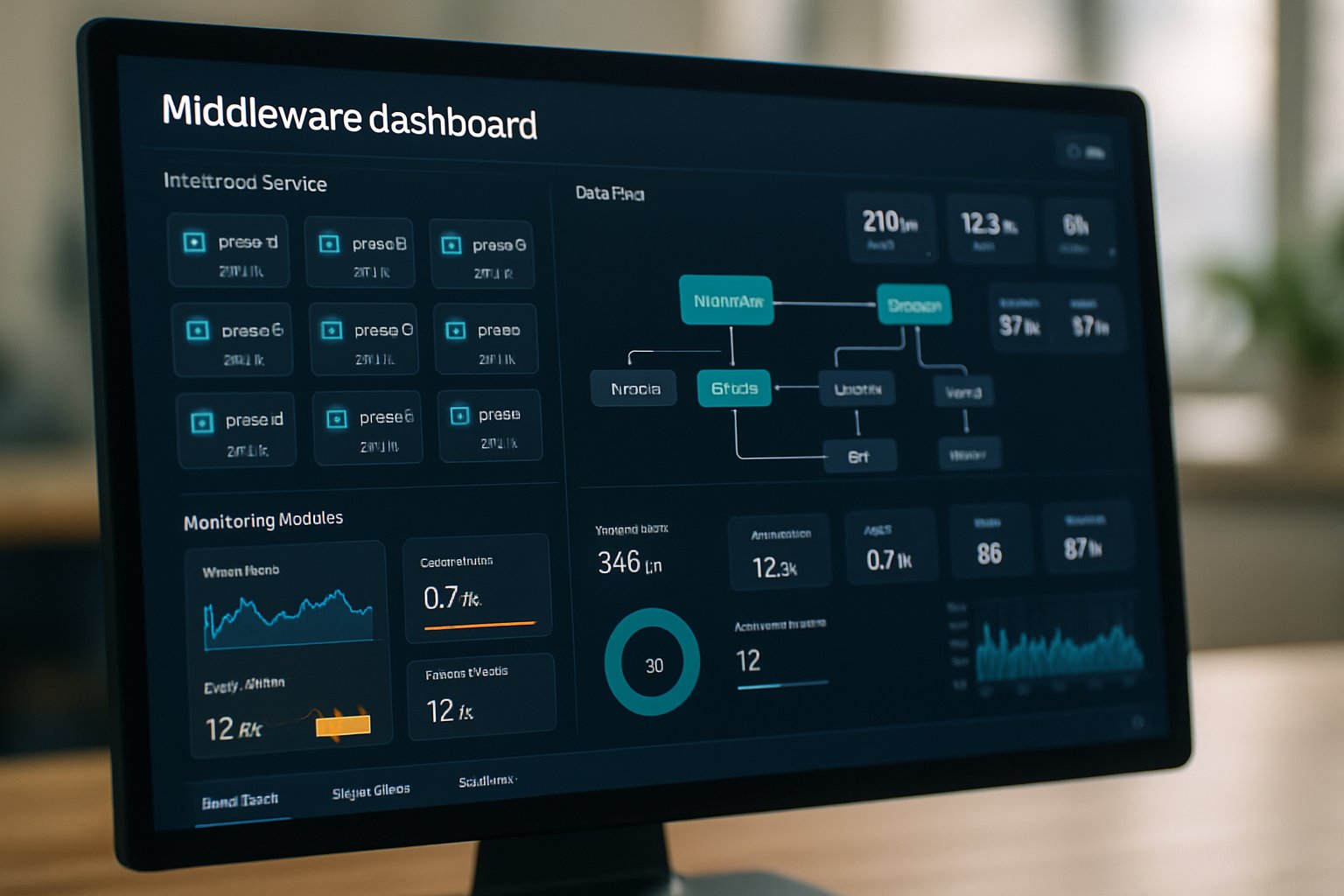
Current Market Drivers Analysis
Demand for real-time personalization, fraud detection, and agentic automation exploded in 2025. Therefore, latency budgets tightened to single-digit milliseconds. McKinsey reports 88% of firms use AI somewhere, yet only one-third scale it. Analysts link the gap to brittle data pipelines and missing governance.
Market estimates echo the urgency. Business Research Insights values middleware at USD 82.7 billion in 2025, growing to USD 137.7 billion by 2035. Meanwhile, Gartner forecasts iPaaS revenue surpassing USD 17 billion by 2028. These numbers convince finance leaders that Integration Middleware Solutions are no longer optional.
- 70–90% of AI pilots stall before production, mainly due to integration debt.
- Real-time feature serving needs sub-10 ms hops to satisfy modern agents.
- Event streaming adoption rose 40% year-over-year, driven by AI context delivery.
These indicators reveal a clear message. However, understanding vendor moves is equally critical.
Consequently, we now explore shifting supplier tactics.
Emerging Vendor Strategy Shifts
Leading suppliers repositioned aggressively. MuleSoft released Anypoint Code Builder updates that expose secure APIs to AI agents. Additionally, the company integrated natural-language copilots that auto-generate connectors.
Databricks acquired Tecton in August 2025. The move embeds a feature store into its lakehouse, ensuring low-latency data for Agent Bricks deployments. In contrast, open-source communities rally around neutrality. KServe joined CNCF incubation, adding LLM runtimes and caching capabilities.
BentoML pushed BentoCloud, offering bring-your-own-cloud inference with scale-to-zero economics. Furthermore, Confluent evangelized Kafka streams as live context feeds for agents. Forrester summarizes the trend succinctly: iPaaS now becomes the front door for AI agents.
These strategic shifts highlight intense competition. Nevertheless, architecture patterns provide the real litmus test for value.
Subsequently, we examine those patterns.
Key Architecture Patterns Explained
Successful deployments share three building blocks. First, event-driven streams ingest and normalize raw data using Kafka or Flink. Second, a feature store such as Tecton guarantees consistent offline and online features. Third, a model-serving layer (KServe, BentoCloud, or SageMaker) scales inference horizontally.
Streaming Feature Store Stack
The pattern flows as follows. Continuous streams push events into the feature store. Models fetch fresh features during inference, ensuring decision accuracy. Moreover, Integration Middleware Solutions expose those model endpoints as controlled APIs with observability hooks.
Autoscaling and caching complement the stack. Scale-to-zero reduces idle spend, while provisioned concurrency avoids cold starts. Therefore, enterprises balance cost and latency effectively.
These patterns confirm a pragmatic route to AI Integration at scale. However, benefits always arrive with trade-offs.
Accordingly, we now weigh pros and cons.
Benefits And Core Risks
The advantages prove compelling. Faster time to production emerges first because Integration Middleware Solutions centralize connectors and governance. Furthermore, consistent features and model observability improve SLA confidence.
Security gains follow. BYOC inference keeps sensitive data within private VPCs, lowering exfiltration risk. Additionally, middleware enforces rate limits and audit trails when agents act programmatically.
Yet challenges persist. Operating a full middleware-feature-serving stack demands scarce talent. Moreover, acquisitions like Databricks-Tecton raise lock-in fears. Latency versus cost trade-offs also require careful tuning. Finally, governance lapses can let autonomous agents trigger unintended actions.
These pros and cons stress deliberate planning. Consequently, a structured roadmap becomes essential.
Next, we outline that roadmap.
Practical Enterprise Implementation Roadmap
Enterprises should begin with an integration audit. Identify critical APIs, data domains, and latency targets. Subsequently, select Integration Middleware Solutions that natively support Software Scalability requirements such as autoscaling and caching.
Phase two involves feature store adoption. Teams map training pipelines to online serving paths, ensuring semantic parity. Meanwhile, choose model-serving platforms with Kubernetes affinity for portable deployments and robust AI Integration.
Upskilling remains vital. Professionals can deepen expertise through the AI Product Manager™ certification. Moreover, internal workshops should cover agent safety, tool discovery protocols, and cost governance.
Finally, establish continuous observability. Capture p95 latency, error rates, and cost per thousand inferences. Therefore, teams iterate quickly and maintain stakeholder confidence.
This phased approach mitigates risk while driving momentum. However, organizations must stay vigilant as standards evolve.
Consequently, we now close with key takeaways.
Conclusion And Next Steps
Middleware now defines the AI production frontier. Integration Middleware Solutions synchronize data, models, and actions, removing historic friction. Recent vendor moves, open-source advances, and market growth statistics underscore their importance.
Despite clear benefits, complexity and governance challenges demand structured execution. Therefore, leaders should adopt the roadmap, track metrics, and invest in talent development.
Ultimately, enterprises that master integration will unlock durable Software Scalability and resilient AI Integration. Begin exploring certifications, benchmark platforms, and pilot architectures today to secure competitive advantage.
Disclaimer: Some content may be AI-generated or assisted and is provided ‘as is’ for informational purposes only, without warranties of accuracy or completeness, and does not imply endorsement or affiliation.


