

AI CERTS
2 months ago
Pharmaceutical AI superintelligence reshapes drug discovery
Consequently, investors, regulators, and researchers are racing to understand its technical limits and societal impact. AlphaFold 3, Lilly’s NVIDIA supercomputer, and rapid startup partnerships signal momentum across the global Pharma sector. Meanwhile, early clinical data hint at higher hit rates for AI-designed molecules entering human trials. Nevertheless, dual-use risks, data bias, and opaque algorithms raise serious governance questions. Therefore, this article explores the landscape, benefits, challenges, and next steps for Pharmaceutical AI superintelligence adoption.
Readers will gain actionable insights for strategy, governance, and skill development within evolving discovery ecosystems. Subsequently, we will move from definitions to technical progress, market signals, regulation, biosecurity, and future scenarios.
Defining The Emerging Concept
Nick Bostrom defined superintelligence as cognitive performance surpassing humans in almost every domain. In practice, Pharmaceutical AI superintelligence now functions as a journalistic shorthand rather than a formal technical term. Moreover, practitioners usually refer to two related interpretations. First, some envision future, general AI systems autonomously handling target selection, design, and experiment scheduling. Second, many teams integrate narrow models, robotics, and cloud labs into a virtual discovery engine.
Under both meanings, the goal remains faster, cheaper, and safer delivery of validated molecules to patients. Furthermore, several experts urge precise language when discussing Pharmaceutical AI superintelligence to avoid hype or misunderstanding. In short, the concept unites visionary aspirations and present-day toolchains. Clear definitions improve dialogue among scientists, investors, and regulators. Consequently, we now examine the core technical building blocks driving practical momentum.
Core Technical Building Blocks
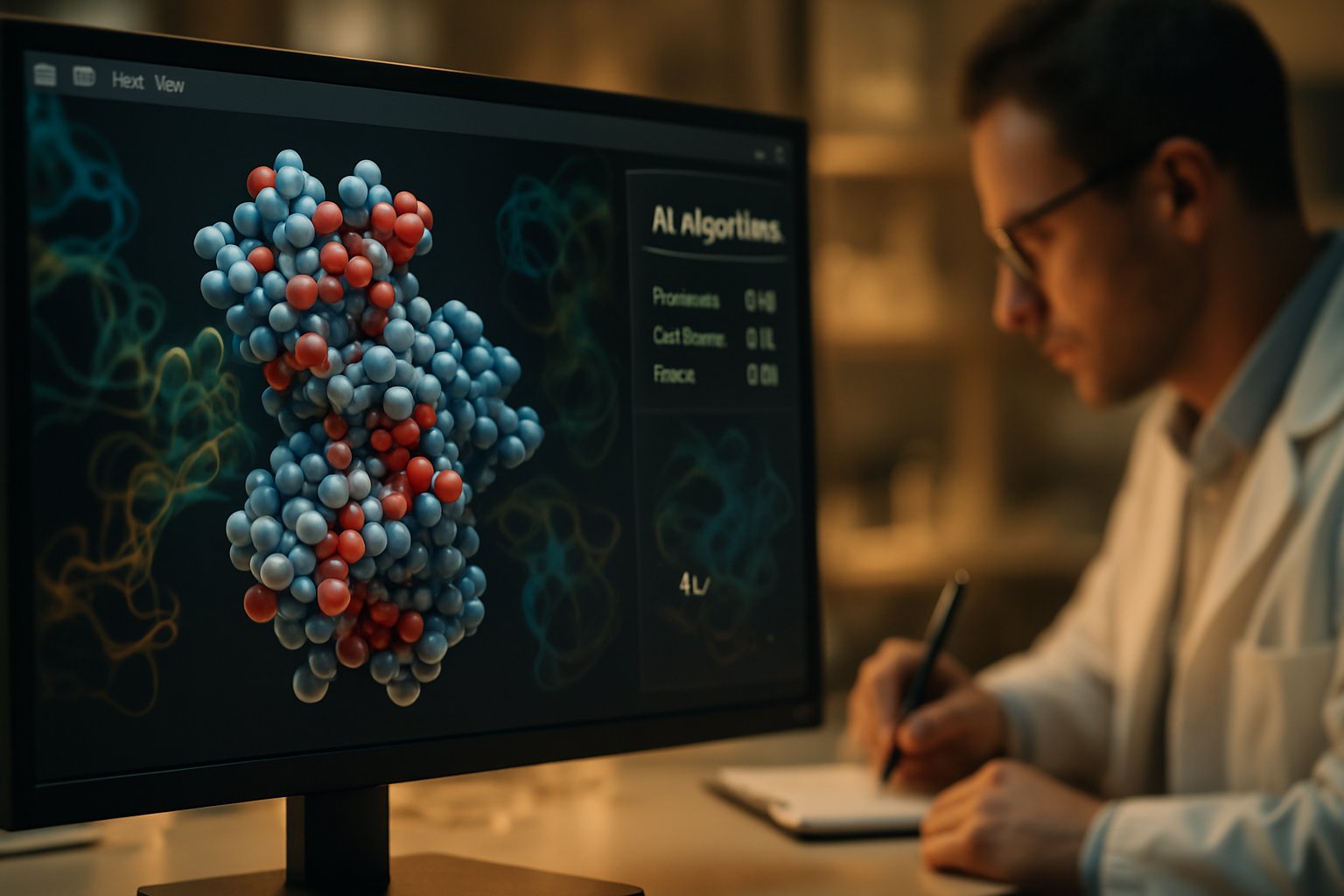
Modern discovery platforms rely on structure prediction, generative design, and automated wet-lab feedback loops. AlphaFold 3 leads the structure prediction frontier by modeling proteins, nucleic acids, ions, and small drug ligands.
AlphaFold Three Breakthrough Advances
DeepMind and Isomorphic Labs reported markedly improved accuracy for protein-ligand binding compared with previous releases. Consequently, bench scientists can prioritize experiments with greater confidence, saving months of manual crystallography. Meanwhile, generative diffusion models propose novel molecules with desired potency, selectivity, and ADME profiles. Recursion, Insilico Medicine, and Nabla Bio couple these models with high-throughput assays to validate suggestions quickly. Additionally, companies like Eli Lilly deploy GPU supercomputers to train custom models on proprietary R&D data.
These investments highlight a shift from renting cloud cycles to owning discovery-grade compute capacity. Moreover, laboratory automation platforms execute synthesis, purification, and basic chemistry analyses without human intervention. Together, these blocks approximate an end-to-end reasoning loop, although full autonomy remains aspirational. Consequently, Pharmaceutical AI superintelligence increasingly describes the orchestrated stack rather than a single monolithic brain. Subsequently, we assess market momentum signals indicating broad adoption.
Key Market Momentum Signals
Venture capital, strategic partnerships, and internal spin-ups reveal strong commercial energy. BCG estimated the AI drug-discovery market at roughly USD 1.8 billion in 2025 with 25% CAGR.
- USD 1.8 billion market size in 2025, BCG estimate.
- 25% projected CAGR toward 2030, according to multiple consultancies.
- 85% Phase I success for AI-discovered candidates in limited BCG sample.
- Three-week design-to-lab antibody cycle reported by Nabla Bio with Takeda.
Reuters reported Eli Lilly’s partnership with NVIDIA to build a DGX SuperPOD dedicated to discovery. Thomas Fuchs framed the machine as a scientific collaborator rather than a mere tool for Pharma teams. Additionally, Nabla Bio and Takeda compressed antibody design cycles to three weeks, stunning traditional R&D executives. Investment banks now track the clinical pipeline of AI-originated molecules separately from conventional candidates. Consequently, early data show Phase I success near 85%, double historical baselines, although samples remain small.
Nevertheless, analysts caution against over-extrapolation until Phase II and III results mature. Pharmaceutical AI superintelligence narratives now appear in earnings calls, investor decks, and annual strategy documents. In summary, capital and confidence keep accelerating. Therefore, attention shifts toward regulation and ethical alignment.
Evolving Regulatory And Ethics
The U.S. FDA released draft guidance on AI use in drug and biological product development during 2024-2025. Furthermore, the agency stressed risk-based evaluation for models informing regulatory decisions. Good Machine Learning Practices frameworks demand provenance records, performance metrics, and reproducibility checks. In contrast, discovery tools not directly submitted for decisions face lighter oversight but still require documentation. European authorities and ICH working groups consider parallel guidance, anticipating harmonized global expectations for Pharma innovators.
Legal scholars debate liability when AI-guided chemistry suggestions yield toxic outcomes. Consequently, companies embed model cards, audit trails, and governance boards into their R&D workflows. Pharmaceutical AI superintelligence deployments will therefore live or die by transparent validation and quality management. These emerging rules frame the ethical perimeter. Subsequently, biosecurity concerns demand deeper attention.
Biosecurity Risk Landscape Today
Generative design tools can unfortunately generate harmful pathogens or toxins when misused. Nature Machine Intelligence published a 2022 demonstration where an algorithm proposed thousands of nerve-agent variants within hours. Moreover, a 2025 Nature Biotechnology correspondence called for built-in biosecurity safeguards and usage monitoring. Tom Inglesby testified to Congress that AI-enabled biothreat creation ranks among top national security risks.
Meanwhile, model providers debate open access versus controlled deployments to prevent malicious chemistry experimentation. Pharma leaders support balanced controls that secure platforms while preserving collaborative science. Nevertheless, concrete enforcement mechanisms remain immature. Pharmaceutical AI superintelligence thus requires proactive design of guardrails, kill-switches, and user vetting procedures. These risks highlight the stakes involved. Consequently, future scenarios merit strategic forecasting.
Likely Future Outlook Scenarios
Consultancies outline three plausible trajectories for discovery over the next decade. Scenario one sees incremental advances where AI doubles screening speed but humans remain central. Scenario two envisions semi-autonomous design loops where Pharmaceutical AI superintelligence coordinates distributed cloud labs. Scenario three projects full autonomy, with AI negotiating experiment budgets and synthesizing molecules without daily oversight. In contrast, severe regulatory crackdowns or major safety incidents could slow progress dramatically.
Moreover, compute cost curves and open-source collaboration might democratize access, challenging incumbent R&D hierarchies. Professionals can enhance their expertise with the AI+ UX Designer™ certification. Consequently, upskilling remains critical for scientists, engineers, and policy makers navigating accelerated chemistry landscapes. Pharmaceutical AI superintelligence will likely reward agile organizations that invest early in talent, governance, and compute. Ultimately, success hinges on balancing innovation velocity with safety and public trust. These scenarios frame strategic options. Therefore, the concluding section distills core lessons and recommended actions.
The superintelligence concept has moved from speculative label to operational reality within leading discovery teams. Advances in structure prediction, generative design, and automated labs now compress R&D cycles and boost early success. However, biosecurity, data quality, and regulatory clarity must keep pace to protect patients and maintain trust. Consequently, stakeholders should embed transparent governance, invest in workforce skills, and engage early with regulators. Ready to lead the transformation? Explore advanced certifications and deepen technical literacy to seize the next decade of AI discovery.


