

AI CERTS
5 months ago
Oracle unveils NetSuite ERP roadmap for AI Cloud automation
Secure connectors will also modernize services work. Analysts immediately asked how quickly customers can exploit the innovations, and at what cost. Consequently, this article examines the roadmap details, market context, and strategic implications for technology leaders.
Launch Context And Timing
Oracle staged the reveal in Las Vegas before roughly 8,000 partners and customers. However, the vendor focused on a global audience of more than 43,000 subscription tenants. NetSuite executives described the NetSuite ERP roadmap as “immediate plus twelve months.” Some capabilities, including Ask Oracle, ship today for core business users. Others enter customer preview in early 2026. Moreover, wider release stretches into late 2026, according to analyst reports. Evan Goldberg emphasized minimal migration pain, stating upgrades require “a button press.” Consequently, attendees left with confidence yet also questions about readiness, pricing, and skills.
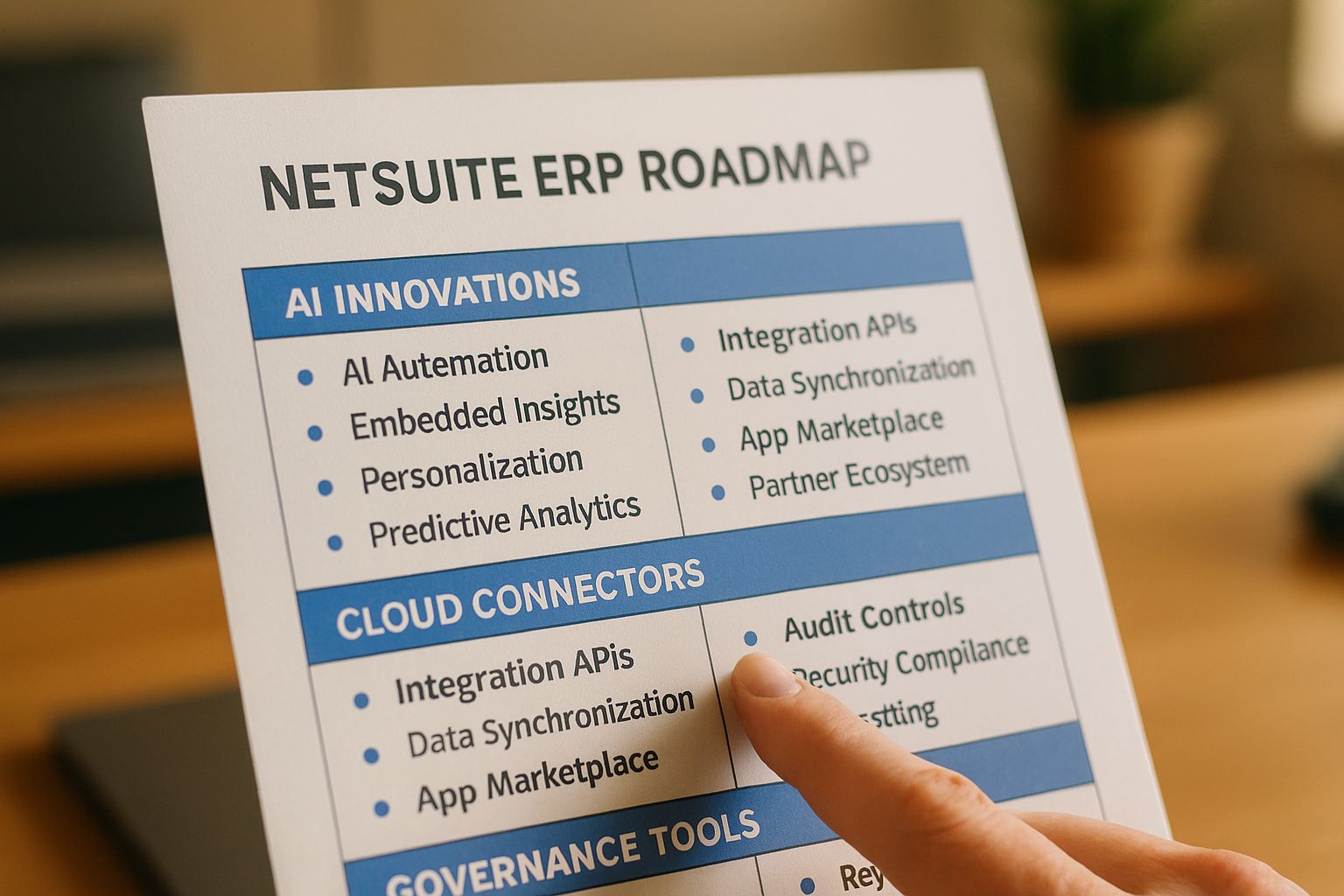
The timeline blends excitement with patience. Meanwhile, companies must prepare tooling and people for what comes next.
Core AI-Native Suite Pillars
NetSuite built three pillars into the new architecture. Firstly, conversational intelligence arrives through Ask Oracle, a natural language assistant that highlights source numbers. Secondly, agentic workflows automate multi-step tasks such as invoice approvals or inventory transfers. Thirdly, the AI Connector Service links external models using the Model Context Protocol. Consequently, Cloud elasticity supports heavy inference loads without new hardware. Robert Kramer called the approach “search, analyze, act in one pane.” The NetSuite ERP roadmap positions these pillars as native, not bolt-on.
Automation also extends to Intelligent Payment Automation and Subscription Metrics modules. Moreover, AI Canvas enables continuous scenario planning, letting finance teams iterate forecasts in minutes. Craig Sullivan stressed explainability by design; users see highlighted values and trace calculations. In contrast, earlier generations forced manual data tracing. Therefore, the pillars aim to boost decision speed while reducing risk.
These pillars embed AI into daily business routines. Consequently, leaders must align data quality to unlock full value.
Developer Tools And Governance
Partners often extend NetSuite for unique industry flows. Subsequently, Oracle delivered SuiteAgents frameworks, AI Toolkits, and AI Studios. Prompt Studio lets administrators craft, test, and govern prompts before release. Narrative Insight Studio then turns dashboards into plain-language summaries. Additionally, AI Canvas supports collaborative design of new agentic workflows.
Toolkit Feature Quick Overview
- AI Connector Service supports standard and custom MCP tools.
- SuiteAgents ships with monitoring dashboards for audit trails.
- Document AI APIs process contracts and receipts natively in Cloud.
- Prompt Studio enforces role-based governance for safe automation.
- SDKs allow continuous deployment of partner-built agents.
Governance remains central. However, some security teams worry about OAuth complexity inside MCP. Oracle counters with pre-built policies and logs. Professionals can enhance their expertise with the AI+ Human Resources™ certification to better manage AI change. Consequently, the NetSuite ERP roadmap promises a balanced mix of creativity and control. Nevertheless, success depends on disciplined development practices.
Robust toolkits lower entry barriers for partners. Meanwhile, governance frameworks aim to keep experimentation safe.
Market And Competitive Pressure
The global ERP market sits between $50 billion and $73 billion, depending on scope. Moreover, analysts expect compound annual growth near nine percent. Incumbents like SAP and Microsoft infuse AI into offerings, while startups such as DualEntry tout AI-first stacks. Consequently, Oracle drafted the NetSuite ERP roadmap to defend share and lure Cloud-native buyers. Additionally, customers seek continuous innovation without disruptive upgrades. NetSuite highlights Redwood UX and “no touch” migration to differentiate. Nevertheless, pricing clarity remains a concern. Katie Evans from IDC cautioned that AI features require budget planning and new skills. Therefore, service partners will offer training, audits, and managed automation packages.
Competition accelerates product cycles and customer expectations. Subsequently, vendors must match speed with reliability and trust.
Risks And Open Questions
No enterprise rollout succeeds without scrutiny. Governance complexities around agent authentication and audit trails top the list. Furthermore, consumption pricing for heavy AI inference may surprise finance leaders. In contrast, Oracle states many features remain bundled. However, specifics are still coming. Security officers reviewing the NetSuite ERP roadmap should map controls against regulatory mandates.
Developer effort is another variable. Building production-grade agents demands testing frameworks, simulation environments, and continuous monitoring. NetSuite offers toolkits, yet partner feedback will confirm real effort levels. Moreover, some industries require certified compliance traces, adding additional layers of review.
These challenges highlight critical gaps. Nevertheless, the upcoming previews will clarify feasibility and value.
Strategic Takeaways Moving Ahead
Technology executives planning budgets need clear priorities. Therefore, start by cataloging processes that receive immediate AI coverage through Ask Oracle and Intelligent Payment Automation. Next, evaluate data readiness because inaccurate records cripple intelligence. Additionally, outline talent gaps in prompt design, agent testing, and governance.
Moreover, align Cloud capacity planning with projected inference spikes during quarter-end closings. Meanwhile, engage finance leaders early regarding consumption fee models. The NetSuite ERP roadmap encourages incremental adoption, allowing pilot teams to validate value before scale.
Structured preparation shortens time to benefit. Consequently, disciplined teams will outpace rivals that wait.
Conclusion And Next Steps
The NetSuite ERP roadmap signals a decisive pivot toward AI-native ERP. Moreover, Oracle couples the roadmap with Cloud breadth, governance tooling, and partner ecosystems. Nevertheless, firms must stay vigilant about pricing, skills, and regulatory alignment. Consequently, leaders should pilot high-value automation while capturing metrics that prove return.
Continuous iteration will keep implementations aligned with shifting business demands. Professionals seeking structured upskilling should explore certifications and partner workshops. Therefore, review the NetSuite ERP roadmap, build a phased plan, and secure executive sponsorship. Mastering the NetSuite ERP roadmap today will pay dividends in 2026. Act now to turn AI vision into measurable business advantage.
Disclaimer: Some content may be AI-generated or assisted and is provided ‘as is’ for informational purposes only, without warranties of accuracy or completeness, and does not imply endorsement or affiliation.


