When a Client Asks “Is this Certification Recognized?”—The Answer that Wins the Deal


A client may ask, “Is this certification recognized?” And most training providers approach it as a straight yes-or-no question. It is not. It’s a signal—a test of trust, a risk check, and a buying decision all in one sentence. The way you answer it is what decides whether you close on the deal or not. This blog dissects what that question actually means in a nutshell, why knowing the correct response based on officially authorized training partner status affects your close rate, and how AI training programs supported by the AI CERTs Authorized Training Partner (ATP) Program provide the answer clients need to be happy with. You will also get the newest statistics, two vibrant infographics, and a clear path to becoming a partner today.
The Question Behind the Question
Imagine this: You’re deep into a sales call, and everything’s going well. The client seems interested. Suddenly, they stop and hit you with, “Is this certification recognized?” Most training providers just blurt out, “Yes!” They might list a few credentials, maybe toss in some industry names, and hope that does the trick. But somehow, the energy shifts. The deal slows down—or even stops.
Here’s the thing they’re missing: That question isn’t really about the certificate itself. It’s about trust, about risk. What the client’s actually thinking is, “If I buy this, am I going to look foolish? Will my team actually get value? Can I justify this to my manager?” When someone asks about recognition, they’re almost sold.
They just want proof, something solid. They want to see that someone credible has already put their stamp of approval on you. That’s exactly what an authorized training partner badge delivers. Without it, your answer is just talk. With it, the client hears real assurance, not just another sales pitch. And honestly, that changes everything.
What “Recognised” Really Means to a Buying Client
Let’s decode the word “recognized” the way a procurement team uses it. They are not asking if the certification is popular. They are asking four things at once:
| What the client says | What the client actually means |
| “Is this recognized?” | Has a credible third party verified this? |
| “Will this count for our team?” | Will employers and industry bodies accept it? |
| “Is this worth the budget?” | Can I justify this spend with proof of quality? |
| “Who else uses this?” | What is the risk if this goes wrong? |
If you can tackle all four layers—not just skim the surface—you become someone your client actually trusts. And when people trust you, deals happen. If they don’t, you just end up with “Let us think about it.”
Clients aren’t really grilling you on what you know. They’re checking to see if someone else has already done the hard work of vetting you. That’s what real recognition means.
Why AI Training Programs Need Authorised Backing Now More Than Ever
AI training is booming right now. The space is packed, and everyone’s shouting about how their program is the best. Clients have to wade through endless choices. Almost every provider insists their certificates are “industry-recognized,” which just adds to the noise. So, buyers need something simple they can trust—a shortcut. The easiest sign is that authorized training partner badge from a big name.
People have always gravitated toward these signals. That’s what makes ISO certification, Microsoft Partner, and Google’s credentials so powerful. If you’re an authorized partner, your credentials have already been vetted. Clients don’t need to do all the legwork themselves. That’s the shortcut they want. It’s why even a smaller competitor with ATP status can take deals right out from under you.
If your AI training doesn’t have backing from a recognized credentialing body, you’re at a disadvantage—especially when clients are about to make a purchase. Instead, with the AI CERTs Authorized Training Partner (ATP) Program, you erase that trust gap before anyone even questions it.
The AI Skills Numbers Your Clients Already Know
Your clients are not in the dark about AI. Many have already read the research. Here is what the data says—and why clients are asking harder questions than ever:
| Stat | Number | Source |
| Enterprises implementing or planning AI engineering roles | 87% | Gartner CIO Survey, 2025 |
| Annual growth in AI-related jobs through 2033 | 36% | U.S. Bureau of Labor Statistics, via ONLC |
| Estimated global AI worker shortage | 700,000+ | Computerworld, 2025 |
| Increase in AI/ML job postings since 2019 | 344% | Proftia, 2025 |
| Job seekers pursuing AI/ML certifications (up from 17% in 2022) | 35% | Gartner, via Computerworld |
Your clients recognize that AI skills are both rare and in demand. They see how many low-quality programs are out there, so it makes sense they’d ask whether your training stands out. The AI training market isn’t slowing down, either—it’s growing fast, from $2.63 billion in 2024 and set to hit $6.98 billion by 2029, with a growth rate of 21.8% every year. Clients spending in this space want their investment protected by credentials they can stand behind.
The Recognition Gap—What Clients Check
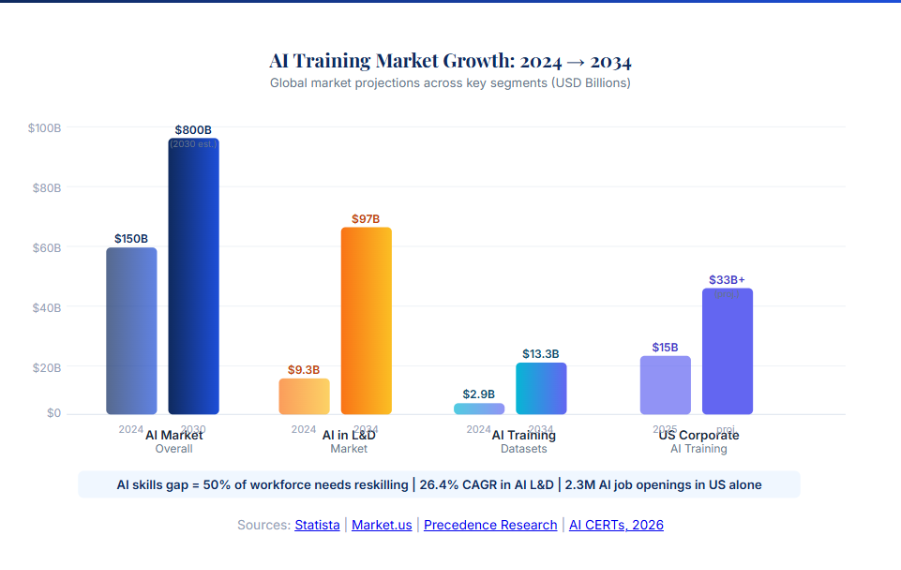
Alt Text – Bar chart showing AI training market growth from 2024 to 2034 across segments, highlighting rapid rise in AI L&D and corporate training demand
How the AI CERTs Authorized Training Partner (ATP) Program Changes Your Answer
AI CERTs has trained over 115,000 learners, worked with more than 500 certified instructors, and partnered with 150 organizations around the world. When you’re an AI CERTs Authorized Training Partner, your credibility speaks for itself. You don’t need to prove your reputation—it’s already established. So when a client asks, “Is this recognized?” and you’re an authorized partner, the answer is simple.
You’re backed by a respected global standard. There’s no need for long explanations; your partnership does the talking.
| What changes | Without ATP | With AI CERT’s ATP |
| Your answer to “is this recognized?” | “Yes, we believe so.” | “Yes—AI CERTs verified us. Check our directory listing.” |
| Client’s ability to verify | Impossible without deep research | Instant—partner directory lookup |
| Curriculum currency | Assumed, unverified | Confirmed via ATP programme review |
| Co-branded assets | None | Multilingual certificates, co-branded marketing |
| Your position in the deal | One of many options | A verified, lower-risk choice |
Beyond the client conversation, the AI CERTs Authorized Training Partner (ATP) Program gives you a turnkey platform, 50+ ready-to-deliver AI certifications, sales toolkits, and launch campaigns. You stop spending time building credibility and start closing deals.
The Deal-Winning Answer Framework
The Close Rate Effect—How Credentials Shift Buying Decisions
There’s a straight connection between how you answer “is this recognized?” and whether you actually close the deal. If a client asks about recognition and you come back with something vague or just talk about yourself, you plant a seed of doubt. Doubt drags out decisions, and when things drag, they often stall out completely. That’s how good training providers end up losing deals they should’ve locked in—not because their training isn’t solid, but because nobody sees their credibility.
Now picture how it feels on the other side. If you’re an authorized training partner and they ask about recognition, you don’t just say “yes.” You back it up. You send them to the AI CERTs partner directory, you show them a co-branded certificate, and you give them real proof instead of just words. That changes the whole conversation.
Without ATP status, you’re basically asking a client to believe in you. With ATP status, you’re telling them to believe in AI CERTs—a third party that’s already put their name on you. That’s a world apart when it comes to closing deals.
Look at what’s happening in the market. 72% of APAC companies say they’re ramping up AI investments, but only 38% of workers have had any real, structured AI training. These clients are ready to buy, but they always pick the providers who can prove their credentials. The number of candidates chasing AI and machine learning certifications has more than doubled in two years—from 17% in 2022 to 35% this year.
Recognition matters more than ever. Clients know quality when they see it—you just have to show them you’re the real thing.
Four Ways to Become a Partner with AI CERTs
Authorized Training Partner (ATP) For training companies, consultancies, and corporate learning teams. Deliver 50+ AI CERTs AI certifications. Access sales toolkits, co-branded assets, and the partner directory listing that makes your “yes” verifiable. 👉 Become an Authorized Training Partner
Authorized Academic Partner: For universities and colleges. Integrate AI CERTs certifications into your degree or professional programs. Give students credentials that enterprise employers recognize at the screening stage.
👉 Become an Authorized Academic Partner
Association Partner: For professional associations and industry bodies. Offer AI CERTs credentials as a value-add to your members. Strengthen your association’s relevance in the AI skills era without building a program from scratch.
👉 Become an Association Partner
Affiliate Partner: For individuals, content creators, and marketing partners. Promote AI CERTs certifications and earn commissions. The fastest way to start building your presence in the AI training ecosystem.
Q1. What does “recognized” really mean when a client asks about an AI certification?
Q2. How does the AI CERTs Authorized Training Partner (ATP) Program help me close more deals?
Q3. Is the AI training market growing fast enough to justify becoming a partner now?
Q4. What is the difference between the ATP Program and the Academic Partner Program?
Q5. What does AI CERTs’ global footprint mean for my clients?
Recent Blogs

FEATURED
What 12 Months of Building Your Own AI Course Actually Costs
April 9, 2026
FEATURED
Why the Training Providers Earning the Most Aren’t the Busiest
April 9, 2026

FEATURED
Fully Booked, Low Margins: The AI Training Trap Most Providers Don’t See Coming
April 7, 2026
FEATURED
The Smaller Competitor Won the Enterprise Deal. Here’s What They Had That You Don’t—Yet
April 7, 2026