The Icarus Trap: Why The “Ghost Pilot” Effect is the Hidden Risk of the AI Age By Brian J. Arnold PhD



The Parable of Flight 447
On the night of June 1, 2009, Air France Flight 447 was cruising through the dark skies over the Atlantic Ocean. It was a state-of-the-art Airbus A330, a marvel of modern engineering designed to fly itself. The pilots were experienced professionals. But then, a minor technical glitch occurred: the pitot tubes (sensors that measure airspeed) froze over with ice crystals.
For a few moments, the flight computer lost its data feed. Confused, the autopilot did exactly what it was programmed to do in a state of uncertainty: it disengaged. It handed control back to the humans.
The pilots, suddenly jolted from the complacency of automation, were faced with a screaming cockpit and confusing readings. They had relied on the computer for so long that their “manual flying” muscle memory had atrophied. In the chaos, one pilot made a fatal error: he pulled the stick back, raising the nose. The plane stalled. For three minutes, they fell from the sky, wrestling with a machine they no longer intuitively understood, all the way down into the ocean.
The tragedy wasn’t just technical failure. It was an automation dependency. The system worked so well for so long that the humans forgot how to fly.
Today, across the corporate world, we are seeing the early stages of a similar phenomenon. We are adopting “autopilot” systems, Large Language Models (LLMs) and Generative AI, at a breathtaking pace. We are handing over our critical thinking, our coding, our writing, our strategy, and our analysis to machines we barely understand.
We are becoming “Ghost Pilots” in our own careers: sitting in the captain’s chair, wearing the uniform, but asleep at the wheel. The risk isn’t just that the AI might make a mistake.
The risk is that when it inevitably “freezes over”, when it hallucinates, biases data, or fails to grasp nuance, you will no longer have the skills left to land the plane.
The Problem: The Illusion of Competence
We are currently living through the “honeymoon phase” of the AI revolution, seduced by the promise of effortless results. The danger is not just blind trust. It is the profound human desire to offload cognition. When a machine offers a confident, instant answer, it satisfies our urge to bypass the hard work of thinking. We accept the output because we want it to be true. This creates a dangerous loop where we validate bad advice and cannot defend our work because we never understood it.
AI systems are efficient at spreading misinformation. One unchecked report can cascade errors across an organization. This is the old rule of “Garbage In, Garbage Out” at scale. If your understanding of the problem is flawed, the AI will simply amplify that confusion with eloquent confidence.
Over time, this reliance causes skill atrophy. Employees forget how to analyze and write because they use tools to do the work rather than help with it. We must now treat critical thinking like physical exercise. Just as cars made walking optional and necessitated the gym, AI makes thinking optional. We must intentionally exercise our minds by auditing and challenging the AI to keep our mental muscles from withering.
This atrophy destroys professional value. In aviation, “automation dependency” occurs when pilots rely too heavily on autopilot and lose the muscle memory to fly manually during a crisis. We are becoming “Ghost Pilots” in our own careers. The risk is not just that the AI might make a mistake. The risk is that when it does, you won’t have the skills left to fix it.
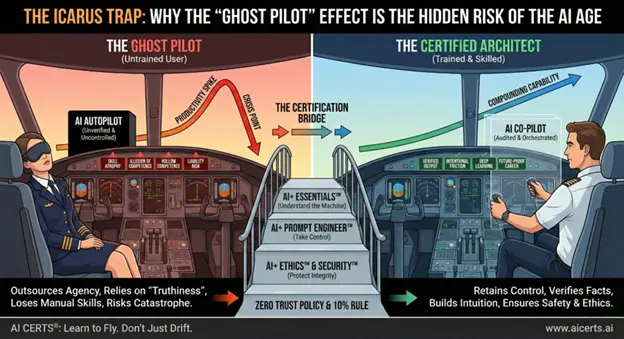
Unpacking the Context: The Cognitive Science of Skill Atrophy
To understand why this is a career-ending trap and not just a productivity hack, we have to look at the intersection of human psychology and AI mechanics. Why exactly does using AI without training make us “dumber”?
1. The Death of the “Generation Effect”
Cognitive science tells us that we learn best through the Generation Effect. We remember information better when we have to actively generate it from our own minds rather than passively reading it.
When you (productively) struggle to write a difficult paragraph, or when you spend three hours debugging a script, your brain is building deep neural pathways. That friction is the learning. When you prompt an AI to “fix this code” or “write this memo,” you bypass the struggle.
🎣You get the result (the fish) but you degrade the skill (the fishing).
Over time, your fundamental understanding of your craft erodes.
2. Dunning-Kruger 2.0
We are all familiar with the Dunning-Kruger effect, where people with low ability overestimate their competence.
AI acts as a turbocharger for this bias.
It provides a “prosthetic competence.” A junior marketer can generate a strategy document that looks like it came from a CMO. This validates their belief that they are operating at a CMO level. But they lack the “tacit knowledge” (the unwritten wisdom gained from experience) to know if the strategy is actually viable.
3. Cognitive Offloading vs. Cognitive Atrophy
There is a difference between using a calculator (offloading a fixed process) and using an LLM (offloading judgment).
When you offload judgment, you stop sharpening your critical thinking faculties. You begin to accept the “average” of the internet (which is what LLMs are trained on) as the standard for excellence.
Diagnostic: Are You a Ghost Pilot?
It is easy to dismiss this warning. “I’m just using it to be faster,” you might say. “I don’t need to be an auto mechanic to drive a car!” But is there more to it?
Or are you losing control? Be honest with yourself as you answer these five questions:
The Ghost Pilot Checklist
- The “Why” Test: When AI gives you a code snippet, a legal clause, or a strategic pivot, can you explain exactly why it works without looking it up?
- The Outage Test: If ChatGPT/Claude went offline for a week, would your output quality drop by more than 50%?
- The Manual Override Test: When the AI provides a response that is 90% right but broken in a specific area, can you take it “offline” and fix the error yourself? Or are you stuck in a loop of prompting “fix this” and hoping it gets lucky?
- The Editor Test: Have you submitted work generated by AI this month that you did not read word-for-word and verify against a primary source?
- The Vocabulary Test: Can you define “temperature,” “token limit,” “zero-shot prompting,” or “hallucination rate” right now?
If you answered “No” to questions 1 or 4, or “Yes” to questions 2 or 3, you are currently flying on some degree of autopilot.
Scenario Spotlights: The Operator vs. The Architect
To see the real-world danger, let’s look at two professionals. Both use AI daily. One is a “Ghost Pilot” (untrained). The other is a “Certified Architect” (trained).
Scenario A: The Developer
- The Ghost Pilot (Untrained): Enters an error message into an LLM. The AI suggests a code fix. The developer pastes it in. It works! The ticket is closed.
- The Hidden Risk: The fix works, but it uses an outdated library with a known security vulnerability (SQL Injection risk). The developer doesn’t know the library well enough to spot it. Six months later, the company is hacked.
- The Architect (Trained): Enters the error. The AI suggests the fix. The Architect recognizes the library is outdated. They prompt: “This library is deprecated. Suggest a secure alternative using the modern framework.” They review the new code, understand the logic, and implement it.
Scenario B: The Content Strategist
- The Ghost Pilot (Untrained): Prompt: “Write a blog post about sustainable finance.” The AI produces a generic, fluffy article filled with platitudes (“Sustainability is key to the future”). The strategist publishes it.
- The Hidden Risk: The content is “digital smog.” It damages the brand’s authority because it offers no new insight. Furthermore, it hallucinates a statistic about carbon credits that turns out to be false.
- The Architect (Trained): The Architect writes the outline first, inserting their unique point of view. They use the AI to expand specific sections, then prompt: “Review this draft for logical inconsistencies and bias.” They fact-check the stats. The result is human insight, accelerated by machine speed.
Future Issues: The Compounding Risks
If we continue to adopt these tools without a foundation of certified understanding, we face three major downstream risks.
1. The Liability Shift: From “Oops” to Negligence
Right now, companies are lenient. That grace period is ending. As AI integrates deeper into enterprise workflows, the liability will shift back to the human operator.
We are moving toward an era where provenance matters.
You will be personally responsible for verifying every output attached to your name.
If you submit a report with hallucinated data, “ChatGPT told me so” will not be a defense, it will be grounds for termination. To be blunt, responsibility tends to roll downhill and your organization can’t fire a bot.
Without training in AI Security and Ethics, you are walking through a legal minefield blindfolded.
2. The “Button Pusher” Economy
There is a widening gap between the Architect and the Button Pusher. The “Button Pusher” is a temporary role; if your primary skill is simply prompting a chatbot to “write a blog post,” you are effectively training your own replacement—a Python script that can execute that same task cheaper and at scale.
To future-proof your career, you must become an Architect. This requires more than just stringing tools together into complex workflows; it requires taking radical responsibility for the output.
The Architect uses AI to handle the rote work so they can focus on being a distinctive voice in a sea of synthetic noise, and an accurate reporter in an era of hallucination. It is this commitment to specificity, verification, and unique perspective that separates the professional from the prompt.
3. The Crisis of Institutional Trust
The “Ghost Pilot” effect is a solvent that dissolves trust. The old saying goes that trust takes years to build, seconds to break, and forever to repair. With AI, it takes a nanosecond. One poor prompt or a PII leak can incinerate a reputation. Submitting AI-generated work without careful review can result in incorrect analysis and recommendations, fabricated data or citations, or tone mismatches with clients or executives.
When credibility is questioned, especially early in a career, it is nearly impossible to recover. Credibility is your currency. Once it is devalued, professional progress stalls.
To survive, institutions must treat transparency as Operational Explainable AI (XAI). Clients do not need to know how the algorithm works, but they do need to know how the work was produced. We must provide a clear and auditable trail of “Transparency of Origin.”
If you cannot distinguish machine synthesis from human verification, your organization is a “black box.” The institutions that thrive will be those that provide a guarantee of oversight. The new standard is clear. It is acceptable not to write every word. It is unacceptable not to verify them. That verification is, quite literally, what you are being trusted and paid for.
This distinction between the passive consumption of the Ghost Pilot and the active oversight of the Architect creates two very different futures. If we map these approaches over the lifecycle of a career, we do not just see a difference in style. We see a divergence in survival.
Visualizing the Risk
Ghost or Architect? One offers an easy path with quick wins but a low ceiling. The other offers a longer, steeper climb with unlimited returns. We must all choose.
🛣️Path 1: The Ghost Pilot Curve: Represents the “sugar rush” of untrained AI adoption. It begins with a vertical spike—instant results with minimal effort. However, this is quickly followed by stagnation, and eventually, a sharp crash when the tool’s capabilities hit a wall or a crisis demands manual intervention.
🛣️Path 2: The Certified Architect Curve: Represents the professional who heavily invests in training. Their start is slower because they are taking the time to learn how to verify. However, their capability compounds because they are building wisdom on top of automation. This curve is defined by “fingers-on-keyboard” time—experimenting with the tools and seeking guidance from experts who have already navigated the innumerable roads you don’t have the time to explore alone.
The decision to take the steeper path is easy to make, but hard to execute. It requires a deliberate shift from passive consumption to active mastery.
So, how do we avoid the Icarus Trap? How do we use these god-like tools without burning our wings?
Recommendations and Next Steps
1. Adopt a “Zero Trust” Policy
Treat your AI not as an expert, but as a brilliant but pathological liar. If it gives you a fact, verify it, – as you would with anyone when creating a professional document. If it gives you code, read it line by line. This verification process is where the new learning happens.
2. The “10% Rule”
Dedicate 10% of your time to learning about the tools you use. If you use ChatGPT daily, spending 30+ minutes a week studying prompt engineering theory or AI ethics is the bare minimum rent you owe for that productivity.
3. Seek Formal Validation (The AI Certs Solution)
YouTube tutorials are great for tips, but they don’t offer a curriculum. To truly protect your career, you need a structured learning path that validates your skills against industry standards.
This is where the mission of AI Certs ties directly into my Humane Technologist’s philosophy. Certification isn’t just a badge; it is a mechanism for grounding.
- Understand the Machine (AI+ Essentials™): You cannot control what you do not understand. The AI+ Essentials certification acts as your “physics of flight” class. It strips away the magic and explains the “transformer architecture,” “tokens,” and “probabilistic nature” of the beast. It ensures you know why the autopilot does what it does.
- Take Control (AI+ Prompt Engineer™): This track moves you past “magic phrases.” It teaches you the mechanics of control—how to use parameters like Temperature and Top-P to mechanically reduce the error rate of the model. It turns you from a passenger into a pilot.
- Protect Your Integrity (AI+ Ethics™ & AI+ Security™): These certifications provide the necessary guardrails. AI security is very much like traditional cybersecurity where the weakest link is often the human element. We used to worry about employees clicking links blindly. Now, the risk is employees using public instances of Generative AI. If you enter PII or confidential information into these tools, that data can be used to train the model. You are effectively leaking your secrets to the world. These tracks teach you how to spot bias, prevent these data leaks, and ensure your use of AI aligns with professional standards.
- How does AI apply to my Role? AI Certs offers Job-role based specializations. The core philosophy is clear. They do not teach Nurses to be Nurses. They teach Nurses to use AI to be more efficient, effective, and safe.
- Job role based AI Skills are uniquely positioned to help individuals become more efficient and effective at their jobs. Take for example a Sales person or Marketing person. They can learn the AI tools that can automate some of the menial tasks they have to perform on a regular basis. Perhaps it is that weekly report that can be automated to look at your calendar and emails, summarize your activity, and use the same data to create action items and follow up emails. Or they can use system data to analyze a customer’s buying patterns to help plan their next sales call.
Learn to Fly
The Air France 447 pilots were not bad people; they were professionals placed in a situation where their tools blinded them to reality.
We have a choice. We can be passive consumers of this technology, letting our skills atrophy as we drift along on autopilot. Or, we can choose to be Humane Technologists: intentional, trained, and deeply skilled. We can choose to understand our tools so well that we remain the undisputed captains of our own future.
Don’t just fly. Learn to fly.
About the Author
Brian Arnold is a Product Board Member at AI Certs and the Editor In Chief of the Humane Technologist. With a deep background in Media Arts, Higher Education and EdTech, he explores the intersection of ethical technology, human agency, and professional development.
Recent Blogs

FEATURED
Why Smarter AI Training Programs Are the Next Big Business Opportunity
March 24, 2026

FEATURED
AI Training Programs Are Changing Fast — Here’s How You Can Lead the Way
March 24, 2026
FEATURED
Why AI Training Programs Need Ethical Data Practices — And What It Means for You
March 24, 2026