12-Step Checklist for Successful AI Training Implementation at Scale


AI training programs are now a board-level priority. Yet many initiatives fail to move beyond pilots. The issue is not demand. It is execution. Organizations often underestimate the operational complexity required to launch AI training programs that are consistent, scalable, and commercially viable.
From our position as an AI training enablement partner, not an agency or consulting firm, we see a clear pattern. Successful AI training implementation depends on structure, not customization. Programs that scale are built on repeatable frameworks, not one-off engagements.
This 12-step checklist outlines what organizations must have in place to implement AI training programs successfully, and why a structured partnership model is the most effective way to achieve it.
Why AI Training Implementation Breaks Down
AI training programs frequently stall for predictable reasons:
- No standardized delivery framework
- High cost of building and maintaining curriculum
- Inconsistent outcomes across regions and clients
- No sustainable revenue model
Without a systemized approach, AI training becomes a project instead of a business capability. Productivity gains remain isolated. Scale remains out of reach.
A 12-Step Checklist for AI Training Implementation
Step 1: Define AI Training as a Business Capability
AI training programs must be treated as an operational offering, not an internal initiative. This mindset shift is foundational.
Step 2: Establish Program Governance
Clear standards for content, delivery, and quality assurance are required before scaling across teams or regions.
Step 3: Align Training Outcomes to Enterprise Use
AI training programs must reflect how organizations actually deploy AI in workflows, decision-making, and operations.
Step 4: Standardize Curriculum Structure
Consistency matters more than customization. A standardized structure ensures predictable outcomes at scale.
Step 5: Enable Repeatable Delivery Models
Training must be deployable across industries and geographies without redesigning the program each time.
Step 6: Build Certification and Validation into the Program
Enterprise stakeholders expect formal validation of training outcomes. This must be embedded, not improvised.
Step 7: Ensure Content Evolves with AI Adoption
AI tools change rapidly. Training programs require built-in update mechanisms to remain relevant.
Step 8: Design for Monetization from Day One
AI training programs must support recurring revenue models, not single engagements.
Step 9: Support Multi-Region and Multi-Industry Rollout
Scalable AI training programs must work across regulatory, cultural, and operational contexts.
Step 10: Maintain Delivery Quality at Scale
As programs expand, delivery quality must remain consistent regardless of location or partner.
Step 11: Enable Partner-Led Growth
Growth accelerates when programs are designed for partner delivery rather than centralized execution.
Step 12: Operate on a Proven Framework
The fastest path to scale is adopting an established framework rather than building infrastructure from scratch.
Why Structure Beats Custom-Built AI Training
Most organizations underestimate how many of these steps require long-term operational investment. Building curriculum, certification systems, and governance internally slows execution and increases risk.
This is where an authorized training partner model becomes critical.
The Authorized Training Partner Model as the Implementation Engine
The Authorized Training Partner (ATP) Program from AI CERTs is designed to operationalize all twelve steps within a single, structured framework.
ATP is not a consulting engagement. It is not an agency model. It is a business enablement system that allows organizations to implement AI training programs without building infrastructure themselves.
How ATP Supports Each Implementation Stage
From Checklist to Scalable Business Model
The 12-step checklist highlights a simple truth. Successful AI training implementation is less about expertise and more about infrastructure.
ATP converts this checklist into an operating model. Every step is embedded into a repeatable system that partners can deploy, grow, and monetize.
This approach allows organizations to focus on delivery and expansion while relying on a proven framework for structure, consistency, and credibility.
If your organization wants to implement AI training programs that scale across enterprises, regions, and industries, the path forward is clear.
Become an Authorized Training Partner and enable organizations to launch and operate enterprise-grade AI training programs.
Recent Blogs

FEATURED
Digital Transformation: How AI Partnerships Accelerate Institutional Success
February 25, 2026
FEATURED
How to Position Your Institution as an AI-Enabled Future-Ready Campus
February 24, 2026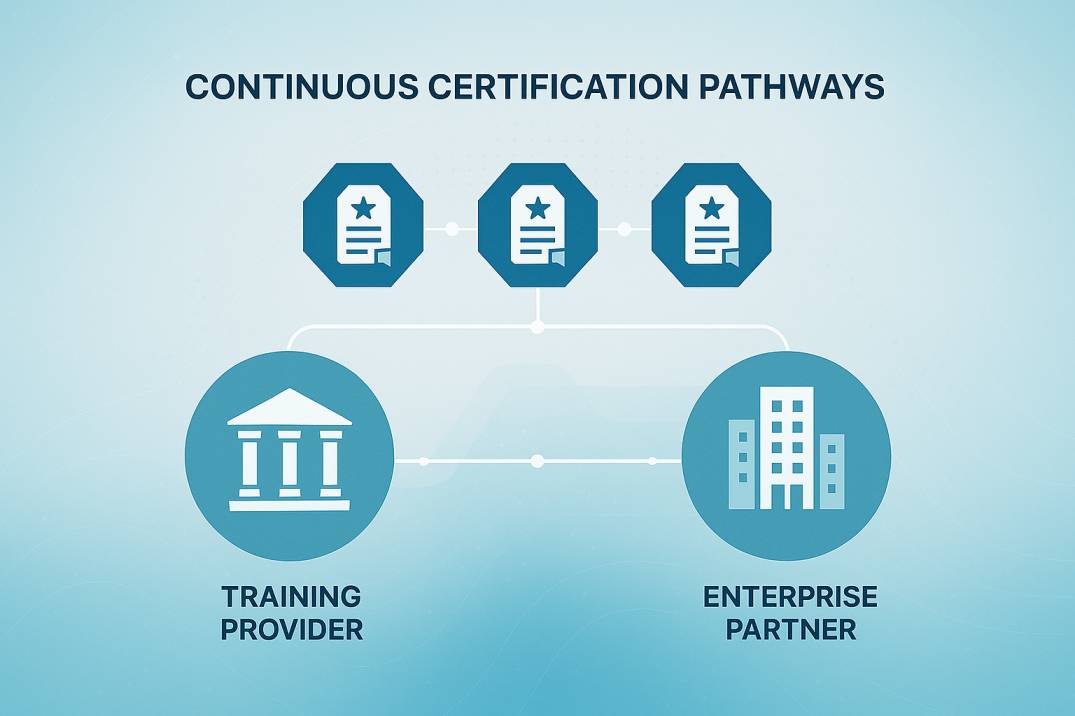
FEATURED
Can Training Providers Support Lifelong Learning?
February 19, 2026
FEATURED
The Top 5 AI Training Questions Training Leaders Are Asking in 2026 (And How Partnerships Provide Answers)
February 19, 2026
FEATURED
UN Approves Global AI Scientific Panel: What It Means for AI Training Partnerships
February 19, 2026