Massachusetts Just Made AI Training Free — Will Enterprise Partnerships Become the New Workforce Strategy?


Massachusetts has launched a new conversation around workforce readiness after announcing a partnership with Google to offer free AI training for Massachusetts residents. The move, supported by Governor Maura Healey, places artificial intelligence skills at the center of economic planning and raises a bigger question: Will government-backed partnerships become the standard model for AI workforce development?
The Massachusetts AI training initiative gives residents access to Google’s AI learning resources, including the Grow with Google AI certificate and related digital skills training pathways. The goal is clear close the AI skills gap, prepare workers for new roles, and strengthen tech workforce competitiveness across industries.
Across the U.S., employers are searching for talent that understands AI tools, automation, and data-driven workflows. Public-private training partnerships may now be shaping the next phase of workforce strategy.
What Is the Massachusetts–Google Free AI Training Initiative?
The program announced this week focuses on AI training for residents, students, job seekers, and small business owners. Through the Google AI training program, participants gain access to foundational AI education and professional certificates at no cost.
Key highlights include:
- Free AI training for Massachusetts residents
- Access to the Google AI professional certificate pathways
- Digital skills training aimed at workforce AI training needs
- Support for career transition and AI workforce development
Governor Maura Healey described the initiative as a step toward preparing citizens for an economy shaped by AI tools and automation.
Want to bring structured AI learning into your organization?
Explore how the AI CERTs Authorized Training Partner (ATP) Program supports organizations building scalable training ecosystems with recognized certifications.
Why Are Governments Funding Free AI Training?
Why is Massachusetts offering free AI training?
States are seeing widening skill gaps. AI adoption is growing across healthcare, finance, manufacturing, education, and retail. Yet many workers lack formal AI education. Public AI education programs help reduce barriers by making AI learning resources accessible to everyone.
Who benefits from free AI training programs?
- Students preparing for future careers
- Job seekers transitioning into AI-supported roles
- Small business owners adapting to automation
- Existing employees needing digital skills training
This approach treats AI education as infrastructure, similar to broadband access or digital literacy programs.
AI Workforce Development Through Partnerships
The announcement signals more than free courses. It shows how government partnership with Google for AI training creates scale quickly.
Public institutions bring reach. Technology companies bring content. Training partners bring delivery, customization, and certification structure.
That third layer — partner-led execution — often decides whether programs succeed at enterprise scale.
Organizations looking at workforce AI training face practical challenges:
- Training thousands of employees across departments
- Aligning learning with job roles
- Measuring skill outcomes
- Connecting training with recognized credentials
This is where authorized training partner models enter the picture.
Build a scalable training model
Organizations interested in structured AI certification pathways can explore the AI CERTs ATP ecosystem and understand how to become a partner aligned with employer-ready credentials.
Will Free AI Training Replace Enterprise Learning Programs?
Short answer: no. Free AI education programs provide foundations. Enterprises still need structured learning paths linked to business outcomes.
Free programs help democratize AI education access. Enterprises need deeper training aligned with roles such as:
- AI strategy leaders
- Data analysts
- Marketing teams using AI tools
- Product and operations managers
This is where AI certification programs backed by industry standards matter. Employers look for skills that translate into measurable performance.
Partner-led ecosystems such as the AI CERTs Authorized Training Partner (ATP) Program give organizations a way to deliver learning at scale while keeping quality consistent.
AI Skills Gap: What the Numbers Suggest
Multiple workforce reports show strong demand for AI capabilities:
- LinkedIn’s global skills data has repeatedly listed AI literacy among the fastest-growing skills categories.
- Employers report challenges finding candidates with practical AI knowledge.
- Digital transformation spending continues to rise, increasing demand for AI workforce development programs.
The Massachusetts AI training initiative addresses these concerns by opening access to AI education through Grow with Google pathways.
Yet access alone does not solve the full problem. Companies need structured implementation — training schedules, assessment frameworks, and certifications that hiring managers recognize.
Are Free AI Certificates Enough to Get a Job?
Free certificates help people start. Hiring decisions depend on proof of applied skills and recognized credentials.
Employers often ask:
- Has the learner completed role-based training?
- Can the employee apply AI tools in real workflows?
- Is the certification aligned with industry needs?
That’s why many organizations combine public AI education programs with partner-led certification ecosystems.
Looking for recognized credential pathways?
Explore AI CERTs partner models that connect training providers, academic institutions, and associations with industry-focused AI certification programs.
Enterprise Strategy: Why Partner-Led Models Are Growing
As AI adoption spreads, companies are shifting from one-time workshops to ongoing AI upskilling programs. Partner-led ecosystems offer several advantages:
- Standardized curriculum delivery
- Certified instructors
- Scalable training across locations
- Alignment with employer skill frameworks
This mirrors how large cloud certification ecosystems grew over the past decade. AI training is following a similar path.
Organizations exploring this direction often consider:
- Authorized Training Partner programs for professional learning
- Academic partnerships for student pipelines
- Association partnerships for industry-wide skill building
- Affiliate partnerships for awareness and reach
Each layer supports a broader AI education program that connects learners with real opportunities.
What Happens Next? The Future of AI Training for Residents and Enterprises
The Massachusetts–Google initiative may mark a turning point. Governments are entering the AI education space with funding and public access. Enterprises are searching for scalable workforce AI training models. Training partners bridge the gap between both worlds.
Expect to see:
- More state-funded AI training programs
- Public-private collaborations focused on AI workforce development
- Growth in AI professional certificate training programs
- Rising demand for partner-led training ecosystems
Ready to scale AI learning?
Organizations, training companies, and educational institutions can explore how to become a partner through AI CERTs programs:
These models help connect AI education with employer expectations and measurable workforce outcomes.
Final Thought
Free AI training for Massachusetts residents sends a strong signal: AI literacy is becoming a public priority. Yet large-scale workforce transformation needs more than access. It requires structured delivery, recognized credentials, and scalable partnerships.
As governments launch public AI education programs and enterprises seek faster upskilling paths, partner-led ecosystems may become the new standard for workforce AI training connecting policy, education, and industry into one coordinated strategy.
Recent Blogs

FEATURED
New Research on Occupational AI Training Models — Are Companies Training the Wrong AI Roles?
February 27, 2026
FEATURED
Fortune Reports AI Market Shakeups — Are Companies Accelerating Employee AI Training to Stay Competitive?
February 27, 2026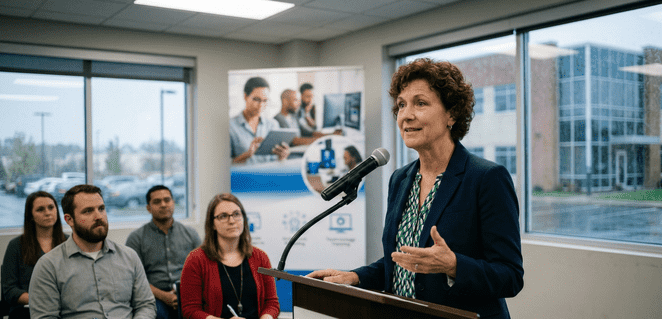
FEATURED
Walmart Leadership Says Workforce Upskilling Is Critical — What This Means for AI Training Programs
February 27, 2026
FEATURED
Are Training Partnerships Replacing Traditional L&D?
February 27, 2026
FEATURED
The New AI Partnership Question: Who Owns Workforce Readiness?
February 26, 2026