The Rise of “Human-AI Symbiosis” and Lessons for Partners


A quiet signal is moving through boardrooms and delivery teams.
New research from Cambridge University and NASSCOM shows that teams working with AI are often judged as less creative by peers and leadership—unless they follow deliberate collaboration designs that place humans and AI in clearly defined roles.
That finding reframes a growing concern. The issue is no longer whether AI speeds up output. The real question is whether organizations are structuring teams so AI improves thinking quality, decision confidence, and creative credibility.
The question leaders are now asking
How do we restructure teams for Human-AI Symbiosis, where AI brings precision at scale and humans bring judgment shaped by experience?
The companies gaining ground in 2026 treat AI as a participant in collaboration, with accountability boundaries, review loops, and shared ownership. Those who reduce AI to a background assistant often see trust drop—both inside teams and in external perception.
Human-AI Symbiosis: A Design Problem, Not a Tool Problem
The Cambridge–NASSCOM study observed that AI-supported teams regain creative trust when three conditions are present:
- Humans make final calls and explain reasoning
- AI outputs are reviewed openly, not quietly pasted in
- Teams receive structured training on how AI fits into workflows
Without these, AI creates speed without confidence.
This aligns with broader workforce data. According to Deloitte’s 2024 Human Capital Trends, 62% of workers say their biggest concern is becoming less valuable as automation grows, not job loss itself.
Training design beyond technology access is the protective factor.
Organizations building AI-ready teams are moving through partner-led training models like the AI CERTs Authorized Training Partner (ATP) framework, which formalizes role clarity and skill validation.
Can Training Partnerships Mitigate Job Displacement Concerns?
Yes, and the evidence is measurable.
The World Economic Forum’s Future of Jobs Report 2025 states that 44% of workers’ skills will shift by 2028, yet companies with structured reskilling programs report higher internal mobility and lower attrition.
Training partnerships reduce anxiety by doing three things:
- They signal long-term investment in people
- They provide external skill validation, not internal promises
- They create visible pathways from role A to role B
IBM reported that roles filled internally after AI training programs cost 40% less than external hiring and reached productivity targets faster.
Workers trust training more when credentials carry market weight. That is why certification ecosystems tied to industry partners, universities, and associations outperform one-off workshops.
The AI CERTs Authorized Academic Partner model allows institutions to align degrees and short programs with real enterprise demand.
How Should Institutions and Companies Collaborate to Reskill Workers at Scale?
Human-AI Symbiosis cannot sit with enterprises alone. The most resilient models link institutions, employers, and policy bodies with shared metrics.
What works in practice
1. Institutions provide curriculum speed
Universities and training bodies update modules faster through industry-validated certification tracks. According to UNESCO, academic programs tied to industry credentials see 30% higher graduate employability within six months.
2. Enterprises define role-based demand
Rather than broad “AI literacy,” firms specify roles—AI product owner, data translator, governance lead, each with skill proof.
3. Governments align incentives
Singapore’s SkillsFuture initiative shows how public funding linked to certified outcomes increases completion and redeployment rates.
Together, these structures turn reskilling from theory into workforce movement.
Industry bodies working with AI CERTs use the Association Partner model to standardize skill signals across sectors.
Treating AI as a Collaboration Participant
The reframe matters. AI should help teams think better, not hide human thinking behind speed.
Microsoft’s 2024 Work Trend Index found that teams who explain AI-supported decisions build higher trust with customers and regulators than teams who keep AI invisible.
This requires:
- Clear ownership of decisions
- Transparent AI usage policies
- Training that includes ethics, review, and accountability
That is where partner ecosystems outperform isolated adoption.
Lessons for Partners Building the 2026 Workforce
Partners—training providers, universities, associations, and affiliates—are shaping how Human-AI Symbiosis lands in real teams.
The most effective partners share three traits:
- Outcome tracking beyond completion rates
- Employer-aligned certification pathways
- Ongoing faculty and trainer upskilling
According to McKinsey, organizations linking learning outcomes to business KPIs are 2.4× more likely to scale AI use beyond pilots.
The AI CERTs Affiliate Partner model supports organizations that want reach, relevance, and measurable workforce impact.
Where This Leaves Leaders
Human-AI Symbiosis is not a culture slogan. It is a design choice—about who decides, who reviews, and who learns.
Teams gain credibility when humans stay visible in judgment and AI stays visible in contribution. Training partnerships turn that balance into repeatable practice.
The companies winning trust in 2026 are not faster because of AI. They are clearer, about roles, skills, and accountability.
That clarity starts with how partners build the workforce.
Recent Blogs

FEATURED
The 2026 “Audit-Ready” Deadline and AI Trust Marks for Partners
February 10, 2026
FEATURED
Moving Beyond “Vanity ROI” and Getting Actual Outcomes with Partnership
February 10, 2026
FEATURED
Who Is Accountable When an Autonomous “Agentic Workflow” Fails?
February 10, 2026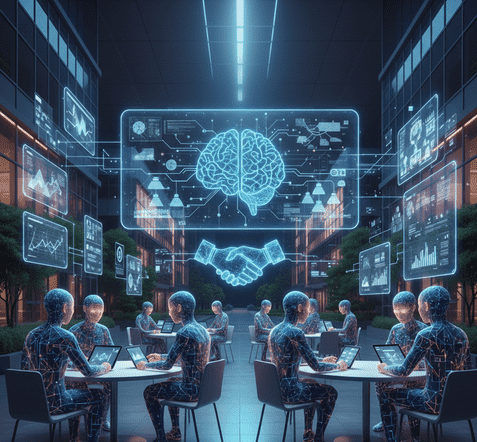
FEATURED
Competency-Driven AI Education: A Framework for Institutional Training Partnerships
February 10, 2026
FEATURED
Why Europe’s AI Training Gap Means New Collaboration Models for Universities & Corporates
February 10, 2026