

AI CERTs
2 months ago
Toto’s Stock Soars on AI Chip Materials Boom
Tokyo traders did a double take when shares of Toto jumped 11% on 22 January 2026. However, the surprise rally had little to do with smart bidets. Investors instead focused on Toto’s hidden revenue engine: electrostatic chucks used in chip fabrication. These ceramic platforms grip wafers during plasma processing. Moreover, demand is soaring as cloud giants expand AI data centers. Jensen Huang recently called the buildout “the single largest infrastructure project in history.” Therefore, every layer of hardware supply is under scrutiny. Toto’s expertise in AI chip materials suddenly looks strategic. In this article we unpack the rally, the technology, and the competitive landscape.
Core Stock Surge Drivers
Market commentary links the jump to a Goldman Sachs upgrade and tight memory supply. Furthermore, Bloomberg data shows Toto’s semiconductor segment delivered 42% of operating income in fiscal 2025. That concentration impressed growth investors seeking pure plays on fabrication tooling. Additionally, the share move marked the largest one-day gain in five years. Analysts argue AI chip materials have shifted Toto’s valuation narrative. With memory makers SK Hynix and Samsung ramping capacity, electrostatic chuck orders strengthen backlog. Nevertheless, revenue still depends on a cyclical customer base.
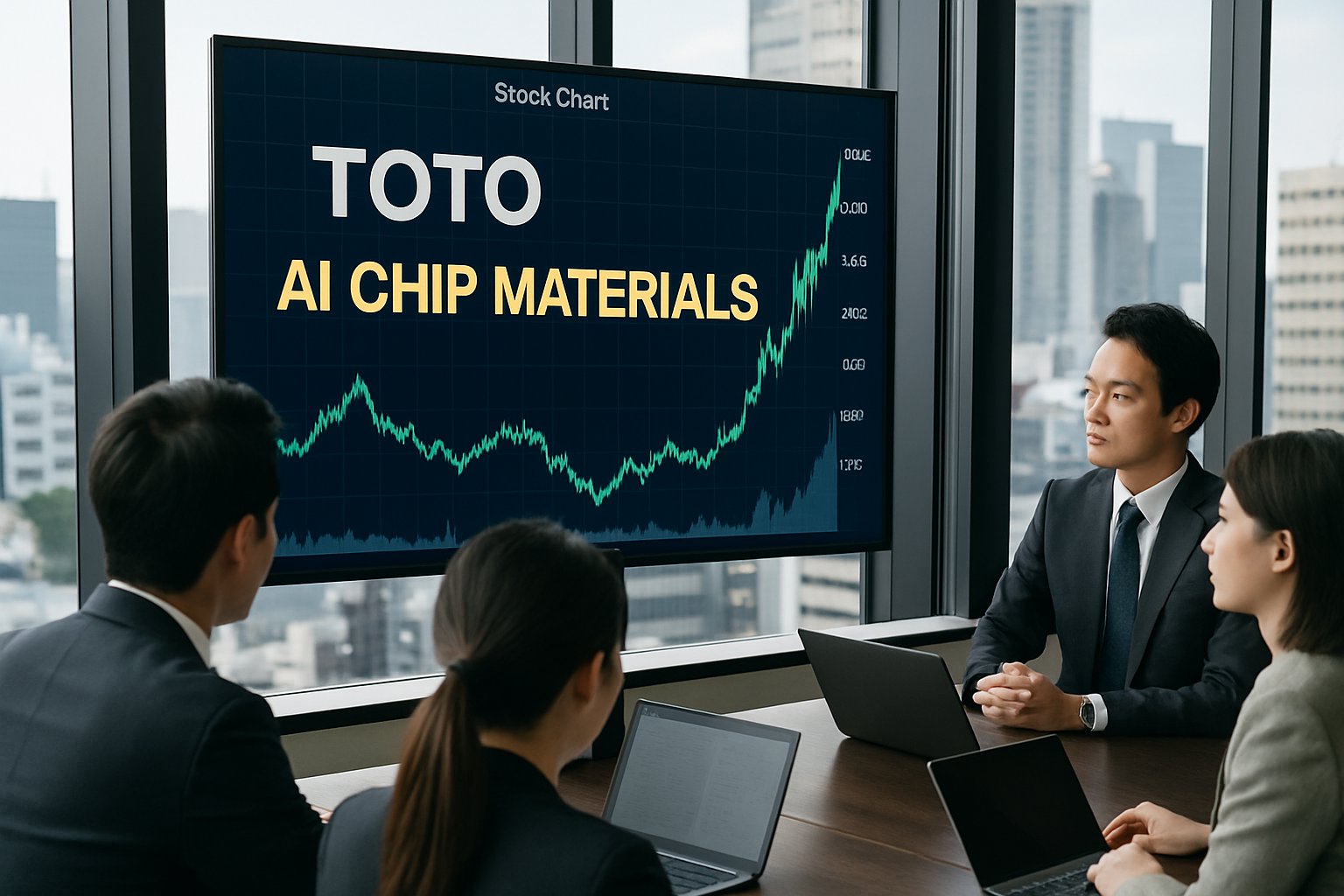
- Intraday gain: 11% on 22 January 2026
- Semiconductor segment: 42% of FY2025 operating income
- Electrostatic chuck market: projected USD 2.2 billion in 2026
- Peer suppliers: Shin-Etsu, NGK, NTK Ceratec
- Investor spotlight on AI chip materials
These figures highlight the dramatic earnings leverage within Toto’s ceramic portfolio. Investors now price Toto as a precision component specialist. Consequently, understanding the underlying technology becomes essential.
Inside Electrostatic Chuck Technology
An electrostatic chuck uses electric fields to clamp silicon wafers during etch, deposition, or thermal steps. Moreover, Toto integrates heaters and cooling channels to keep temperatures uniform. The company’s fine ceramics provide insulation while dissipating heat efficiently. In contrast, metal plates would short the high-voltage electrodes. Importantly, each surface must release few particles to avoid yield loss. Toto began mass production in 1988 and now offers 450 mm compatibility. Such lineage gives customers confidence that AI chip materials meet strict tool qualifications.
This architecture explains why ceramics command premium pricing. Reliable clamping improves throughput and yield for memory fabs. Subsequently, material choice becomes a competitive moat that we explore next.
Ceramics Offer Competitive Edge
Advanced ceramics combine high thermal conductivity, electrical insulation, and plasma resistance in one lattice. Furthermore, Toto’s dielectric formulations resist cracking despite repeated thermal cycling. That durability reduces downtime for tool maintenance. Memory producers therefore favor suppliers with proven ceramic expertise. AI chip materials with these traits shorten process qualification time and save capital. Nevertheless, ceramics remain costly and brittle, raising barriers for new entrants.
Fine ceramics clearly differentiate Toto from many household rivals that lack industrial R&D. The resulting margins exceed restroom fixture returns. Consequently, demand trends in artificial intelligence now take center stage.
AI Infrastructure Fuels Demand
Generative models drive unprecedented server deployments across every hyperscaler. Additionally, each GPU cluster requires vast pools of high-bandwidth memory. That expansion ripples back through the semiconductor supply chain, lifting tool, chemical, and component suppliers. Jensen Huang framed the momentum by citing trillion-dollar infrastructure needs. Therefore, memory makers are accelerating fab expansions in Korea, Japan, and the United States. Every new chamber shipped needs electrostatic chucks built from AI chip materials.
Spending plans from Samsung, SK Hynix, and Kioxia already exceed pre-pandemic peaks. Toto’s order pipeline should track those capital budgets. Consequently, investors must weigh upside against known cyclical risks.
Risks Temper Bullish Outlook
Memory markets swing violently with consumer demand and data-center utilization. Moreover, an economic slowdown could delay node migrations and equipment orders. In contrast, new entrants such as NGK Insulators compete aggressively on price. Qualification cycles also stretch 12-24 months, limiting rapid supplier switches. Any stumble converting AI chip materials into high-volume ESCs could erode share. Nevertheless, Toto’s patents and long client list mitigate some pressure.
Volatility across the semiconductor supply chain injects uncertainty into otherwise strong forecasts. Strategic hedging remains necessary for management and investors. Subsequently, a broader ecosystem view clarifies relative resilience.
Impact On Broader Ecosystem
Japan hosts many niche champions that quietly anchor the semiconductor supply chain. Ajinomoto builds substrate materials, while Shin-Etsu supplies wafers and chucks. Furthermore, the Ministry of Economy supports these firms through tax credits and R&D grants. The Toto surge thus signals renewed confidence in national manufacturing policy. Additionally, tighter Western restrictions on Chinese fabs may reroute orders toward Japanese vendors. AI chip materials companies across the archipelago could benefit.
Ecosystem dynamics suggest upside extends beyond a single ticker. Supply resilience depends on cross-company collaboration and talent development. Therefore, professionals should consider personal strategies to capitalize on these trends.
Strategic Moves For Professionals
Engineers and managers can deepen domain insight through targeted credentials. Professionals can enhance their expertise with the AI+ Researcher™ certification. Moreover, supply-chain analysts should monitor inventory swings, capital expenditure cycles, and competitor roadmaps. Building fluency in AI chip materials lets experts advise procurement teams on risk mitigation. Meanwhile, staying informed about semiconductor supply chain policy shifts helps anticipate sudden demand pivots.
- Track quarterly memory capital expenditure announcements.
- Compare electrostatic chuck qualification timelines across suppliers.
- Evaluate currency hedges against yen volatility.
Proactive learning and data tracking sharpen competitive positioning. Credentials and market vigilance convert news into actionable advantage. Consequently, we close with key reminders and next steps.
AI infrastructure spending is lifting demand for electrostatic chucks, fine ceramics, and other AI chip materials. Toto’s 11% rally underscores how quickly hidden industrial assets can reshape valuations. Nevertheless, cyclical memory markets and focused competition warrant disciplined analysis. Furthermore, national policy and supply-chain geopolitics add complexity that savvy professionals must track. By pairing continuous market monitoring with recognized credentials, readers can capture upside while guarding against volatility. Explore additional resources and certifications to stay ahead in this fast-moving arena.


