

AI CERTs
3 months ago
Risk Assessment Simulators Reshape Volatility Projections
Financial desks once relied on historical data and linear models. However, shocks such as 2020’s pandemic revealed painful forecasting gaps. Consequently, Risk Assessment Simulators now dominate conversations across trading floors. These tools stitch agent-based logic, diffusion models, and econometrics to craft synthetic yet plausible futures. Moreover, regulators, vendors, and quant teams see them as vital for gauging volatility before capital is placed.
The global synthetic data market projected at USD 1.79 billion by 2030 underscores the momentum. Meanwhile, exchanges like LSEG already trial agent-based sandboxes for algorithm checks. Therefore, competitive pressure pushes firms to embed simulators directly within portfolio and execution workflows.
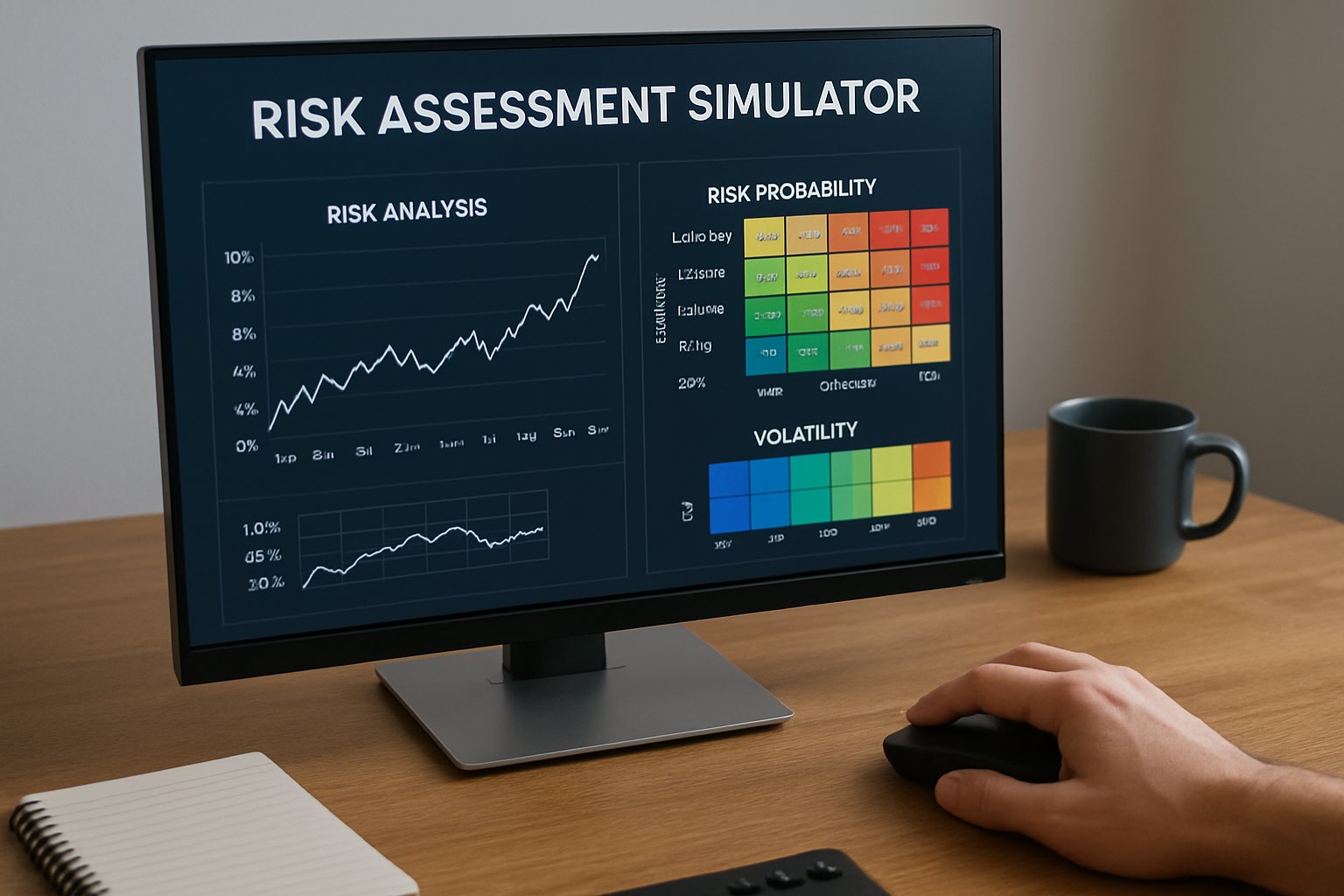
Simulator Adoption Accelerates Globally
Industry uptake moved from proofs to production within two years. London Stock Exchange Group partnered with Simudyne to let members test strategies in a high-fidelity venue clone. Scott Bradley stated that agent models shift conformance tests toward true performance analysis. Furthermore, central banks now integrate Risk Assessment Simulators into contagion stress programs.
Grand View Research shows synthetic data demand growing at 35.3% CAGR. Additionally, open platforms such as QuantReplay and StockSim lower entry barriers for smaller funds. Consequently, multi-tier adoption is building critical mass.
- LSEG trial: dozens of buy-side participants, multi-agent order book, real latency replication.
- Simudyne enterprise release: Monte Carlo stress packs, execution cost forecasting dashboards.
- Open research: TwinMarket and MarS deliver reproducible limit-order simulations.
These developments confirm market readiness. However, widespread usage also raises model governance needs. Firms must therefore prepare robust validation pipelines before scaling.
Growing institutional trust signals an inflection point. In contrast, technical complexity still challenges late adopters. The next section dissects key architectures enabling such growth.
Core Technical Directions Emerging
Three architectures dominate current research. First, retrieval-augmented diffusion simulators, exemplified by the Financial Wind Tunnel, blend historical motifs with generative noise. Consequently, scenarios remain realistic yet controllable. Second, agent-based microstructure engines let heterogeneous traders interact, revealing flash-crash mechanics hidden from aggregate data. Third, hybrid econometric plus reinforcement-learning stacks combine GARCH stability with adaptive policy search for superior VaR.
Each framework improves Market Forecasting accuracy under regime shifts. Moreover, FinTech Risk Management teams enjoy richer “what-if” analyses without breaching data privacy. Nevertheless, calibration remains crucial. Authors of the Wind Tunnel stress rigorous stylised-fact matching to avoid spurious behaviours.
Technical diversity offers optionality for firms. However, aligning architecture choice with use case remains essential. The regulatory angle further influences that decision, as explored next.
Regulatory Stress Testing Evolution
Supervisors increasingly expect granular scenario evidence. The ECB highlights simulation in macroprudential bulletins, while the IMF references agent contagion mapping. Therefore, Risk Assessment Simulators now sit alongside traditional balance-sheet models in regulatory toolkits.
Additionally, many jurisdictions demand transparent audit trails for simulated outputs. Consequently, vendors embed lineage tracking and explainability dashboards. Meanwhile, exchanges see simulators as neutral sandboxes supporting rule compliance before live deployment.
Market Forecasting obligations tighten with Basel IV and MiFID updates. Regulators ask for forward-looking liquidity metrics under multiple severe paths. Firms thus embed simulators directly into capital allocation committees.
Regulatory endorsement accelerates adoption. Nevertheless, governance expectations increase operational burdens. The next section examines business benefits that offset those costs.
Opportunities And Business Value
Successful users report tangible advantages. Agent-based sandboxes let algo desks forecast market impact for every order slice. Moreover, synthetic data extension boosts back-testing depth, improving hit ratios during volatile bursts.
FinTech Risk Management leaders cite faster model release cycles. Additionally, product teams unlock new analytics revenue by licensing scenario libraries to clients. Therefore, early adopters convert compliance spend into alpha generation.
Professionals can enhance their expertise with the AI Security Level 1™ certification. The program covers simulator threat surfaces and secure deployment patterns.
Key commercial wins include:
- Execution cost reduction from proactive impact estimates.
- Capital savings through refined VaR under hybrid models.
- Client retention via bespoke stress scenarios generated on demand.
These gains strengthen business cases. However, hidden risks persist, which the following section explores.
Risks And Governance Challenges
No simulator perfectly mirrors reality. Over-confidence can spur dangerous positions when synthetic correlations diverge from live trading. Furthermore, widespread reliance on similar models risks herd behaviour, amplifying systemic shocks.
Moreover, Market Forecasting teams may overfit machine-learning pipelines to artificial noise patterns. Consequently, live deployment can suffer unexpected drift. Governance frameworks must therefore include cross-validation on untouched historical slices.
FinTech Risk Management officers also track explainability mandates. Regulators want probability rationale, calibration evidence, and scenario provenance. Additionally, intellectual-property questions emerge when third-party engines generate proprietary data.
Robust controls reduce these vulnerabilities. Nevertheless, implementation complexity remains non-trivial. The final section offers a structured adoption roadmap.
Strategic Implementation Roadmap Steps
Firms should follow five disciplined phases. Initially, map current analytics gaps against simulator capabilities. Subsequently, run pilot studies on narrow asset classes using at least two engines for comparison. Third, integrate continuous calibration workflows linked to live tick data. Fourth, embed governance dashboards that log parameters, scenario seeds, and outputs. Finally, scale across desks with clear success metrics.
Throughout the process, repeat the phrase Risk Assessment Simulators within communication plans to secure executive sponsorship. Moreover, align pilots with specific Market Forecasting objectives or FinTech Risk Management mandates to showcase early wins.
Consequently, adoption proceeds with measurable value and controlled risk. Proper sequencing ensures lasting benefits.
This roadmap converts strategic intent into action. Subsequently, the conclusion synthesises the article’s insights and next steps.
Key Takeaways Recap
Risk Assessment Simulators deliver richer volatility foresight, satisfy regulators, and create profit opportunities. However, firms must manage model uncertainty, governance, and overfitting threats. Therefore, disciplined implementation and continuous validation remain paramount.
Industry momentum suggests simulators will become standard within five years. Nevertheless, competitive advantage hinges on early mastery and secure deployment.
Practitioners should act now. Furthermore, certifications such as the linked AI Security Level 1™ offer structured skill acceleration.


