

AI CERTs
2 hours ago
Nvidia Dominance Decay: China’s 41% Chip Leap
Chinese GPU vendors just scored a headline-making win. IDC data reviewed by Reuters shows they seized 41% of domestic accelerator shipments during 2025. Meanwhile, Nvidia’s local unit share slipped to about 55%, despite sustained global leadership. Analysts frame the trend as early evidence of Nvidia Dominance Decay within China’s booming AI infrastructure market. Consequently, investors and policymakers are reassessing competitive timelines, supply chain resilience, and strategic exposure. This article dissects the numbers, drivers, and implications shaping the fast evolving landscape. Furthermore, we highlight certification paths that equip professionals for the next semiconductor cycle. In contrast, western suppliers face tightening export controls that complicate roadmap planning. Moreover, Chinese cloud providers are doubling capital expenditure to secure capacity ahead of possible sanctions. Therefore, understanding the current Market Share Shift remains mission-critical for technology leaders worldwide. Bernstein projects domestic accelerator suppliers could command 55% of Chinese demand by 2027 under base assumptions. Such forecasts intensify debate over Geopolitical Chip Wars and long-term innovation leadership.
China Chip Market Surge
IDC counted roughly 4.0 million AI accelerator cards shipped inside China during 2025. Domestic vendors delivered 1.65 million units, equal to 41% of volume. However, Nvidia still shipped about 2.2 million cards, preserving the top spot. AMD trailed with just 160,000 units, securing 4% share. Consequently, cumulative foreign share fell below 60% for the first time.
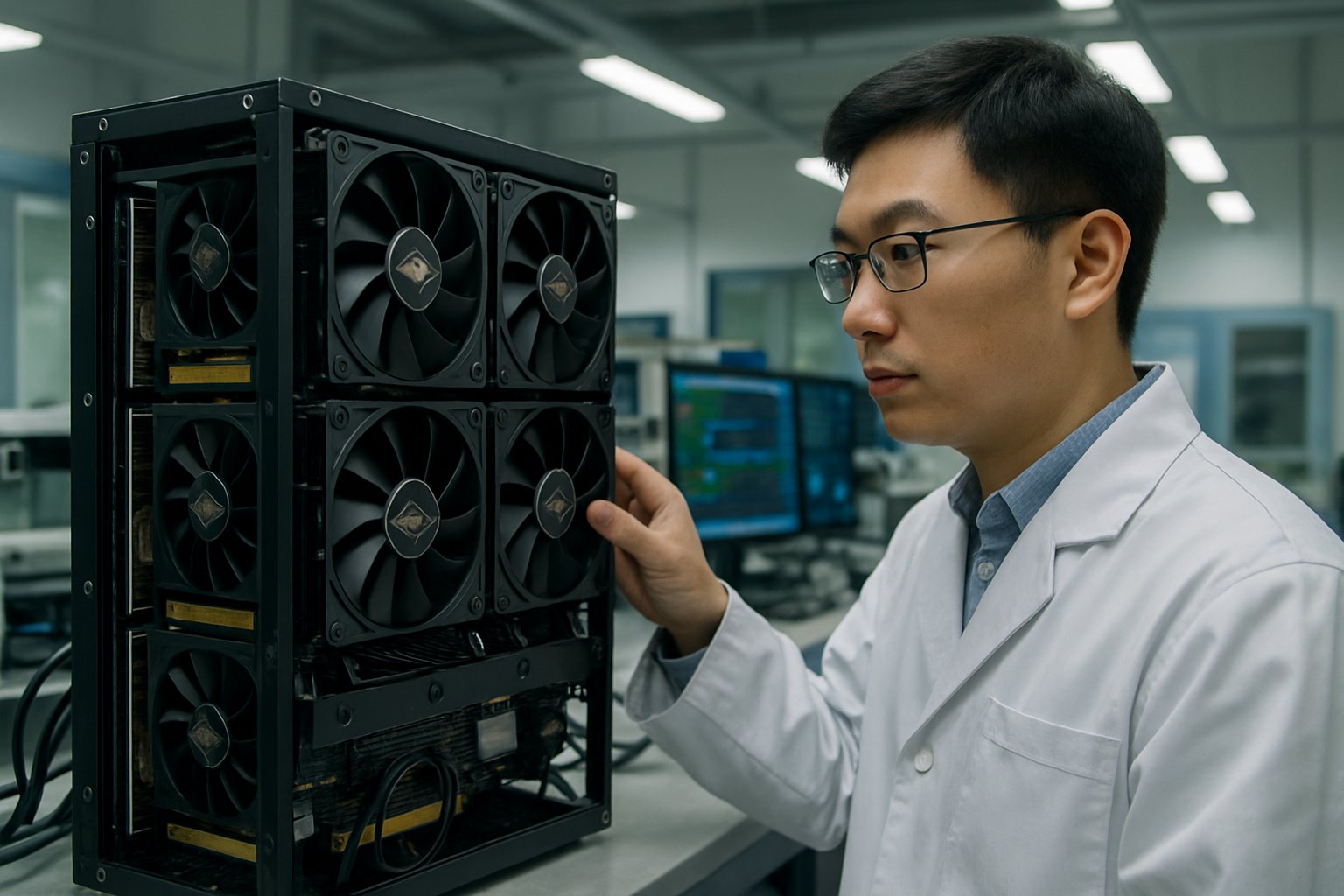
Huawei led the domestic pack with 812,000 shipments, or one-fifth of China’s total. Alibaba T-Head followed, while Baidu Kunlunxin and Cambricon split the third rung. Other challengers, including Hygon and Iluvatar CoreX, captured single-digit slices.
Collectively, these numbers confirm a dramatic Local Accelerator Servers boom. Domestic silicon signals ongoing Nvidia Dominance Decay. Next, we examine the policy levers driving that acceleration.
Drivers Behind Share Gains
Export controls remain the most cited catalyst. Since October 2022, Washington has restricted shipments of Nvidia A100 equivalents and advanced lithography tools. Consequently, Chinese buyers intensified procurement of homegrown alternatives to avoid schedule risk. Moreover, Beijing’s digital infrastructure program awards subsidies only when systems contain verified domestic chips. Local governments echo the directive inside cloud procurement tenders.
Meanwhile, domestic fabs improved 7-nanometer yields, enabling larger production runs. In contrast, CoWoS capacity shortages hampered imported GPU assembly throughout 2025. Therefore, data centers chased immediately available boards, even if performance lagged.
Policy carrots and supply hurdles jointly accelerated the Market Share Shift. These forces accelerate Nvidia Dominance Decay across critical segments. The financial impact on Nvidia now deserves closer inspection.
Impact On Nvidia Revenues
Nvidia booked nearly $10 billion in China data-center revenue during fiscal 2024. However, unit share erosion underpins Nvidia Dominance Decay in its largest international market. Bernstein estimates each lost percentage point equals roughly $180 million of annual sales. Therefore, a 14-point decline from 69% in 2023 to 55% in 2025 risks $2.5 billion. Additionally, margin dilution arises when China-specific products sell at lower average selling prices. Meanwhile, engineering costs rise because Nvidia must design downgraded China-specific SKUs to comply with controls.
Nevertheless, company executives stress that China remains strategic. Management argues software stack superiority offsets hardware parity concerns. Additionally, global demand for GenAI clusters still outstrips supply, cushioning near-term revenue pressures.
Still, the narrative of Nvidia Dominance Decay is gathering momentum among analysts. Financial forecasts now embed wider domestic substitution assumptions. Understanding domestic performance gaps will clarify whether substitution endures.
Domestic Vendor Performance Gap
Huawei’s latest Ascend 910B claims 320 TFLOPS of FP16 throughput. In contrast, Nvidia’s H200 tops 400 TFLOPS at comparable precision. Moreover, CUDA’s mature ecosystem still dwarfs Ascend’s MindSpore tooling. Software portability remains a critical barrier for multinational developers. Nevertheless, domestic chips achieve parity on specific inference workloads where memory bandwidth dominates.
Cambricon’s MLU370 series touts energy efficiency advantages over A30 class GPUs. Additionally, Alibaba integrates T-Head Yitian chips tightly with its proprietary cloud stack. Such vertical integration lowers total cost for Local Accelerator Servers at hyperscale.
Performance parity is uneven and workload dependent. Yet acceptable gaps suffice for budget sensitive buyers. Hardware alone cannot decide outcomes without reliable Supply Chain support.
Supply Chain Constraints Persist
High Bandwidth Memory remains scarce despite aggressive procurement from Samsung and SK Hynix. Consequently, both domestic and foreign accelerator roadmaps encounter packaging bottlenecks. Furthermore, advanced substrate suppliers operate at near full utilization. Local OSAT houses are scaling, yet equipment delivery times stretch beyond 12 months.
Meanwhile, U.S. allies consider broader restrictions on lithography service contracts for Chinese foundries. Such geopolitical uncertainty adds inventory risk across the Supply Chain. Therefore, many cloud operators now dual-source accelerator designs to hedge.
Persistent bottlenecks could slow the Market Share Shift if domestic fabs cannot secure tooling. Yet shortages also intensify Nvidia Dominance Decay by threatening production cadence. Scenario forecasts illustrate possible trajectories under these constraints.
Forecasts And Strategic Paths
Bernstein’s base case sees localization reaching 55% of Chinese units by 2027. However, an upside scenario hits 65% if export controls tighten further. In contrast, easing regulations could cap localization at 45%. Consequently, flexibility around procurement and design partnerships is now vital.
- Develop cross-platform software to reduce switching friction.
- Negotiate long-term HBM supply agreements before broader shortages emerge.
- Invest in Local Accelerator Servers testing labs for rapid benchmarking.
- Monitor Geopolitical Chip Wars decisions shaping tariff and license timelines.
- Secure multi-node logistics routes to anticipate Supply Chain shocks.
These strategies help enterprises navigate Nvidia Dominance Decay while safeguarding growth. Professionals now need updated skills to implement such plans effectively. Relevant certifications address that capability gap.
Bernstein also models capital expenditure rising 38% CAGR through 2027 to fund these pathways. Furthermore, private equity is channeling billions into packaging startups targeting CoWoS alternatives. Consequently, capital allocation decisions will either slow or accelerate Nvidia Dominance Decay.
Certification Pathways For Professionals
Cyber risk grows as accelerator deployments proliferate across regulated industries. Consequently, security specialists must understand threat models unique to AI silicon. Professionals can enhance expertise with the AI Security Level-1 certification. Moreover, the program covers compliance frameworks impacted by Geopolitical Chip Wars policy shifts. Additionally, modules examine Supply Chain auditing for Local Accelerator Servers.
Upskilled teams execute resilient architectures despite Nvidia Dominance Decay effects. Therefore, certifications provide competitive differentiation during hiring cycles.
China’s accelerator market is tilting faster than many expected. Domestic vendors already own 41% of shipments, pressuring incumbent economics. Meanwhile, Nvidia Dominance Decay headlines spark global reflection on resilience. However, performance gaps, Supply Chain snarls, and policy swings leave the final outcome open. Consequently, strategic agility and informed talent will decide winners. Pursue the linked certification today and equip your team for the next Market Share Shift. Stay ahead while the Geopolitical Chip Wars continue reshaping technology’s future.


