

AI CERTS
2 hours ago
MIT Wristband Boosts Robot Learning Systems
However, current camera methods struggle with occlusion and limited resolution. The wristband bypasses such issues by imaging muscles and tendons from inside the wrist. Furthermore, an AI model decodes that feed into 22 joint angles within 120 milliseconds. Early results hint at transformative applications for housework robots, surgical robotics, and immersive VR. Moreover, wearable sensors promise a privacy-friendly path because no external cameras record surroundings. The following report examines the technology, benefits, gaps, and commercial horizon.
Ultrasound Wristband Technology Breakthrough
At the core sits a flexible ultrasound array tucked into a chunky wristwatch shell. Meanwhile, tiny batteries and a Bluetooth module keep the prototype fully wireless during trials. Researchers used standard wearable sensors design practices to ensure safe acoustic exposure. Additionally, the transducer captures cross-sectional images of muscles and tendons at 15 frames per second. A supervised neural network then maps each frame to 22 precise degrees of freedom. Consequently, users can flex, extend, or pinch, and the model outputs corresponding joint angles instantly.
Latency remains under 120 milliseconds, meeting industrial teleoperation requirements. Nevertheless, the demo involved only eight volunteers, each needing personal calibration sessions. These engineering details underline a leap in internal sensing fidelity. However, decoding accuracy deserves a deeper look next.
Real-Time Hand Decoding
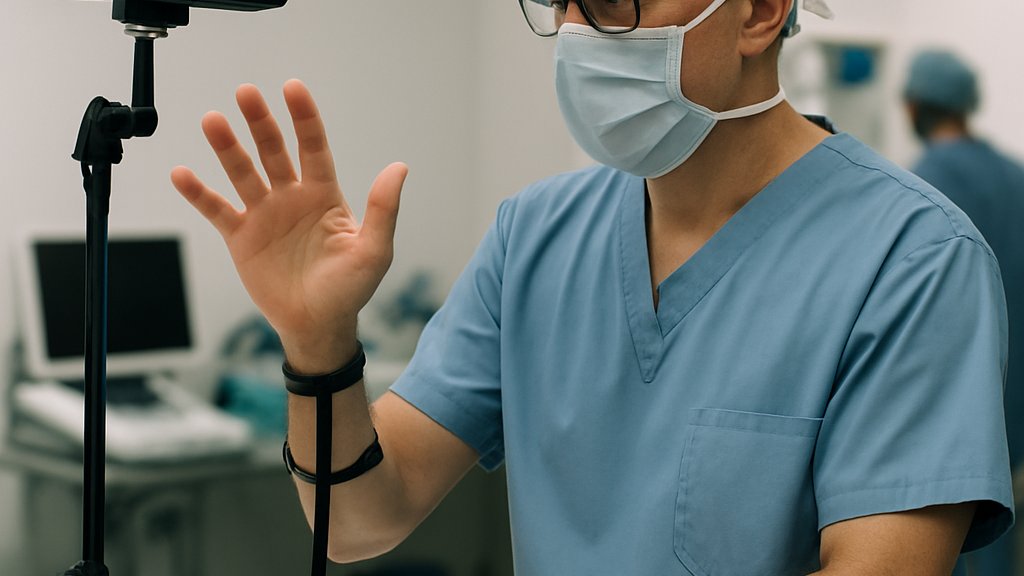
The Nature Electronics paper reports comprehensive metrics for the decoding pipeline. Furthermore, root-mean-square joint errors stayed below five degrees for most motions. In contrast, optical trackers often double that figure when fingers occlude one another. Subsequently, MIT researchers validated robustness across different band positions around the wrist.
- 22 output dimensions covering every finger joint.
- Tracking delay stayed below 120 milliseconds during tasks.
- 33 grasp types recognized, including power, pinch, and tripod.
- Eight human subjects with wrist sizes from 12.8 to 18.4 centimeters.
Consequently, the team teleoperated a commercial robotic hand to play piano and shoot mini basketballs. Moreover, sign language letters A through Z were decoded with high accuracy. These quantitative results confirm that internal imaging offers rich motion features for Robot Learning Systems. The evidence sets the stage for broader robotic training scenarios. High-fidelity decoding unlocks real-time control unseen in prior wearables. Next, we explore how this data fuels robotic skill acquisition.
Implications For Robot Training
Training dexterous manipulators has long stalled due to insufficient realistic demonstrations. Robot Learning Systems thrive when exposed to thousands of natural hand trajectories. Additionally, the wristband turns every wearer into a mobile motion capture studio. Imagine crowdsourcing dishwashing grasps or delicate housework folds during daily chores. Consequently, warehouses, kitchens, and elder-care centers could supply domain specific data for imitation learning. Moreover, recorded trajectories feed reinforcement algorithms that refine grip strength and collision avoidance.
The approach aligns with MIT projects that build shared autonomy controllers for collaborative robots. In contrast, glove-based wearable sensors often require tethered power, limiting natural movements. Subsequently, large datasets could accelerate surgical robotics where complex bimanual suturing still challenges automation. Therefore, hospitals may record surgeon gestures for Robot Learning Systems without obstructive cameras. These possibilities extend lab prototypes into everyday environments. However, limitations around personalization remain, as the following section explains.
Limitations And Open Questions
Despite impressive demos, several hurdles must be cleared before mainstream deployment. First, the published study involved only eight participants with per-user calibration. Consequently, generalization across different skin tones or pathologies remains unproven. Secondly, long-term comfort and battery safety need extended wear trials. Moreover, continuous imaging of internal tissue raises fresh privacy and regulatory debates. In contrast, camera systems at least avoid direct physiological capture. Nevertheless, encrypted on-device inference could mitigate data leakage risks.
Subsequently, MIT filed a provisional patent, signaling commercial intent and possible licensing friction. Researchers also noted hardware miniaturization goals but shared no firm timelines. These gaps emphasize why independent validation and open benchmarks are critical next steps. However, ongoing collaboration with industry may resolve several issues quickly. Stakeholders now turn to commercialization and compliance hurdles.
Commercialization And Regulation Roadmap
Start-ups already court the research group for exclusive rights to the ultrasound design. Meanwhile, consumer giants seek reliable hand tracking for next-generation headsets, kitchens, and housework helpers. Regulators will likely treat the band as a Class II medical device if marketed for surgical robotics control. Therefore, developers must present safety data, electromagnetic compliance, and cybersecurity plans. Moreover, open sourcing datasets can build community trust while attracting Robot Learning Systems researchers. Professionals can enhance their expertise with the AI+ Robotics™ certification.
Consequently, certified practitioners will navigate regulatory submissions and algorithm audits more effectively. In contrast, hobbyists may leverage open protocols for experimental teleoperation rigs. These commercialization activities will shape standards and data governance over the next five years. Subsequently, strategic forecasts outline future research priorities. Market traction hinges on regulatory clarity and user trust. The following outlook distills emerging trends and action points.
Future Outlook And Action
Analysts expect mass-produced bands within three years, pending silicon integration success. Furthermore, large subscription platforms may distribute curated motion datasets to corporate Robot Learning Systems customers. Such libraries would accelerate imitation learning across logistics, retail, and delicate assembly. Moreover, hospitals envisage real-time coaching of surgical robotics trainees through combined haptics and visual cues. Therefore, future curriculum will integrate wearable sensors programming alongside anatomy and control theory. Consequently, universities plan capstone projects where students collect housework manipulations for domestic robots.
Government agencies also eye workforce reskilling grants focused on Robot Learning Systems development. Nevertheless, policymakers must draft privacy guardrails before massive data harvesting begins. Subsequently, standard bodies should define benchmark tasks for imitation learning reproducibility. These proactive steps will ensure ethical, inclusive, and trustworthy Robot Learning Systems. However, sustained funding and open collaboration remain essential. Industry and academia share responsibility for safe progress.
The ultrasound wristband marks a pivotal junction for advanced manipulation research. Furthermore, its internal imaging redefines data quality for Robot Learning Systems seeking humanlike dexterity. Consequently, imitation learning pipelines can absorb richer examples from everyday housework or complex surgical robotics procedures. Nevertheless, safety, privacy, and fairness must guide every deployment decision.
Therefore, stakeholders should pursue standards, certifications, and transparent benchmarks immediately. Professionals ready to lead can validate their skills through specialized courses and the linked certification. Explore emerging curricula and join the next wave of Robot Learning Systems innovation today.
Disclaimer: Some content may be AI-generated or assisted and is provided ‘as is’ for informational purposes only, without warranties of accuracy or completeness, and does not imply endorsement or affiliation.


