Meta’s Muse Spark Debut Signals Multimodal AI Shift
Consequently, product teams now test advanced multimodal features across Facebook, Instagram, WhatsApp, Messenger, and connected glasses.
Unlike previous releases, the launch arrived simultaneously in the Meta AI app and on meta.ai, giving users instant access. Meanwhile, enterprise developers gained a private-preview API, hinting at broader platform ambitions. This quick distribution could reshape expectations for consumer embedded assistants worldwide.
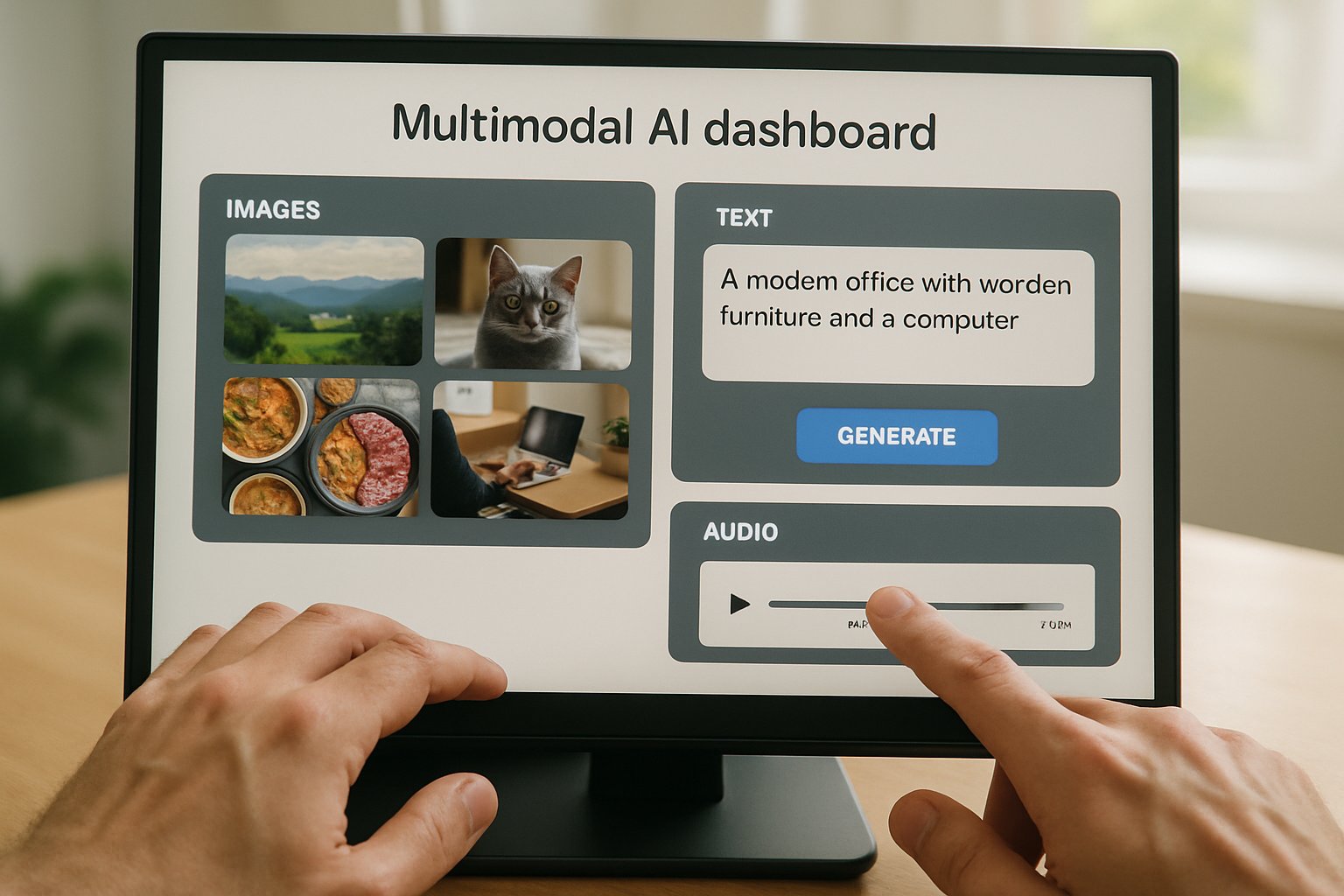
User experiments with a Multimodal AI dashboard in a realistic setting, highlighting accessibility.
Therefore, decision-makers need a clear view of the model’s strengths, limitations, and strategic trajectory. The following sections break down technical foundations, benchmark evidence, UX modes, and potential business impact. Readers will also find actionable next steps and certification resources to stay competitive.
Launch Day Highlights Report
Meta framed the debut as the first milestone on its road toward personal superintelligence. However, executives stressed that Muse Spark does not yet claim clear state-of-the-art leadership. Artificial Analysis placed the model fifth overall on its Intelligence Index v4.0. Moreover, the analyst noted the system consumed roughly 58 million output tokens during evaluation, showing unusual efficiency.
Two user-facing modes shipped immediately: Instant for quick replies and Thinking for deeper reasoning. Furthermore, the company teased a future Contemplating mode that will coordinate multiple subagents in parallel. Consequently, users should expect richer answers without linear latency growth. Early adopters experience Multimodal AI responsiveness across chat, vision, and voice in the Meta AI app.
The launch delivered speed, efficiency, and ambitious roadmaps. Nevertheless, understanding the underlying architecture clarifies why these claims matter.
Technical Foundations Explained Now
At its core, the model integrates vision and text inside a single transformer backbone. Therefore, it performs visual chain-of-thought instead of delegating perception to a detached encoder. In contrast, earlier systems stitched separate vision heads onto text generators, limiting cross-modal attention. This Multimodal AI backbone enables cross-modal attention without costly routing.
Moreover, Muse Spark employs thought compression to solve tasks with fewer internal tokens. Artificial Analysis attributes this compression to optimized intermediate representations and aggressive pruning during training. Additionally, the architecture can spawn subagents that explore solution branches concurrently before merging results.
These design choices boost multimodal flexibility while maintaining manageable serving costs. Consequently, product teams can bundle sophisticated features into resource-constrained mobile and edge devices.
The architecture fuses modalities and optimizes compute through compression and concurrency. Subsequently, benchmark numbers paint a clearer performance picture.
Benchmark Scores In Context
Artificial Analysis awarded the system a 52 on its latest Intelligence Index, trailing only four marquee peers. Meanwhile, independent hands-on testers echoed strong vision reasoning but observed mixed coding performance. In contrast, analysts emphasised that absent public weights, broader verification remains pending.
Key quantitative findings include:
52 Intelligence Index score, top five globally.
Approximately 58 million output tokens used during benchmark run.
Latency under 350 ms for Instant mode on consumer hardware.
Vision accuracy rivaling Claude Opus 4.6 on MMMU subset.
Crucially, Multimodal AI scoring put vision tasks nearly on par with leading rivals.
Moreover, the efficiency figure suggests lower cloud spend for comparable user throughput. However, the absence of long-horizon agent tasks clouds full capability assessment.
Early data confirms competitive placement and compelling efficiency signals. Therefore, examining user experience shows how those statistics translate in practice.
Product Modes And UX
Consumer testers immediately noticed distinct personalities between Instant and Thinking responses. Instant delivers concise summaries with minimal chain-of-thought exposure. Meanwhile, Thinking elaborates decisions step-by-step, offering transparent reasoning trails valuable for professionals.
Shopping demos combined camera input and text prompts to generate tailored styling suggestions in seconds. Moreover, healthcare prototypes interpreted skin images and outlined next diagnostic steps, although disclaimers urged medical confirmation. These scenarios highlight Multimodal AI advantages for time-sensitive guidance. That blend exemplifies Multimodal AI merging perception and language for immediate utility.
Developers in the private preview can query the same modes through a REST endpoint. However, capacity caps and opaque pricing still limit large-scale experimentation.
Distinct modes balance latency, transparency, and guidance quality. Consequently, leaders must weigh benefits against unresolved governance gaps.
Opportunities And Key Concerns
Enterprises can embed Multimodal AI assistants into customer workflows, boosting satisfaction and funnel conversion. For example, dynamic visual troubleshooting beats static FAQ pages. Additionally, token-efficient models trim inference costs, freeing budget for novel products.
Nevertheless, experts flag privacy implications because user data flows through social platform infrastructure. In contrast, open-weights advocates worry the proprietary pivot reduces academic scrutiny. Furthermore, benchmark coverage still lacks adversarial safety testing and deep code evaluation.
Risk-aware managers should demand clearer retention policies and independent audits. Professionals can deepen expertise through the AI+ UX Designer™ certification.
Opportunities appear significant yet paired with tangible governance risks. Subsequently, strategic roadmaps must incorporate both upside and caution.
Enterprise Impact And Next
Boards now evaluate whether Muse Spark integrations warrant immediate pilot budgets. Moreover, early adopters could secure data network effects before competitors replicate experiences. Therefore, leaders should assign cross-functional teams to test priority use cases within ninety days.
Meanwhile, the company promised broader API access, indicating potential pricing clarity within the quarter. Consequently, vendor selection committees should prepare detailed throughput and latency requirements. Additionally, they should monitor benchmark expansions, especially around coding and multi-agent reasoning.
Investors will track how many applications harness Multimodal AI efficiently at scale. In contrast, regulators will watch privacy adherence during that expansion. Sustained success will depend on robust Multimodal AI monitoring across deployments.
The next six months will reveal uptake speed and economic impact. Nevertheless, core themes already guide immediate action items.
Muse Spark arrives as a nimble contender in the crowded frontier model race. It delivers token efficiency, multi-agent orchestration, and native multimodal fluency. However, proprietary licensing and limited safety detail leave open questions for enterprises. Consequently, leaders should run controlled pilots, request transparent documentation, and track upcoming benchmark releases. Multimodal AI promises differentiated user experiences, yet disciplined governance remains essential. Explore certifications like the AI+ UX Designer™ to build in-house design expertise. Act now to translate frontier innovation into measurable business value.