

AI CERTs
4 months ago
India Education gets 500 AI-ready universities
India’s higher learning landscape stands on the brink of a hardware revolution. The Union IT Ministry plans to furnish 500 universities with GPUs, datasets, and advanced AI tools. This ambitious drive is a flagship pillar of the IndiaAI Mission, backed by a ₹10,372-crore budget. Consequently, researchers and students will gain unprecedented computational muscle without leaving campus. Meanwhile, policymakers argue the move will democratise innovation across diverse linguistic and regional contexts. The initiative also carries big implications for India Education quality, talent pipelines, and industrial competitiveness. Furthermore, officials confirmed that subsidised cloud access will complement any on-premise clusters. Therefore, institutions lacking robust data centres can still join the programme from day one. The following analysis examines policy drivers, infrastructure details, timelines, benefits, and looming challenges. Readers will also discover partnership trends and career upskilling options tied to the rollout.
Strategic Policy Vision Roadmap
IndiaAI Mission emerged in 2025 as a holistic framework for national artificial intelligence leadership. Subsequently, the compute pillar received almost 45 percent of the total mission funds, officials revealed. Ashwini Vaishnaw recently extended the mandate, promising GPUs and tools for 500 universities. Moreover, the ministry wants every engineering and science campus to experiment with large-scale models in local languages. In contrast, earlier digital programmes focused mainly on connectivity rather than compute horsepower.
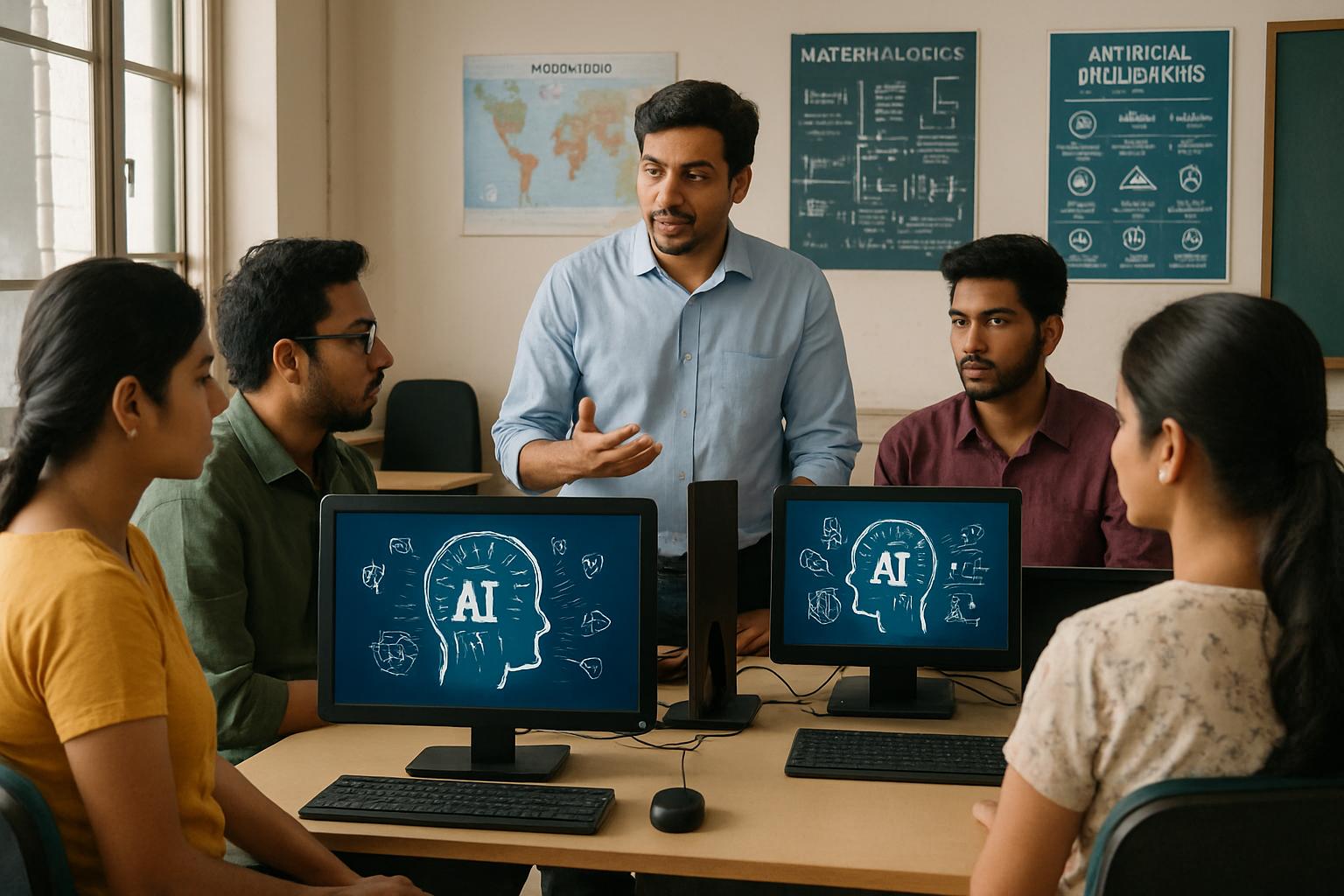
The strategic roadmap also emphasises sovereign datasets through AIKosha to cut foreign dependency. Consequently, models trained on Indian languages, governance data, and agritech corpora should gain accuracy and relevance. India Education stakeholders expect curriculum changes that marry ethics, policy, and deep learning techniques. These policy commitments set ambitious expectations. However, execution speed will determine eventual impact on classrooms. The vision aligns budgets, data, and hardware toward one transformative goal. Next, the focus turns to the affordable GPU Access framework powering that goal.
Affordable GPU Access Framework
Central to the programme is the IndiaAI Compute Portal, a cloud marketplace aggregating 34,381 GPUs. Additionally, private data-centre partners host NVIDIA H100s, AMD MI300Xs, and other accelerators behind a single login. Therefore, universities will enjoy GPU Access at subsidised rates as low as ₹67 per hour. Furthermore, the portal automates quota management, billing, and student authentication to prevent resource hoarding.
- Subsidy covers up to 40 percent of hourly compute fees.
- Portal currently supports 1,400+ public datasets for immediate experimentation.
- Real-time dashboards reveal GPU Access availability across multiple regions.
- Dedicated helpdesks guide India Education institutions through onboarding steps.
Consequently, faculty can schedule training jobs during off-peak hours, stretching limited research grants. Moreover, start-ups incubated on campus can share the same resource pool, reinforcing local ecosystems. India Education administrators view this shared model as fiscally prudent compared with building isolated clusters. These infrastructure mechanics lead directly into the timeline debate. Consequently, we now examine scheduled milestones for the 500-campus rollout.
University Rollout Timeline Details
Officials have not published the full university list, yet internal memos suggest a phased approach. Subsequently, central institutions like IITs and NITs will pilot clusters during summer 2026. In contrast, state universities may rely exclusively on remote GPU Access during the first year. Therefore, MeitY expects national coverage within 24 months, subject to procurement clearances. Energy planning, including nuclear supplements, sits on a parallel track.
A probable sequence, based on tender windows, unfolds as follows.
- Q2 2026: Pilot installations complete at 20 institutes.
- Q3 2026: Portal access extended to 150 additional campuses.
- Q1 2027: Hardware delivery begins for tier-two universities.
- Q4 2027: Programme scales to the promised 500 universities.
Nevertheless, industry observers caution that supply constraints could stretch these milestones. India Education advocates insist transparent dashboards will keep momentum visible and accountable. These timeline estimates frame expectations for students and faculty. Next, we explore how learners may benefit once GPUs arrive.
Student Benefits Explored Deeply
Hands-on access to large accelerators changes the pedagogical equation. Previously, many classes relied on theoretical walkthroughs because labs lacked adequate hardware. Now, capstone teams can fine-tune transformer models on vernacular corpora within a semester. Moreover, data science clubs gain continuous GPU Access for hackathons and research competitions. Consequently, portfolio quality improves, boosting placement prospects in domestic and global firms.
Additionally, interdisciplinary programmes plan to integrate product-management training alongside model development. Professionals can enhance their expertise with the AI Product Manager™ certification. India Education counsellors highlight such credentials as bridges between technical fluency and market strategy roles. These academic advantages encourage wider stakeholder buy-in. However, several operational challenges remain unresolved. The next section reviews those hurdles and potential mitigations.
Key Implementation Challenges Ahead
High-performance GPUs demand reliable power, cooling, and skilled operators. Therefore, campuses in warmer regions must upgrade data-centre airflow and energy infrastructure. Additionally, vendor concentration around NVIDIA raises procurement risks during export-control shocks. Nevertheless, the government claims framework agreements with multiple suppliers dilute single-vendor exposure.
Budget sustainability also invites scrutiny. Subsidies covering 40 percent today could shrink if adoption surges faster than expected. Consequently, universities will need clear cost forecasts for multi-year research planning. The programme’s transparency portal aims to supply that financial visibility. India Education planners worry that uneven faculty training could undercut hardware investments. Despite hurdles, corporate partnerships offer resources and mentorship that ease deployment burdens. Our next subsection tracks those alliances.
Industry Partnerships Emerging Rapidly
The upcoming India AI Impact Summit will gather executives from Google, NVIDIA, and Reliance. Moreover, philanthropic groups like the Gates Foundation will discuss health and agriculture datasets for joint projects. Start-ups expect preferential IndiaAI credits to integrate portal compute into commercial offerings. Consequently, campus incubators could evolve into regional AI hubs servicing government and private needs.
India Education observers predict coordinated internship pipelines flowing from universities to partner labs. Additionally, shared events will showcase research breakthroughs developed on subsidised GPUs. These collaborations set the stage for long-term ecosystem resilience. Subsequently, we assess broader outlook scenarios.
Future Outlook Summary Scenarios
Analysts outline three plausible trajectories for the programme. Best-case, hardware delivery and curriculum revamps coincide, yielding rapid AI talent expansion. Moderate-case, supply chain friction slows deployment, yet cloud GPUs fill interim gaps. Worst-case, subsidy erosion and operational bottlenecks stall momentum at under 300 campuses. Nevertheless, even conservative forecasts project a dramatic rise in AI literacy.
Therefore, stakeholders must monitor tender milestones, budget reviews, and capacity dashboards closely. India Education governance councils will play a critical oversight role during this monitoring. These forward-looking insights prepare readers for the concluding synthesis.
India Education now sits at a historic inflection point. Government funding, private partnerships, and sovereign datasets converge to deliver ubiquitous compute. Consequently, students will experience transformational learning that aligns with future industry needs. Nevertheless, power, supply, and budget challenges demand vigilant oversight from every stakeholder. University leaders should engage early with MeitY dashboards and vendor workshops. Meanwhile, professionals can future-proof careers by pursuing specialized certifications and product-mindset training. Consider the AI Product Manager™ credential for emerging leadership roles. Join the conversation, share rollout experiences, and propel India’s AI ambitions forward. The era of accessible supercomputing on campus has finally arrived.
Disclaimer: Some content may be AI-generated or assisted and is provided ‘as is’ for informational purposes only, without warranties of accuracy or completeness, and does not imply endorsement or affiliation.


