

AI CERTS
2 months ago
Google Gemini 3 and Advanced LLM Performance
Advanced LLM Performance sits at the heart of this debate, shaping budgets and deployment decisions. Moreover, executives must judge not only raw accuracy but also cost, latency, and safety trade-offs. This report distills verified statistics, independent quotes, and pricing details for time-pressed professionals. Additionally, it highlights open questions that remain despite Google’s impressive marketing narrative. Read on to understand the numbers behind the headlines and their concrete enterprise implications.
Reasoning Claims Under Review
Independent researchers scrutinized Gemini 3 across many tasks. Moreover, they compared results with rival frontier models. LMArena, LLMDB, and other sources supplied the most cited numbers.
Key Stats At Glance
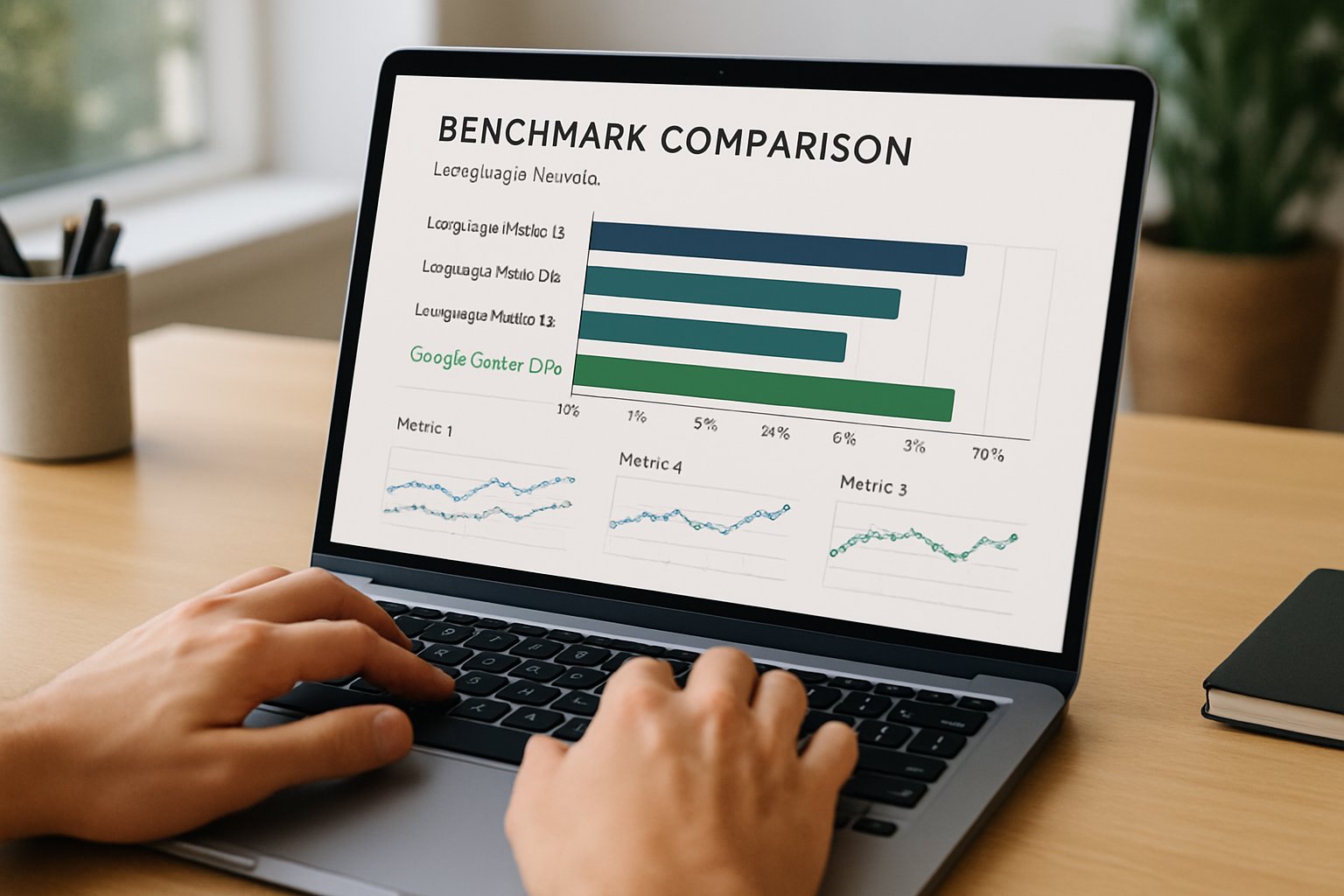
- Text reasoning Elo: 1501, first model to pass 1500.
- AIME 2025 math score: 95% without tools, 100% with code execution.
- GPQA Diamond: 91.9%, up five points over Gemini 2.5.
- ARC-AGI-2 abstract puzzles: 31.1%, rising to 45.1% in Deep Think mode.
- MMMU-Pro multimodal benchmark: 81% accuracy, with video variant at 87.6%.
These numbers showcase Advanced LLM Performance in controlled environments. However, each benchmark measures narrow skills rather than holistic intelligence. The evidence still indicates strong Benchmarks leadership for Gemini 3. Nevertheless, experts caution against equating leaderboard wins with flawless production behavior. These findings frame the remaining discussion. Consequently, the next section explores multimodal breadth beyond pure text.
Multimodal Strengths And Limits
Gemini 3 handles images, audio, and code alongside text. Furthermore, Google touts seamless Multimodality across the Gemini app, Search AI Mode, and Vertex AI. Tests confirm the claim, yet practical caveats surface.
The 1 M-token context window enables long video transcripts, design docs, and code bases. Consequently, agentic workflows like “vibe coding” become feasible. In contrast, latency rises when context grows or Deep Think toggles on. Users noticed slower replies during extensive reasoning chains.
Additionally, multimodal tasks reveal uneven reliability. A study by Artificial Analysis showed confident hallucinations on complex diagrams. Nevertheless, the model’s top-five image classification stood above most peers. Advanced LLM Performance again appears impressive but not uniform across modalities.
Gemini 3 therefore offers headline-grabbing breadth. However, deployment teams must prototype workloads before promising service-level agreements. These strengths and limits set the stage for pricing realities.
Cost Context And Pricing
Google published preview rates alongside the November launch. Input tokens cost roughly $2 per million. Output tokens cost $12 per million for prompts under 200 k tokens. Moreover, higher tiers apply to very long contexts.
Deep Think mode multiplies compute consumption. Consequently, organizations face substantial bills when pushing maximum Reasoning depth. In contrast, the Gemini 3 Flash variant halves latency and cuts cost for lighter tasks. Tulsee Doshi told The Verge that Flash preserves core reasoning quality.
Budget planners must weigh these figures against comparable offerings from OpenAI or Anthropic. Advanced LLM Performance delivers value only when matched with sustainable spend. Therefore, cost modeling should include downstream GPU charges and potential cache strategies.
Pricing transparency helps but does not close every gap. Nevertheless, Google’s early disclosure aids CFOs preparing 2026 forecasts. Next, consider reliability, an equally critical variable.
Reliability Concerns Still Persist
Strong scores conceal notable weaknesses. Artificial Analysis reported hallucination-when-wrong rates near 90% on knowledge probes. Additionally, safety researchers highlighted overconfident errors during edge cases. These patterns undermine trust despite high Benchmarks wins.
Furthermore, Google has not published full parameter counts or dataset sources. Opaque internals limit independent audits. In contrast, some rivals now release partial model cards detailing safety testing.
Zvi Mowshowitz summarized the issue bluntly: “vast intelligence with no spine.” Nevertheless, Google promises continuous tuning through reinforcement learning and tool use. Professionals can enhance their governance with the AI Security Level 1 certification, which adds structured risk-management skills.
Reliability thus remains the primary barrier to scaled adoption. However, integration advantages could offset some hesitation when paired with strict oversight. The following section examines those advantages.
Enterprise Integration And Implications
Gemini 3 reaches users through Search, Workspace, and Cloud APIs. Moreover, Vertex AI pipelines let teams connect the model to custom data and tools. Consequently, migration friction drops for existing Google Cloud customers.
Agentic coding demos showed Gemini 3 planning multi-file repositories. Additionally, long context windows enable traceable audit trails. These capabilities could accelerate prototype-to-production timelines.
In contrast, vendor lock-in risks grow as workflows intertwine with proprietary endpoints. Therefore, architects should maintain abstraction layers and monitor egress costs. Advanced LLM Performance provides competitive leverage only when paired with flexible architecture.
Integration ease offers real upside. Nevertheless, unanswered questions about internal mechanics encourage cautious rollouts. Forward-looking teams now ask what comes next.
Future Outlook And Questions
Google hinted at bigger “Deep Think” upgrades and broader Multimodality support in 2026. Meanwhile, rival labs plan similar advances. Consequently, today’s leaderboard may shift quickly.
Additionally, regulators push for transparency on training data and safety evaluations. Enterprises therefore need adaptive governance frameworks. Advanced LLM Performance alone cannot guarantee compliance.
Subsequently, independent benchmarks will broaden to include real-time tool calls and regional availability. Moreover, cost compression may arrive through hardware optimization.
These trends could reshape procurement guidelines within months. However, leaders who track evidence and invest in staff skills will keep pace. The concluding section synthesizes these lessons.
Gemini 3 Pro proves that Advanced LLM Performance is achievable at scale. The model dominates several Benchmarks and expands Reasoning depth across modes. However, high hallucination rates, opacity, and variable cost temper the excitement. Multimodal breadth attracts innovators, yet robust testing remains critical. Therefore, executives should pilot targeted workloads, monitor billing, and upskill teams through certifications. For deeper guidance, explore additional reports and secure your competitive edge today.


