

AI CERTS
2 days ago
Google Eloquent and the Mobile AI Dictation Disruption
Industry analysts call the release a pivotal milestone for Mobile AI. Gemma, Google’s new edge model family, now reaches knowledge workers directly. Consequently, enterprises now have an iOS option that operates offline yet optionally connects to Gemini for cloud polishing. The company frames Eloquent as next-generation dictation for professionals tired of keyboards.
Inside The Quiet Launch
The launch strategy puzzled regular observers. Furthermore, Google released Eloquent with no accompanying blog post or press briefing. Reporters noticed the listing on 6 April and quickly shared screenshots. Nevertheless, within hours the metadata changed as references to Android disappeared, reinforcing an iOS-first focus. App size weighed only 67.1 MB, confirming that the Gemma model is lightweight enough for on-device use. Meanwhile, the listing stated English-only support at launch, a limitation that tempers global ambitions.
The stealthy publication hints at internal testing priorities rather than classic marketing theatrics. However, operational details still required inspection before judgment.
How Eloquent App Operates
The application divides its workflow into two distinct modes. Moreover, each mode targets separate user needs. Setup requires iOS 16 or newer, and the download completes within minutes.
Local Mode Key Details
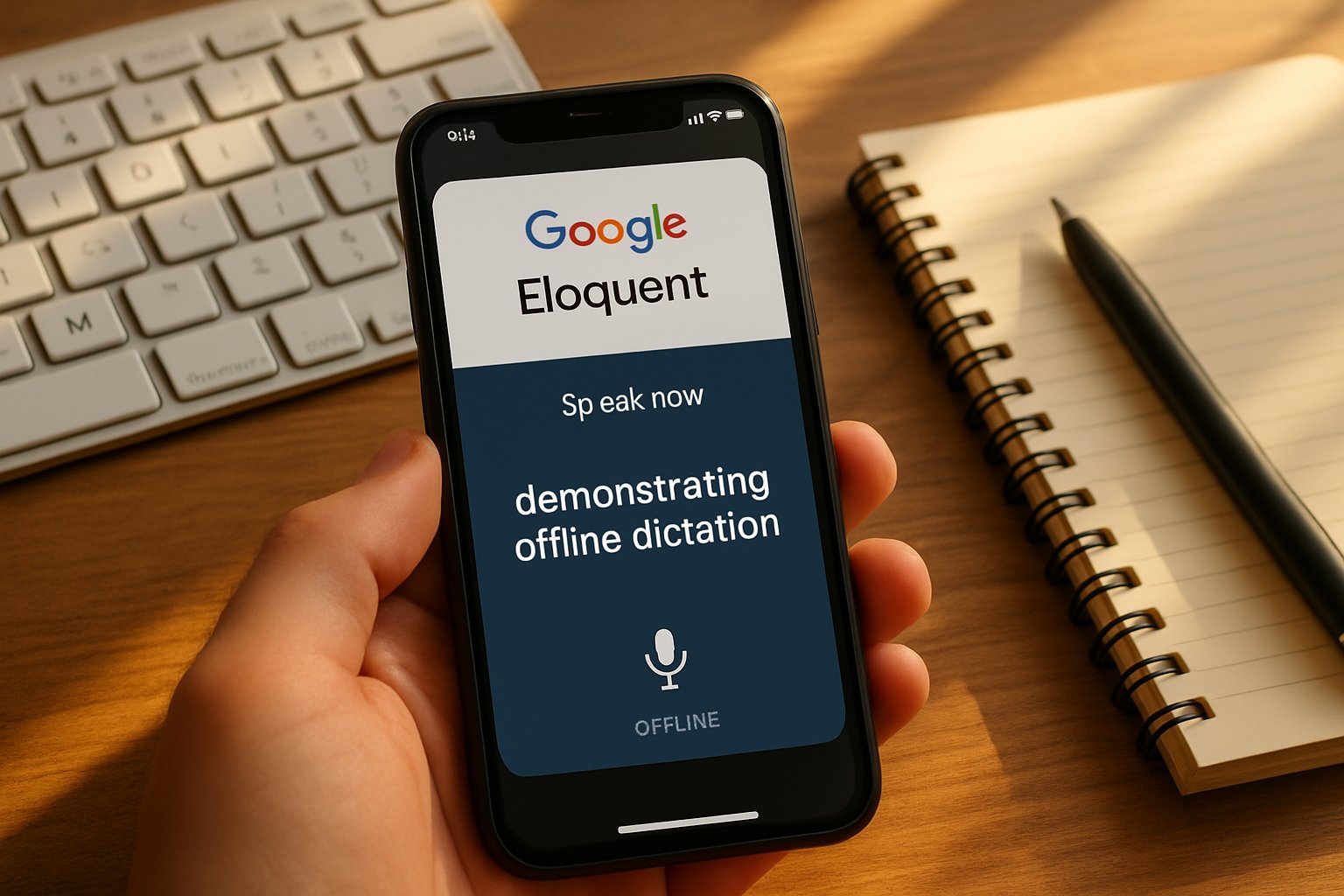
Under local mode, audio remains on the iPhone. Consequently, the Gemma ASR model transcribes speech in real time and removes filler words like “um.” Latency sits around 200 ms in early tests, keeping the experience conversational. Additionally, on-device inference ensures privacy compliance in environments where network access is restricted or costly. Users can review per-session statistics, including words-per-minute and total word count, without leaving the screen. This pure offline path aligns with enterprise security policies. Such speed proves the promise of Mobile AI for field reporters in low-bandwidth zones.
Cloud Polishing Workflow Explained
In contrast, the cloud mode hands the raw text to Gemini for stylistic refinements. Therefore, professionals can request bullet summaries, formal tone, or concise abstracts with one tap. Importantly, activation is optional, and audio still never leaves the device; only text travels for polishing. Subsequently, the app offers an opt-in Gmail vocabulary import that personalizes future recognition while maintaining local storage. The hybrid workflow exemplifies Mobile AI by keeping compute near users and outsourcing heavy reasoning only.
Eloquent balances latency, accuracy, and privacy by separating recognition from polishing. Consequently, professionals receive ready-to-send prose faster than with manual edits.
Market Context And Stakes
Voice technology revenue reached roughly USD 19 billion in 2025, according to Fortune Business Insights. Moreover, analysts project a climb toward USD 24 billion by 2026 with embedded solutions as the fastest segment. Such momentum underscores why Mobile AI experiences like Eloquent attract boardroom attention. Therefore, a free, offline-first approach could expand the pie further by lowering adoption barriers.
- Estimated 22-24 % compound annual growth rate for on-device ASR.
- Roughly 65 % of professionals still rely on manual typing for meeting notes.
- Subscription dictation tools cost between USD 85 and USD 180 annually.
Stakeholders now assign budget to Mobile AI pilots that shorten documentation cycles. These data points reveal a sizable cost-savings narrative. Consequently, Eloquent positions Google to gain share before rivals recalibrate pricing.
The expanding market signals room for several winners. However, the next battleground involves product depth and platform reach.
Competitive Landscape Rapid Shifts
Wispr Flow, SuperWhisper, and Willow long dominated mobile dictation niches. However, their plans rely on monthly fees that many freelancers resist. In contrast, Mobile AI entrants from big clouds can subsidize pricing because they monetize elsewhere.
Google’s surprise release therefore pressures every paid competitor. Meanwhile, analysts highlight that Eloquent lacks system-wide keyboard integration offered by Wispr Flow. Nevertheless, pricing often trumps convenience during early adoption cycles. Additionally, Eloquent’s offline capability improves reliability during flights, hospitals, and remote worksites. Wispr Flow also targets iOS professionals but charges monthly.
- Free usage with no caps
- Edge-optimized Gemma models
- Optional Gemini polishing
- Personal vocabulary import
Competitors must react with either feature leaps or price drops. Consequently, users will enjoy faster innovation regardless of brand allegiance.
While competition escalates, individual professionals must evaluate skills to leverage these tools fully.
Opportunities For Tech Professionals
The shift toward on-device intelligence opens new product roles. Moreover, mobile enterprise buyers now demand staff who understand Gemma deployment constraints. Therefore, content strategists, app engineers, and solution architects can differentiate by mastering edge model pipelines.
Professionals can validate expertise through the AI Writer™ certification, which demonstrates applied prompt and workflow design. Consequently, certified staff often secure higher consulting rates.
Because Mobile AI workloads run near the sensor, latency budgets shrink. In contrast, traditional backend developers seldom confront such constraints. Subsequently, learning quantization, on-device caching, and thermal profiling becomes essential.
Product managers should also track regulatory trends. However, Eloquent’s limited European availability shows that regional approval can stall revenue even for heavyweight brands like Google. Therefore, compliance knowledge represents another hiring differentiator.
Skill gaps create both risk and upside for ambitious teams. Consequently, early movers will shape best practices for edge voice workflows.
Risks And Open Questions
No technology lands without caveats. Moreover, Eloquent’s English-only launch excludes vast markets. Additionally, absent benchmark data leaves accuracy claims unverified.
Privacy advocates remain cautious despite the offline processing promise. Nevertheless, Gmail import requests permission scopes that could concern auditors. Meanwhile, developers await clarity on which Gemma variants ship inside the 67 MB bundle.
Analysts also question longevity of free pricing. Consequently, Google may later gate advanced dictation features behind Workspace subscriptions. Therefore, organisations must plan exit strategies if costs rise. Without multilingual support, the Mobile AI vision remains incomplete.
Open issues show the product is still embryonic. However, transparent technical notes from Google could rapidly ease skepticism.
With uncertainties noted, strategic focus shifts to practical next steps.
Conclusion And Next Steps
Google’s Eloquent signals a broader Mobile AI shift toward private, low-latency computing. Moreover, the free, offline-first model threatens subscription dictation businesses and accelerates edge innovation. Enterprises must still assess language coverage, privacy posture, and eventual pricing before widescale rollout. Nevertheless, early pilots can unlock measurable productivity wins. Therefore, readers should test the app, benchmark its accuracy, and pursue credentials such as the linked AI Writer™ certification to stay relevant. Finally, share operational feedback with peers so the ecosystem matures responsibly.


