

AI CERTS
2 months ago
Financial Workspace AI: Quant Trading Platforms Accelerate 2025
LSEG, QuantConnect, and a swarm of startups now unveil AI-native platforms weekly. Meanwhile, partnerships with Anthropic and OpenAI push licensed market data directly into large language models. Global Finance faces mounting pressure to incorporate AI responsibly. Grand View Research expects algorithmic Trading revenue to double by 2030, reflecting accelerating adoption. Additionally, Reuters notes quant funds added forty-four billion dollars in assets during early 2025. Consequently, Financial Workspace AI now sits at the heart of competitive strategy for hedge funds. Nevertheless, questions about model Risk, data licensing, and regulatory oversight remain unresolved. This article maps the market, profiles key players, and evaluates opportunities and challenges. Readers will gain a structured briefing ready for boardroom discussion and tactical planning.
Current Markets Momentum Overview
Quantitative innovation often follows data availability and compute cost curves. Moreover, falling cloud costs and new vector databases fuel continuous model retraining. Grand View Research places algorithmic Trading revenue near twenty billion dollars today. In contrast, several studies project forty-three billion dollars by 2030, indicating sustained demand. Reuters further highlights eighty thousand entrants in the 2025 WorldQuant contest, a historic high. Consequently, Financial Workspace AI platforms seek to capture that enthusiasm with ready-made research pipelines. Nevertheless, high expectations pressure vendors to deliver measurable productivity gains quickly.
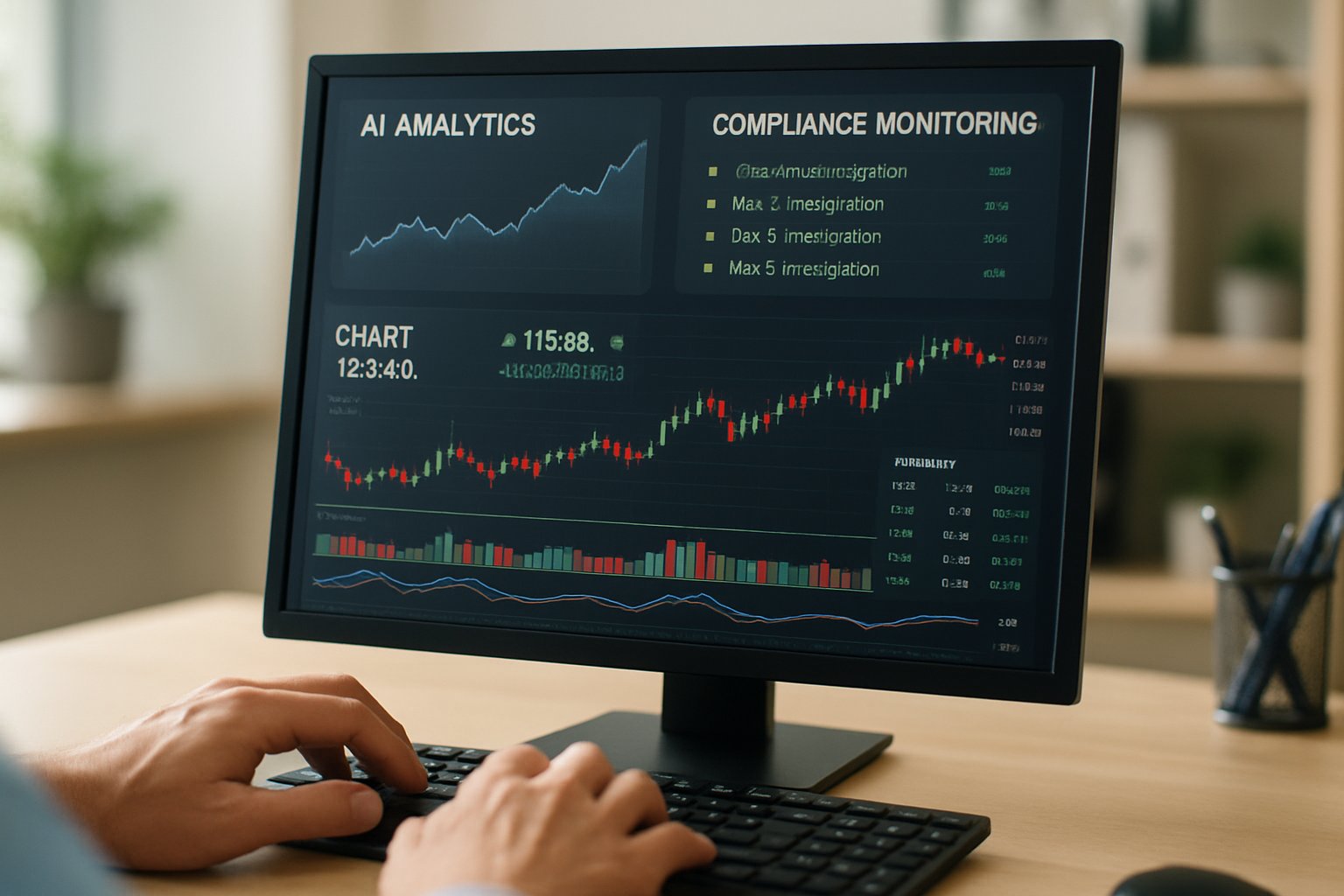
- Algorithmic market size: approximately USD 17-22 billion, depending on methodology.
- Projected value: up to USD 43 billion by 2030, per Grand View Research.
- Quant fund inflows: USD 44 billion added during H1 2025, With Intelligence reports.
These indicators confirm a robust appetite for automated strategies. Therefore, platform launches are accelerating to meet evolving quant needs. Let us examine those launches in detail.
Platform Launches Surge Ahead
Vendors large and small unveiled notable workspaces throughout 2025. Additionally, LSEG led headlines by embedding natural language search inside its flagship Workspace suite. The group partnered with Anthropic in October and OpenAI in December to enable licensed data calls. Subsequently, LSEG promised initial user access during H1 2026 across enterprise tiers. QuantConnect followed with Ask Mia, an agent that edits code, runs backtests, and pushes live orders. Moreover, startups like TrustStrategy, AIQuant, and FQAI released upgrades touting NVIDIA acceleration and crypto coverage. QTX.AI even closed fresh funding to scale its cloud workspace by June. Consequently, enterprise buyers now evaluate a crowded matrix of features, prices, and security postures.
Meanwhile, cloud partners Microsoft, Databricks, and Snowflake provide the storage layers for many offerings. In contrast, some startups rely on fully managed infrastructure to shorten onboarding for retail quants. Financial Workspace AI adoption hinges on ease of connectivity between these layers. Therefore, standardization efforts like the Model Context Protocol attract strong investor interest.
Launch momentum benefits users through expanded choice and faster iteration. However, tool proliferation complicates architecture decisions for technology leaders. Understanding the agentic layer clarifies those decisions.
Agentic Trading Tools Explained
Agentic systems assign large language models multi-step tasks without constant supervision. For example, Ask Mia can draft code, call a backtesting API, and deploy Trading strategies. Additionally, LSEG demonstrates earnings-call summarization that links directly to charting widgets and order tickets. Consequently, Financial Workspace AI shifts from passive data terminals to interactive copilots. Nevertheless, model autonomy raises obvious Risk considerations, especially around real-time execution. WorldQuant founder Igor Tulchinsky observes that single-person teams now compete effectively using AI helpers. Therefore, capability diffusion could disrupt traditional Quantitative hiring patterns.
- Prompt model with strategy objective.
- Generate code and allocate backtest resources.
- Evaluate metrics, adjust parameters, and redeploy.
Agentic workflows compress experimental cycles from days to minutes. However, governance must evolve to match that speed. The next section unpacks benefits and drawbacks.
Opportunities And Key Challenges
Integrated environments deliver clear productivity gains across ideation, testing, and compliance tracking. Moreover, smaller asset managers gain access to institutional datasets once locked behind expensive terminals. Financial Workspace AI platforms often bundle notebooks, execution gateways, and model lineage dashboards. Consequently, auditing and reproducibility improve because every step remains inside one Workspace. In contrast, potential herd behaviour emerges when many agents learn from similar templates. Furthermore, shared cloud dependencies increase systemic Risk during outages or vendor changes. Data licensing also presents Quantitative legal ambiguity as LLMs store latent representations of proprietary feeds. Therefore, MCP connectors attempt to restrict payloads while preserving analytical richness.
- Pro: Faster strategy iteration via auto-generated code.
- Pro: Lower compute expense through elastic cloud nodes.
- Con: Model Risk amplification during volatile markets.
- Con: Vendor lock-in around proprietary data schemas.
Benefits appeal to innovators seeking speed and scale. Nevertheless, unchecked risks could erode confidence and returns. Regulators are already sharpening their focus.
Regulatory Lens Emerging Now
Supervisors on both sides of the Atlantic study agentic tooling with growing intensity. Additionally, OSFI and SEC staff underline the duty to document model assumptions and overrides. SEC guidance reminds Trading firms that delegating decisions to algorithms never transfers fiduciary responsibility. Consequently, compliance teams embed kill switches, audit trails, and human-in-the-loop checkpoints. Finra expects clear evidence of scenario testing and Risk controls before retail deployment. In contrast, early movers argue that on-chain transparency and real-time telemetry reduce opacity concerns. Therefore, Financial Workspace AI vendors now market governance modules as competitive differentiators.
Regulatory momentum favors firms investing early in robust oversight. However, guidance remains dynamic and region-specific. Education and certification can bridge knowledge gaps for practitioners.
Talent And Education Pathways
Demand for hybrid quant-developer skills accelerates as workflows merge coding, data science, and Finance. Moreover, WorldQuant’s contest signals a pipeline of self-taught entrants empowered by language models. Professionals can enhance their expertise with the AI Prompt Engineer™ certification. Consequently, hiring managers now prioritize adaptive learning capacity over legacy tool familiarity. Financial Workspace AI knowledge increasingly appears in interview case studies and technical assessments. Additionally, continued education programs cover cloud orchestration, Quantitative validation, and ethical AI guidelines.
Upskilling ensures teams can evaluate vendor claims effectively. Therefore, education buffers firms against human capital shortages. Finally, we assess the broader outlook.
Strategic Outlook To 2026
Industry observers expect consolidation as core capabilities standardize. Furthermore, incumbents may acquire niche startups to integrate specialized agentic modules. Quantitative funds will likely diversify supplier rosters to mitigate vendor and data exposure. Meanwhile, cloud alliances should drive unified pricing models for compute, storage, and Financial Workspace AI usage. Subsequently, latency improvements and edge deployment will target high-frequency segments. Fintech analysts project double-digit revenue growth for platform providers through late 2027. Therefore, leadership teams must track evolving standards, regulatory positions, and competitive feature maps.
The market trajectory remains bullish yet uncertain. Nevertheless, informed strategy can convert volatility into advantage. We now summarize actionable insights.
Financial Workspace AI has moved from prototype to production across capital markets. Consequently, integrated data, agentic code, and elastic execution reshape competitive dynamics. Launch momentum spans incumbents, cloud partners, and venture-backed specialists. Nevertheless, Risk management, licensing, and regulatory compliance remain essential guardrails. Firms that combine rigorous governance with rapid experimentation will unlock sustainable alpha. Moreover, continuous education equips professionals to supervise autonomous processes responsibly. Decision makers should benchmark platform roadmaps, vendor viability, and total cost of ownership. Digital Finance teams must act decisively amid rapid tooling shifts. Therefore, start exploring certifications and hands-on trials to future-proof your Quantitative edge today. Visit the certification link above and evaluate a pilot deployment now.


