

AI CERTS
2 hours ago
Blockchain AI Integration Fuels Market Intelligence Revolution
Meanwhile, tokenised indices like the S&P Digital Markets 50 push equities directly on-chain. Bloomberg terminals recently added experimental feeds for such products, signalling mainstream interest. Recent announcements further highlight growing appetite for labelled feeds and robust Data License frameworks. Therefore, executives must grasp both technical architectures and shifting risk profiles. This article investigates the convergence, provides hard numbers, and outlines strategic steps for firms entering these hybrid markets.
Institutional Tokenization Surge
Institutional tokenization accelerated throughout 2025. S&P Dow Jones Indices and Dinari tokenised the Digital Markets 50, blending 35 equities with 15 crypto assets. Chainlink oracles feed verifiable prices to those dShares, ensuring on-chain settlement within seconds. Moreover, Ondo Finance moved US Treasury funds and major ETFs onto public chains, again leaning on Chainlink standards.
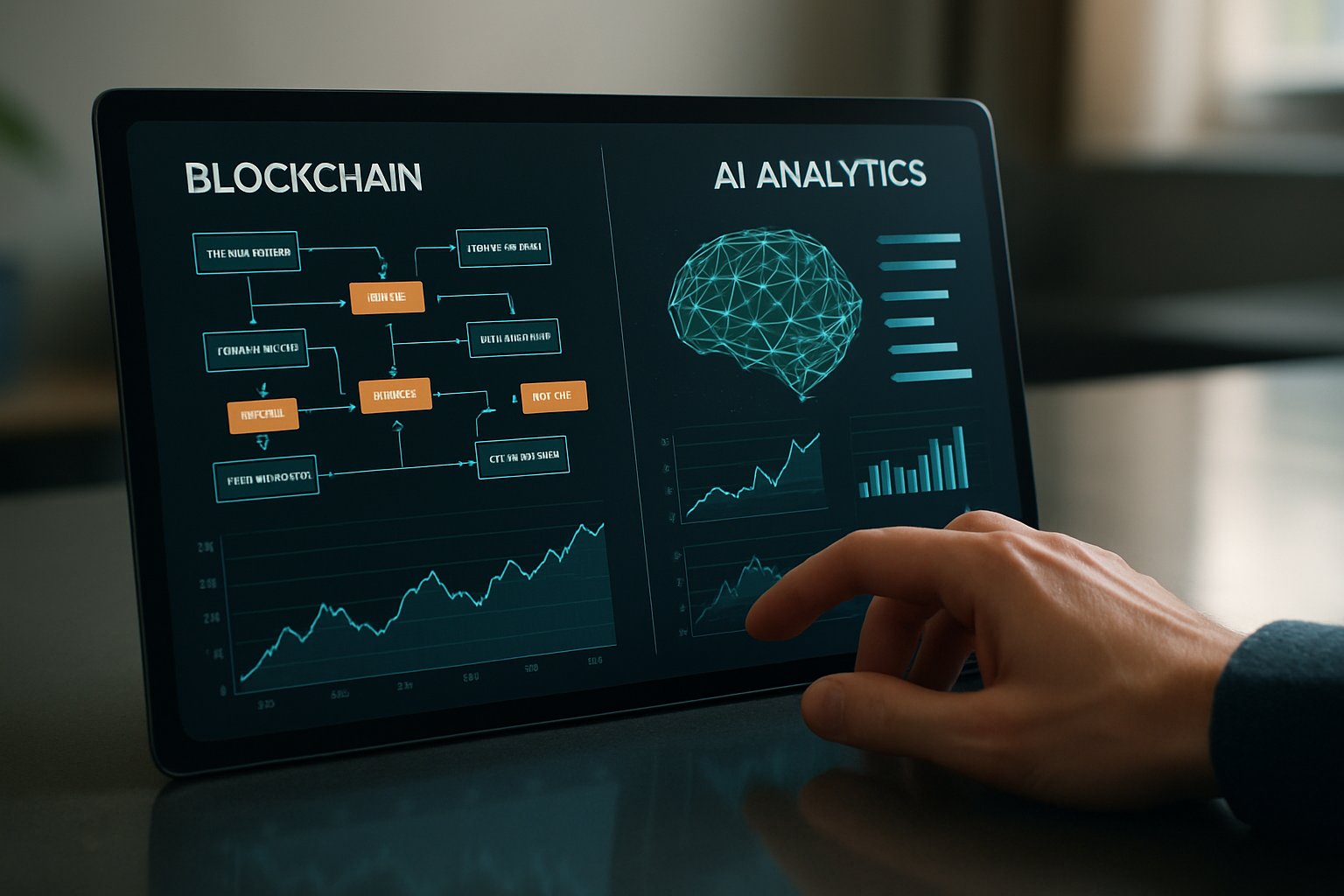
Bloomberg covered these launches four times during Q4 2025, underscoring rising mainstream awareness. Meanwhile, rwa.xyz dashboards logged distributed real-world assets surpassing $27 billion by March 2026. Consequently, liquidity providers now treat tokenised treasuries as routine collateral.
Kaiko Partnership deals multiplied as desks sought granular tick data for pricing tokenised stocks. Each agreement included a strict Data License clause to deter free riders and protect proprietary enrichments. Therefore, competitive edges now rest on feed depth, not mere access.
Tokenisation thus reaches institutional scale, backed by audited datasets and mature infrastructure. Blockchain AI Integration now feels inevitable. Nevertheless, raw data alone holds limited value, setting the stage for smarter analytics.
On-Chain Data Advantage
On-chain ledgers deliver immutable, time-stamped events. Consequently, analysts can reconstruct every trade, transfer, and governance vote without trusting intermediaries. However, raw hex strings require context before supporting trading desks.
Indexing projects such as The Graph, Covalent, and Space and Time transform block logs into SQL-like endpoints. Moreover, Nansen enriches those endpoints with 500 million labeled addresses, creating a research-ready dataset.
Bloomberg recently piloted internal pipelines that combine Nansen metrics with its terminal functions. This experiment shows how established data monopolies adapt by licensing external crypto analytics. Therefore, Data License negotiations now include sampling frequency, retention windows, and redistribution rights.
Kaiko Partnership statements echo this shift. The firm positions itself as a bridge between DeFi logs and regulated instruments, offering low-latency feeds plus audit trails. Blockchain AI Integration platforms consume these feeds to train forecasting models.
High-fidelity ledgers thus enable rapid feature engineering and back-testing. In contrast, legacy OTC feeds still suffer from delayed batch updates. The next section explores how AI agents capitalise on this structural benefit.
AI Agents Enter Trading
LLM-powered assistants already digest on-chain metrics and suggest precise trades. Nansen AI launched in September 2025 with Claude under the hood. Moreover, the product roadmap promises agentic execution once compliance checks mature. Blockchain AI Integration converts insights into executable workflows for junior traders.
Sentora, formed from IntoTheBlock and Trident, secured a $25 million Series A to build similar capabilities for funds. Consequently, desks can request risk reports, yield projections, and swap paths through a single chat interface.
Blockchain AI Integration benefits from transparent ground truth, letting models validate predictions against live ledgers. However, hallucination risk remains. Vendors therefore embed guardrails, rate limits, and human approval loops.
- 500 million labeled wallets powering Nansen AI research.
- Sub-second pricing delivered by Chainlink oracle updates.
- A major market data vendor releasing four beta terminals with on-chain agent plugins.
- Eight Kaiko Partnership clients testing automated hedging modules under a revised Data License.
These advances convert static dashboards into conversational copilots. Nevertheless, new market primitives also introduce ownership and privacy dilemmas, explored next.
Emerging Data Token Markets
Data itself now becomes a financial instrument. Ocean Protocol pioneered tokenised datasets in 2020, yet institutional uptake lagged. Subsequently, academic projects like FinML-Chain proposed modular benchmarks combining high-frequency on-chain records with macro releases.
OmniLytics+ added zero-knowledge proofs, enabling private model training while preserving public verifiability. Consequently, datasets can trade without exposing raw rows. Investors purchase access keys represented by ERC-20 tokens and receive streaming royalties.
Kaiko Partnership engineers evaluate similar mechanics for proprietary order-book feeds. Each micro-dataset sits under a granular Data License, aligned with Bloomberg best practices. Blockchain AI Integration platforms treat those tokens as live features in reinforcement loops.
Nevertheless, liquidity remains thin. Market-makers hesitate until valuation frameworks mature. However, composability with DeFi yield vaults could accelerate adoption.
Tokenised datasets unlock new revenue for data vendors while supplying richer inputs for agents. Therefore, understanding associated risks becomes critical.
Risk Factors And Controls
Every new primitive introduces fresh failure modes. Oracle exploits can trigger forced liquidations, as 2022 DeFi history showed. Moreover, tokenised equities inherit corporate-action risk, including dividend misalignment and voting rights confusion.
- Oracle manipulation causing mis-priced collateral.
- Contract breaches leaking proprietary curves.
- Regulatory freezes on asset transfers across jurisdictions.
- Model hallucinations inside Blockchain AI Integration agents.
Chainlink mitigates oracle risk with multi-source aggregates and cryptographic proofs. However, attackers may still exploit low liquidity moments. Consequently, firms set circuit breakers that pause smart contracts when variance exceeds set thresholds.
Privacy concerns also intensify. Zero-knowledge schemas hide rows, yet metadata can deanonymise counterparties. Meanwhile, BIS reminds regulators that token arrangements still mirror traditional settlement risks.
Holistic controls thus require layered defence across data feeds, governance, and model oversight. Subsequently, strategic planning gains importance for asset managers. Blockchain AI Integration provides the analytic backbone for that planning.
Strategic Outlook For Institutions
Forward-looking desks now assemble cross-functional squads combining quant talent, legal counsel, and dev-ops engineers. Moreover, early movers lock in discounted feed bundles from Kaiko Partnership networks while negotiating exclusivity.
Bloomberg integration experiments suggest incumbents will blend proprietary datasets with open ledgers rather than replace systems. Consequently, middleware firms offering Blockchain AI Integration APIs gain partner leverage.
- Audit existing oracle dependencies and map circuit-breaker coverage.
- Run sandbox pilots with Nansen AI or Sentora to test agent workflows.
- Tokenise an internal dataset to explore revenue potential.
- Upskill staff through targeted credentials like the AI+ Quantum Data™ certification.
These actions establish governance foundations before volumes scale. Therefore, institutions position themselves for compliant growth.
Conclusion And Next Steps
Tokenised assets, enriched data, and intelligent agents now converge into a single value chain. Consequently, operational speed and data quality define competitive advantage. Blockchain AI Integration will underpin research, execution, and risk management across global desks. However, oracle fragility, regulatory flux, and model drift demand proactive controls.
Firms that secure robust Data License terms and embrace Kaiko Partnership ecosystems gain defensible moats. Meanwhile, Bloomberg and similar platforms will normalise hybrid feeds, accelerating adoption. Act now by enrolling in the AI+ Quantum Data™ certification and exploring pilot projects.


