

AI CERTs
2 months ago
Autonomous Labs: Thermo Fisher and NVIDIA Redefine AI Research
Robots no longer simply fetch samples; they now design, execute, and analyze entire experiments. Consequently, the life-sciences sector is sprinting toward fully digital research workflows. The latest catalyst comes from Thermo Fisher Scientific and NVIDIA. On 12 January 2026, the companies unveiled plans for Autonomous Labs linking instruments with agentic AI. Moreover, the announcement positions the partners at the center of an expanding automation market. Grand View Research values that market at over eight billion dollars in 2024, with strong double-digit growth ahead. However, financial terms and rollout timelines remain undisclosed. Nevertheless, analysts predict the collaboration will reshape computing, instrumentation, and data governance inside pharmaceutical pipelines. This article unpacks the market context, technical stack, opportunities, risks, and next steps. Throughout, we explain how Nvidia Bio tools and Thermo Fisher hardware may converge in real laboratories. Finally, we outline skill paths, including a linked certification, for professionals monitoring these disruptions.
Autonomous Labs Market Impact
Thermo Fisher already supplies millions of laboratory instruments worldwide. Meanwhile, NVIDIA holds dominant positions in GPU compute and AI model tooling. Together, they can push automated experimentation from niche robotics installations into mainstream workflows. Industry estimates suggest the lab automation market could hit eighteen billion dollars by 2033, growing roughly nine percent annually. In contrast, AI analytics for drug discovery may exceed ten billion dollars by 2030, reports indicate. Consequently, venture investors and corporates are racing to claim leadership in instrument-to-cloud ecosystems.
- Global lab automation: USD 8.27B in 2024, CAGR 9.3% (Grand View Research)
- AI life-science analytics: projected low-double digit billions by 2030
- Thermo Fisher annual revenue: >USD 40B
These numbers indicate massive addressable revenue for early movers. Therefore, Autonomous Labs could redefine competitive moats across biotech and instrumentation. With financial stakes clarified, we next examine the partnership mechanics.
Partnership Announcement Key Details
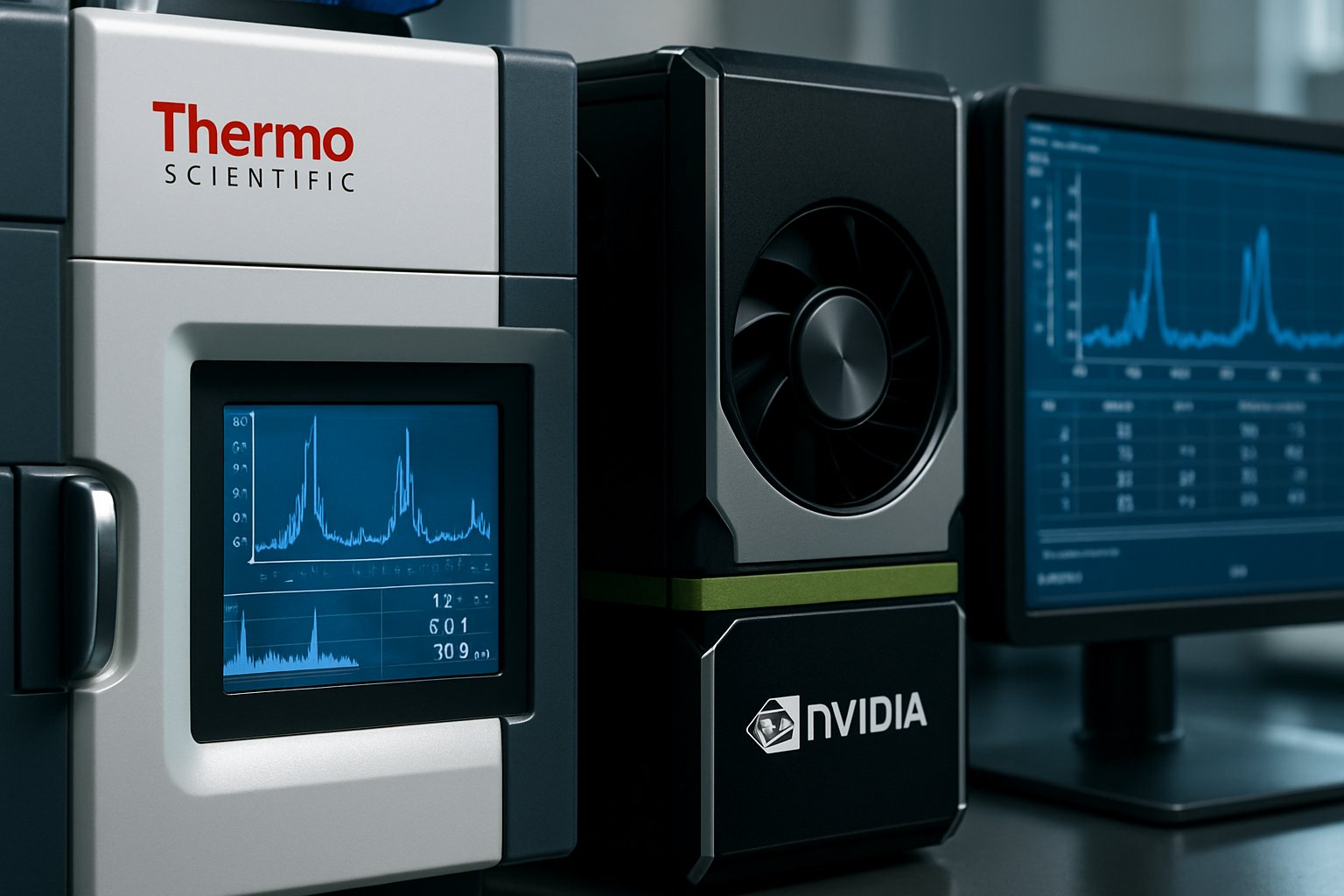
The collaboration was revealed during the J.P. Morgan Healthcare Conference in San Francisco. NVIDIA simultaneously expanded its BioNeMo model library and introduced DGX Spark, a benchtop supercomputer. Meanwhile, Thermo Fisher committed to integrate those assets into chromatography, imaging, and genomic platforms. Kimberly Powell, NVIDIA’s healthcare vice president, called the move the foundation of “lab-in-the-loop” science. Furthermore, Thermo Fisher executive Gianluca Pettiti highlighted improved accuracy and faster experimental turnaround. Neither release disclosed financial terms, pilot sites, or firm product launch dates. Nevertheless, both firms stated the ultimate objective remains field-deployable Autonomous Labs capable of continuous iteration. Notably, Nvidia Bio resources will supply pretrained protein and molecule models for early customer tests. The announcements sketch an ambitious but still high-level roadmap. However, understanding the technology stack clarifies feasibility questions.
Underlying Technical Stack Details
At the heart lies a layered compute platform extending from bench to cloud. DGX Spark offers dense GPU horsepower within standard lab racks. Moreover, local edge nodes minimize latency between AI inference and instrument actuation. Above that layer, the NeMo framework orchestrates multi-agent decision loops. BioNeMo, part of Nvidia Bio, converts raw sequence, structure, and spectral data into actionable embeddings. Consequently, proposed protocols reach instruments, execute experiments, and return results with minimal human clicks. That closed loop is essential for scaling Autonomous Labs beyond isolated automation islands. Integration partners, including TetraScience, will streamline data transfer and metadata harmonization. Therefore, scientists can retrain models overnight using fresh experimental feedback. The stack couples compute, connectivity, and content into one controllable chain. In contrast, previous systems relied on fragmented vendors, slowing iteration. Opportunity analysis illustrates why consolidation matters next.
Core Opportunities And Benefits
Autonomy promises dramatic throughput gains. A Nature Chemical Engineering paper reported one hundredfold acceleration in materials screening using self-driving rigs. Furthermore, robotics cut human error, boosting reproducibility for regulatory submissions. Standardized datasets also enrich model training, shortening each design-test-learn cycle. Economic upside stretches beyond big pharma. Contract research organizations can monetize capacity by offering on-demand Autonomous Labs services. Moreover, academic groups may access DGX Spark installations through shared facilities. Analysts therefore expect democratization similar to cloud computing’s early trajectory. In sum, throughput, accuracy, and accessibility form the promise trilogy. However, every promise invites parallel risks, examined next.
Critical Risks And Unknowns
Autonomy also lowers barriers for malicious experimentation. Nature Biotechnology editors warn that generative models plus automated synthesis intensify dual-use concerns. Consequently, governance frameworks must include sequence screening, access controls, and audit trails. Thermo Fisher and NVIDIA have not yet detailed built-in refusal mechanisms. Additionally, intellectual property ownership across data, model weights, and protocol agents remains unsettled. Without clear rules, Autonomous Labs deployments could spark contractual disputes or regulatory intervention. Meanwhile, safety engineers must ensure robots and humans share spaces without accidents. Therefore, early pilots will likely adopt human-in-the-loop oversight before scaling. Risk mitigation, not raw speed, will dictate adoption velocity. Subsequently, commercial viability hinges on balanced governance, discussed in the following section.
Projected Commercial Outlook Ahead
Despite missing financial figures, analysts forecast meaningful revenue synergies for both firms. Thermo Fisher can upsell smart upgrades across its vast installed instrument base. Moreover, NVIDIA benefits by embedding GPUs near data sources, defending share against rival clouds. Nasdaq commentators suggest per-lab capital expenditure may drop as DGX Spark volumes increase. Consequently, mid-size biotech companies could justify in-house Autonomous Labs rather than outsourcing. Still, uptake depends on validated return-on-investment metrics and regulatory clarity. Future earnings calls may disclose Nvidia Bio license fees or subscription tiers attached to instrument bundles. Revenue projections therefore appear promising yet speculative. Accordingly, professionals should monitor pilot metrics while upgrading their own skill sets. Certification guidance supports that upskilling mission next.
Skills And Certification Pathways
Technical teams need hybrid fluency across robotics, bioinformatics, and secure AI operations. Moreover, regulators expect responsible AI practices embedded within laboratory pipelines. Professionals can deepen expertise with the AI Security Level-1™ certification. The program covers threat modeling, data sovereignty, and practical safeguards for Autonomous Labs environments. Additionally, familiarity with Nvidia Bio APIs will enhance agent orchestration skills. Therefore, upskilled staff can guide adoption decisions and audit automated workflows effectively. Skill programs create organizational readiness for next-generation discovery. Consequently, leadership gains confidence to invest. We now synthesize the discussion.
Autonomous Labs represent a pivotal shift from manual pipelines to continuous, data-driven experimentation. Thermo Fisher contributes instruments and service reach, while NVIDIA supplies the AI engines. Opportunities span faster iteration, richer datasets, and new revenue streams. However, biosecurity, safety, and intellectual property challenges demand proactive governance. Therefore, organizations should pilot cautiously, collect metrics, and refine guardrails. Upskilling staff through targeted programs, including the linked certification, builds internal competence. Consequently, early adopters can capture competitive advantage as the ecosystem matures. Stay informed, skill up, and prepare to lead the next wave of scientific innovation.


