

AI CERTS
2 months ago
NVIDIA’s AI Cash Surge Signals a Bigger Truth Why AI Training Is Now a Business Imperative
Recent reports show that NVIDIA generated over $36 billion in quarterly operating cash flow and nearly $35 billion in free cash flow, with annual revenues crossing $215 billion—fueled by massive AI demand from cloud providers and enterprises. These numbers highlight a clear reality: AI is no longer experimental. It is now the backbone of global business growth.
At the same time, the broader market tells a more complex story. While companies are pouring billions into AI, returns are not always immediate or guaranteed. In fact, global tech giants are expected to collectively spend close to $700 billion on AI in 2026, raising concerns about profitability and long-term sustainability. Even companies like Microsoft are seeing reduced free cash flow due to aggressive AI investments.
This contrast—between massive potential and uncertain execution—reveals the real gap in today’s AI economy.
AI Investment Is Booming But Execution Is Uneven
There is no doubt that AI is transforming industries. From healthcare to finance to retail, organizations are embedding AI into operations to drive efficiency, reduce costs, and unlock new revenue streams. Studies show that AI adoption is accelerating across sectors, with companies using it to improve productivity and decision-making at scale.
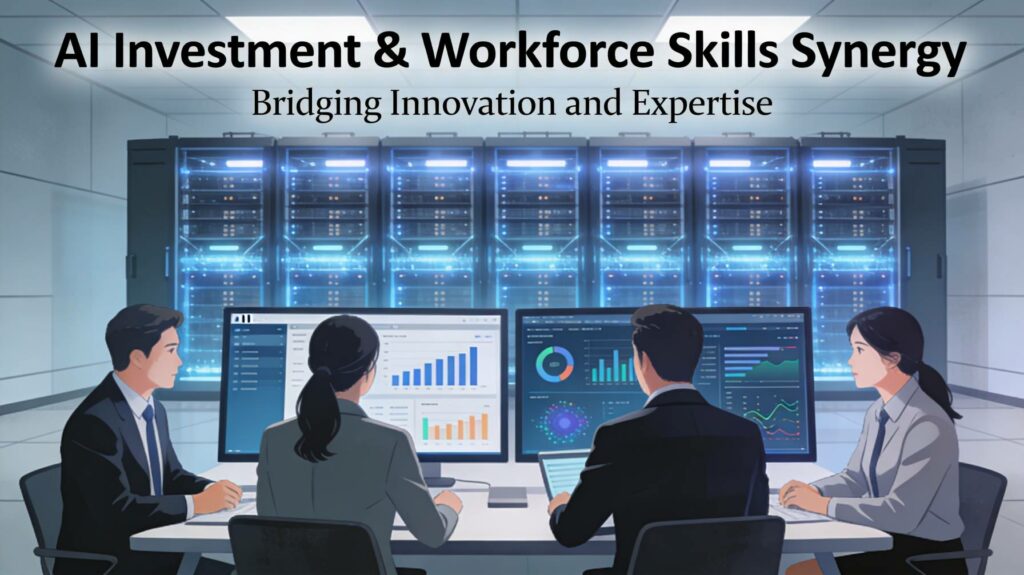
However, the biggest challenge companies face is not access to AI technology. It is the lack of skilled professionals who can implement, optimize, and scale AI effectively.
This is where the gap becomes critical.
Many organizations are investing heavily in infrastructure chips, data centers, and software—but are struggling to extract value because their workforce is not fully equipped to leverage these tools. AI, unlike previous technologies, requires not just adoption but deep understanding, strategic alignment, and continuous learning.
Without that, even the largest investments can underperform.
NVIDIA’s Success Highlights a Deeper Lesson
NVIDIA’s financial success is not just about selling chips. It reflects a broader ecosystem shift where AI infrastructure, software, and expertise are converging to create value.
The company benefits because it sits at the center of this transformation. Its GPUs power AI models, data centers, and enterprise applications. As demand for AI grows, so does its cash flow.
But for most organizations, the situation is different.
They are not selling AI infrastructure. They are trying to use AI to improve their business. And that requires a completely different capability—one rooted in skills, strategy, and execution.
This is why some companies are already seeing strong returns from AI, while others are still struggling to justify their investments. The difference is not the technology. It is the people using it.
The Real Bottleneck Is AI Talent
One of the most consistent findings across industry reports is that the biggest barrier to AI adoption is the shortage of skilled professionals.
Companies need individuals who can understand AI models, interpret data, align AI initiatives with business goals, and manage ethical and operational risks. Without this, AI remains underutilized or misapplied.
This is also why many organizations are moving from experimentation to structured AI strategies. They are realizing that success depends on building internal capability—not just buying external tools.
In other words, AI is no longer just a technology investment. It is a talent investment.
Why AI Training Is No Longer Optional
The current AI landscape makes one thing clear: organizations that invest in training will outperform those that only invest in technology.
AI training enables professionals to move beyond basic usage and develop a deeper understanding of how AI can be applied within their specific industry. It helps leaders make informed decisions, reduces implementation risks, and accelerates innovation.
More importantly, it creates a culture of adaptability—something essential in a world where AI is evolving rapidly.
As competition intensifies and margins come under pressure, companies will need to ensure that every AI investment translates into measurable business outcomes. That is only possible when teams have the right skills.
Bridging the Gap Between AI Spending and ROI
The current wave of AI spending is unprecedented. But spending alone does not guarantee success.
To bridge the gap between investment and return, organizations must focus on three key areas: understanding AI capabilities, aligning them with business objectives, and continuously upskilling their workforce.
This is where structured learning frameworks and certification programs become essential.
They provide a clear pathway for professionals to build AI expertise, stay updated with industry trends, and apply knowledge in real-world scenarios.
Without this, even the most advanced AI tools can fail to deliver value.
How AI CERTs ATP Can Help
As the AI economy continues to expand, the need for skilled professionals will only grow. Organizations that prioritize training today will be better positioned to lead tomorrow.
The AI CERTs Authorized Training Partner (ATP) program plays a crucial role in this transformation. It enables training providers and organizations to deliver industry-recognized AI certifications, ensuring that professionals gain practical, relevant, and up-to-date skills.
By becoming part of this ecosystem, organizations can build internal AI capability, improve ROI on AI investments, and stay competitive in a rapidly evolving market.
FAQs
1. Why is NVIDIA’s cash growth important for the AI industry?
It reflects the massive demand for AI infrastructure, showing that AI is becoming a core driver of global business growth.
2. Why are some companies struggling to see returns from AI investments?
Many lack the skilled workforce needed to effectively implement and scale AI solutions, leading to underutilized investments.
3. What is the biggest challenge in AI adoption today?
The shortage of trained AI professionals who can bridge the gap between technology and business outcomes.
4. How does AI training improve business performance?
It helps teams understand, implement, and optimize AI solutions, leading to better decision-making, efficiency, and ROI.
5. What is the AI CERTs ATP program?
It is a training partnership model that enables organizations to deliver globally recognized AI certifications and build workforce readiness for the AI-driven future.
Disclaimer: Some content may be AI-generated or assisted and is provided ‘as is’ for informational purposes only, without warranties of accuracy or completeness, and does not imply endorsement or affiliation.


