

AI CERTS
2 hours ago
AI Infrastructure Investments Are Expanding Beyond Big Tech and Why AI Training Is Becoming a Business Priority
One example is Regal Rexnord, a manufacturing and automation company that analysts believe is well-positioned to benefit from rising demand for AI-powered robotics and data center equipment. The report reflects a broader market realization that the future of AI depends as much on physical infrastructure as it does on intelligent algorithms.
While this shift creates exciting opportunities for businesses across industries, it also raises an important question. As AI infrastructure continues to grow at an unprecedented pace, does the workforce possess the skills required to implement, manage, and maximize these technologies? The answer will define which organizations successfully capitalize on AI and which struggle to keep pace.
AI Is Becoming an Industrial Transformation
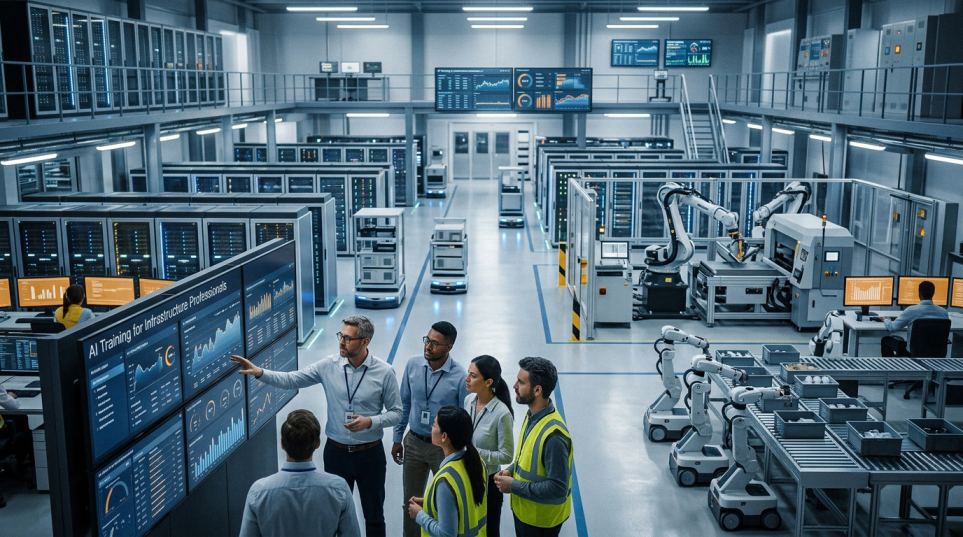
The first wave of AI adoption centered around chatbots, content generation, and business productivity tools. Today, AI is driving large-scale investments in robotics, automation systems, manufacturing equipment, and next-generation data centers. Companies producing motors, motion control systems, industrial components, and intelligent automation technologies are becoming integral to the AI ecosystem because they enable AI systems to operate efficiently in real-world environments. (Business Insider)
This transition demonstrates that AI is becoming deeply embedded in industries such as manufacturing, logistics, healthcare, retail, and energy. Organizations are increasingly integrating AI with physical operations to improve productivity, reduce operational costs, optimize maintenance schedules, and enhance decision-making. AI is evolving from being a supporting technology into a core business capability that drives competitive advantage.
Technology Investments Need Skilled Professionals
Purchasing AI-enabled equipment or deploying advanced AI platforms is only the first step. Organizations also need professionals who understand how AI models function, how data should be managed, how automation workflows can be optimized, and how AI systems should be governed responsibly.
Many organizations are discovering that technology investments alone cannot deliver measurable returns without employees capable of integrating AI into existing business processes. Whether implementing predictive maintenance in manufacturing, deploying intelligent robotics in warehouses, or managing AI infrastructure in data centers, skilled professionals remain the deciding factor between successful transformation and underutilized technology.
This growing skills gap is becoming one of the biggest challenges facing enterprises worldwide. As AI adoption accelerates, businesses are actively seeking professionals who combine technical AI knowledge with practical business understanding.
Lessons Businesses Can Learn from This Industry Shift
The growing focus on AI infrastructure offers valuable lessons for organizations planning their own AI strategies. First, AI should be viewed as a long-term business investment rather than a short-term technology trend. Companies investing today are building capabilities that will support innovation for years to come.
Second, successful AI adoption extends far beyond software implementation. It requires collaboration between leadership teams, technical specialists, operations professionals, and business decision-makers. Every department must understand how AI contributes to organizational objectives.
Finally, continuous learning has become essential. AI technologies, regulations, and industry applications continue to evolve rapidly. Organizations that prioritize ongoing AI education will be better prepared to adapt to new opportunities while managing associated risks responsibly.
Why AI Training Is Becoming a Strategic Business Investment
As industries embrace intelligent automation, employers increasingly value professionals who can translate AI capabilities into measurable business outcomes. Practical AI knowledge enables teams to identify suitable use cases, improve operational efficiency, strengthen governance, and confidently manage AI-driven transformation initiatives.
Professional AI training helps individuals develop these competencies through structured learning that combines foundational concepts with practical applications. It also provides organizations with a scalable approach to building AI-ready teams capable of supporting digital transformation initiatives across departments.
Rather than reacting to technological change after it occurs, businesses that invest in AI education position themselves to lead innovation, accelerate implementation, and achieve greater returns from their AI investments.
Preparing the Workforce for the Next Phase of AI
The latest developments in AI infrastructure demonstrate that the future of artificial intelligence extends well beyond software applications. Robotics, smart manufacturing, automation systems, and AI-ready infrastructure are becoming the backbone of modern enterprises. As these technologies continue expanding across industries, organizations need professionals equipped with practical AI knowledge to unlock their full potential.
Businesses looking to build AI capabilities can benefit from partnering with an AI CERTs Authorized Training Partner. Through globally recognized certification programs, hands-on learning experiences, and industry-focused AI education, Authorized Training Partners help organizations develop skilled professionals who are prepared to implement AI responsibly, drive innovation, and support long-term business growth. Learn more about becoming an AI-ready organization through the AI CERTs Authorized Training Partner network.
Disclaimer: Some content may be AI-generated or assisted and is provided ‘as is’ for informational purposes only, without warranties of accuracy or completeness, and does not imply endorsement or affiliation.


