

AI CERTS
1 hour ago
AI-Driven GCC Operating Models Are Becoming a Competitive Advantage and Why AI Training Is Now Business-Critical
This transformation is creating a major competitive advantage for organizations that are ready to adapt. At the same time, it is exposing a growing skills gap that businesses can no longer afford to ignore. As AI becomes central to GCC strategy, the demand for trained AI professionals, AI governance experts, automation specialists, and AI-ready leadership teams is rising rapidly.
The future of GCCs is no longer just about operational efficiency. It is about intelligence, innovation, and workforce readiness.
GCCs Are Evolving Into AI-Native Innovation Hubs
India’s GCC ecosystem is experiencing a remarkable evolution. According to recent industry insights, organizations are increasingly investing in Agentic AI, GenAI, and enterprise-wide automation to redesign workflows and improve global decision-making. GCCs are now becoming “enterprise intelligence hubs” where AI, data, R&D, and innovation converge.
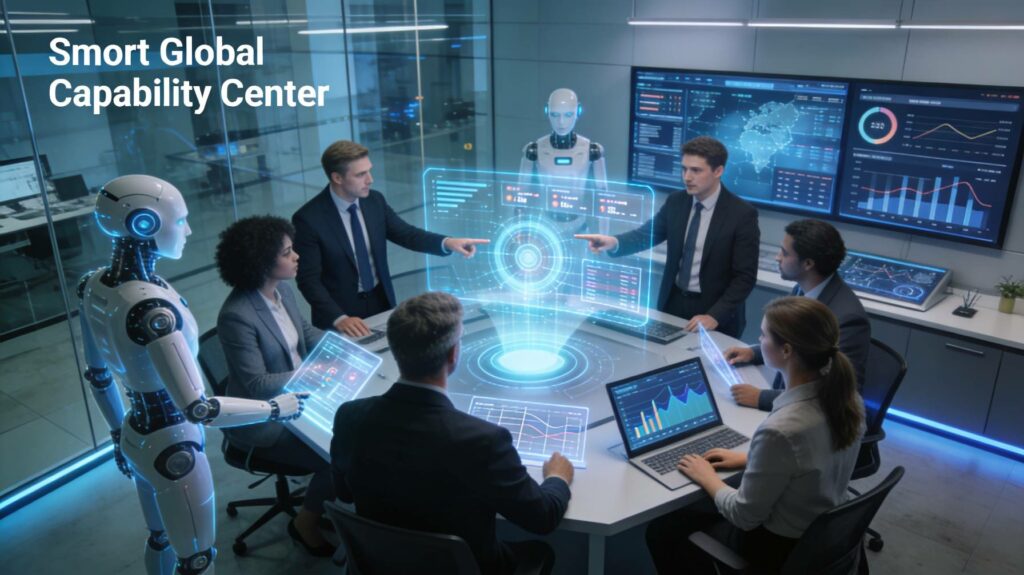
This shift is changing the role GCCs play within multinational enterprises. Instead of functioning as backend delivery centers, GCCs are now leading AI-led transformation initiatives across finance, customer service, cybersecurity, operations, and product innovation. Reports indicate that 83% of GCCs are already investing in GenAI while a large percentage are actively deploying agentic AI capabilities across business functions.
Organizations are realizing that competitive advantage no longer comes only from scale or labor arbitrage. It comes from the ability to combine AI with skilled talent, strong governance, and agile operating models.
AI Is Reshaping GCC Workforce Expectations
As GCCs become more AI-driven, entirely new job roles are emerging. AI orchestration specialists, AI governance architects, multimodal interaction designers, AI compliance auditors, prompt engineers, and AgentOps managers are becoming increasingly important inside modern GCC ecosystems.
This transformation is not only changing technology infrastructure but also redefining workforce expectations.
Companies are actively looking for professionals who understand AI implementation, human-AI collaboration, automation strategy, responsible AI, and data governance. The challenge, however, is that many existing teams are still adapting to these rapid changes.
That is why organizations are investing heavily in upskilling initiatives. Recent industry findings show that over 70% of GCCs are prioritizing workforce reskilling to prepare employees for future AI-driven roles.
Without structured AI education and certifications, businesses risk slowing down their transformation journey while competitors move ahead with AI-ready talent.
Why AI Training Has Become a Strategic Business Priority
The AI conversation has matured significantly in 2026. Businesses are moving beyond experimentation and focusing on measurable value, governance, trust, and scalable deployment. Industry experts now emphasize that successful AI adoption depends not just on technology investments but on workforce preparedness and responsible implementation.
This is where AI training becomes essential.
Organizations cannot build intelligent GCC operating models if employees lack the skills to work alongside AI systems, interpret AI-driven insights, or manage AI risks effectively. Even the world’s leading consulting firms are investing in AI-focused workforce transformation programs to help employees understand how AI will reshape their roles.
The demand today is not simply for technical AI experts. Businesses also need leaders who can strategically align AI with business goals, professionals who can govern AI responsibly, and teams capable of integrating AI into real-world enterprise workflows.
AI literacy is becoming a core business competency.
Intelligent GCCs Need AI-Ready Leadership
One of the biggest shifts happening inside GCCs is the move toward AI-first operating models. Organizations are redesigning enterprise structures around autonomous workflows, intelligent automation, and human-AI collaboration. (EY)
However, technology alone cannot create transformation.
Leaders must understand how to manage AI responsibly, evaluate AI-driven risks, identify AI opportunities, and build sustainable innovation ecosystems. This requires continuous learning and professional AI certification programs that align with evolving industry demands.
As GCCs become more strategic to enterprise growth, companies that invest in AI-trained leadership teams will gain stronger operational agility, faster innovation cycles, and improved decision-making capabilities.
The organizations that succeed in the next decade will not simply adopt AI tools. They will build AI-capable cultures.
How AI CERTs ATP Can Help Organizations Prepare for the Future
As GCC operating models become increasingly AI-driven, businesses need trusted partners that can help bridge the growing AI skills gap.
The AI CERTs Authorized Training Partner Program helps organizations, training providers, and enterprises deliver globally recognized AI certification programs designed for modern workforce transformation.
From AI leadership and prompt engineering to AI governance and automation, these certifications help professionals build practical, industry-relevant AI expertise that aligns with evolving GCC requirements.
For organizations looking to create AI-ready teams, future-proof leadership, and accelerate intelligent transformation, AI CERTs ATP offers a scalable pathway to workforce readiness in the age of AI.
FAQs
1. Why are GCCs becoming important in AI transformation?
GCCs are evolving into innovation and intelligence hubs where enterprises centralize AI, automation, analytics, and digital transformation initiatives to improve global business operations and decision-making.
2. What skills are most in demand in AI-driven GCCs?
Skills related to GenAI, AI governance, automation, data analytics, prompt engineering, AI orchestration, cybersecurity, and human-AI collaboration are increasingly in demand.
3. Why is AI training important for GCC professionals?
AI training helps professionals adapt to changing workflows, understand AI systems, improve productivity, and contribute effectively to AI-led enterprise transformation.
4. How are companies addressing the AI skills gap?
Many organizations are investing in reskilling initiatives, AI certifications, and workforce transformation programs to prepare employees for future AI-driven roles.
5. How can AI CERTs ATP support AI workforce development?
AI CERTs ATP provides globally recognized AI certification programs that help organizations and professionals gain practical AI skills needed for modern enterprise and GCC environments.
Disclaimer: Some content may be AI-generated or assisted and is provided ‘as is’ for informational purposes only, without warranties of accuracy or completeness, and does not imply endorsement or affiliation.


