

AI CERTS
4 days ago
96% Less Traffic! The AI Disruption Publishers Didn’t See Coming (And How AI Training Can Save You)
That’s not a hypothetical. It’s already happening.
The Shocking Reality: AI Is Killing Referral Traffic
Recent research reveals that AI chatbots and search tools are delivering up to 96% less referral traffic to publishers compared to traditional search engines like Google.
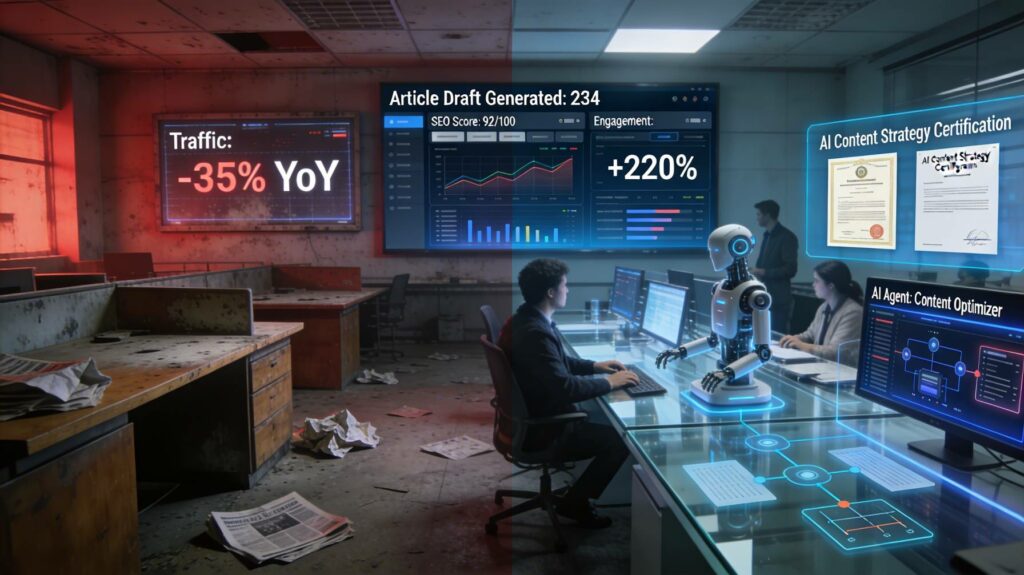
Let that sink in.
Instead of clicking links, users now get instant answers directly from AI interfaces. The result?
No clicks. No visits. and No ad impressions.
This isn’t a gradual shift—it’s a structural disruption.
In short: the traffic model publishers depended on is collapsing.
What’s Driving This Collapse?
The answer lies in how AI fundamentally changes user behavior.
1. From “Search & Click” to “Ask & Get”
Traditional search engines acted as gateways. Users searched, scanned results, and clicked through to websites.
AI eliminates that journey.
Now, users simply ask—and AI delivers a summarized answer instantly. No need to visit the source.
This phenomenon is called “zero-click behavior”, and it’s accelerating rapidly. Studies show that nearly two-thirds of news searches now result in no click at all.
2. AI Is Consuming Content Without Sending Traffic Back
Behind the scenes, AI bots are aggressively crawling the web.
- - AI training crawlers make up 63% of AI bot activity targeting media
- - Real-time “AI fetchers” pull content to generate instant answers
- - AI scraping activity has surged by up to 300%
Publishers are essentially feeding AI systems—without getting audience traffic in return.
3. Revenue Models Are Breaking
Less traffic means fewer ads, fewer subscriptions, and fewer conversions.
Some reports show:
- - Small publishers losing up to 60% of search traffic
- - Local publishers seeing 25–50% traffic declines
For an industry built on pageviews, this isn’t just disruption—it’s existential.
Why This Disruption Is Bigger Than SEO
This isn’t another algorithm update.
It’s a complete shift from Search Engine Optimization (SEO) to what many now call Answer Engine Optimization (AEO).
In the past, success meant ranking on Google.
Now, success means being:
- - Cited by AI
- - Structured for machine readability
- - Trusted by algorithms, not just users
And most publishers—and professionals—are not prepared for this shift.
The New Reality: AI Is the Audience
Here’s the uncomfortable truth:
Your next “reader” may not be human.
AI systems are becoming:
- - The primary content consumers
- - The intermediaries between brands and users
- - The new gatekeepers of visibility
As one industry insight puts it, the web is shifting from human traffic to AI-mediated consumption.
This changes everything:
- - Content strategy
- - Distribution models
- - Monetization frameworks
So, What Can Publishers (and Professionals) Do?
This is where most conversations stop at fear.
But the real opportunity lies in adaptation.
1. Build AI-Ready Content
Content must now be:
- - Structured (schema, metadata, clarity)
- - Context-rich (not just keywords)
- - Authority-driven (E-E-A-T signals)
2. Diversify Beyond Traffic
Relying only on search traffic is no longer viable.
Publishers are already shifting toward:
- - Subscriptions
- - Communities
- - Direct engagement channels
3. Understand AI Systems—Deeply
And this is the most critical shift.
Because the winners in this new era won’t be those who fight AI…
They’ll be the ones who understand and leverage it.
How AI Training Becomes the Survival Advantage
This is where the conversation shifts from problem to solution.
The disruption is not just technological—it’s a skills gap.
Most professionals today:
- - Don’t understand how AI retrieves content
- - Don’t know how AI ranks or cites sources
- - Aren’t trained to optimize for AI ecosystems
And that’s exactly why AI training is no longer optional.
It’s strategic.
The Opportunity: Become an AI-First Organization
Forward-thinking organizations are already investing in structured AI education frameworks—like the AI CERTs Authorized Training Partner (ATP) Program.
Instead of reacting to disruption, they are:
- - Training teams in AI literacy and application
- - Building AI-driven content and marketing strategies
- - Creating new revenue streams aligned with AI ecosystems
Why ATP Matters Now
The ATP model enables:
- - Training providers to deliver industry-recognized AI certifications
- - Organizations to upskill teams quickly
- - Professionals to stay relevant in an AI-first economy
In a world where AI controls visibility, those who understand AI will control growth.
The Bottom Line
The “traffic era” of the internet is fading.
AI is not just changing how people search—it’s changing whether they search at all.
Publishers who rely on old models will continue to see decline.
But those who:
- - Adapt their content
- - Rethink their distribution
- - Invest in AI training
…won’t just survive.
They’ll lead.
FAQs
1. Why are publishers losing traffic due to AI?
AI tools provide direct answers, eliminating the need for users to click on links, which drastically reduces website visits and referral traffic.
2. What does “96% less traffic” actually mean?
It means AI-driven platforms send only a fraction of the visitors that traditional search engines like Google used to send to publisher websites.
3. Are all publishers equally affected?
No. Smaller publishers are hit the hardest, with some losing up to 60% of their traffic, while larger brands have slightly more resilience.
4. Can publishers recover from this decline?
Yes—but only by adapting. This includes diversifying revenue streams, optimizing for AI systems, and building direct audience relationships.
5. How does AI training help in this situation?
AI training helps professionals understand how AI systems work, enabling them to create content, strategies, and business models that align with the new AI-driven digital ecosystem.


