

AI CERTs
2 hours ago
AI Labor Displacement: Parsing Job Market Signals in 2026
Boardrooms worldwide face urgent questions about workforce futures.
Investors, regulators, and employees all track AI Labor Displacement trends closely.
Yet the actual labour market data remain muddy and often contradictory.
Moreover, global reports project sweeping changes across every major economy.
Conversely, near-term studies reveal only modest aggregate losses but sharp pockets of pain.
Consequently, leaders need a clear map of signals, drivers, and policy moves.
This article distills the latest evidence and outlines practical next steps.
We draw on WEF, McKinsey, Stanford, and Challenger findings through early 2026.
Additionally, we examine impacts on unemployment, sector transitions, and corporate strategy.
Our goal is actionable insight for executives navigating rapid change and unpredictable demand.
Nevertheless, every claim is checked against primary documents to ensure rigor.
Mixed Signals Now Surface
Global forecasts headline optimistic net job creation.
However, short-term payroll microdata tell a calmer story, even amid automation investments.
Stanford's ADP analysis finds early-career employment falling roughly thirteen percent in exposed occupations.
Meanwhile, Challenger tracked 54,800 U.S. layoffs explicitly blamed on AI during 2025.
In contrast, national unemployment rates barely moved, insulated by robust service growth.
Such divergence fuels debate over the trajectory of AI Labor Displacement.
Evidence diverges between headline projections and present payroll realities.
Decision makers must read both signals carefully.
Next, we explore why younger staff absorb disproportionate shocks.
Young Workers Hit Hard
Stanford researchers describe young employees as employment “canaries” in AI mines.
Furthermore, workers aged twenty-two to twenty-five saw double-digit relative declines in AI-exposed tasks.
Seasoned colleagues often captured augmentation benefits instead of displacement.
Brookings notes similar patterns across the finance industry and software services.
Consequently, entry-level roles that traditionally build foundational skills now vanish or shrink.
AI Labor Displacement therefore threatens talent pipelines and long-term productivity.
Early-career pain signals wider systemic risk.
Organizations cannot ignore looming skills bottlenecks.
The broader employment outlook, however, remains contested, as our next section shows.
Net Jobs Outlook Diverges
WEF projects one-hundred-seventy million new roles and ninety-two million displaced by 2030.
Therefore, the net balance appears positive, despite persistent headlines about AI Labor Displacement.
McKinsey scenarios agree but warn that twenty to thirty percent of work hours face automation.
UNCTAD, in contrast, warns forty percent of global jobs carry some exposure.
Moreover, capital concentration may funnel gains toward large firms while the wider economy benefits less.
These conflicting models sustain uncertainty around upcoming waves of AI Labor Displacement across every industry.
Long-range projections differ because adoption speed and policy choices remain fluid.
Thus executives should prepare for multiple futures, not a single forecast.
We now examine how sectors vary in exposure and transition demands.
Sector Trends And Transitions
Task exposure varies sharply across manufacturing, healthcare, finance, and creative media.
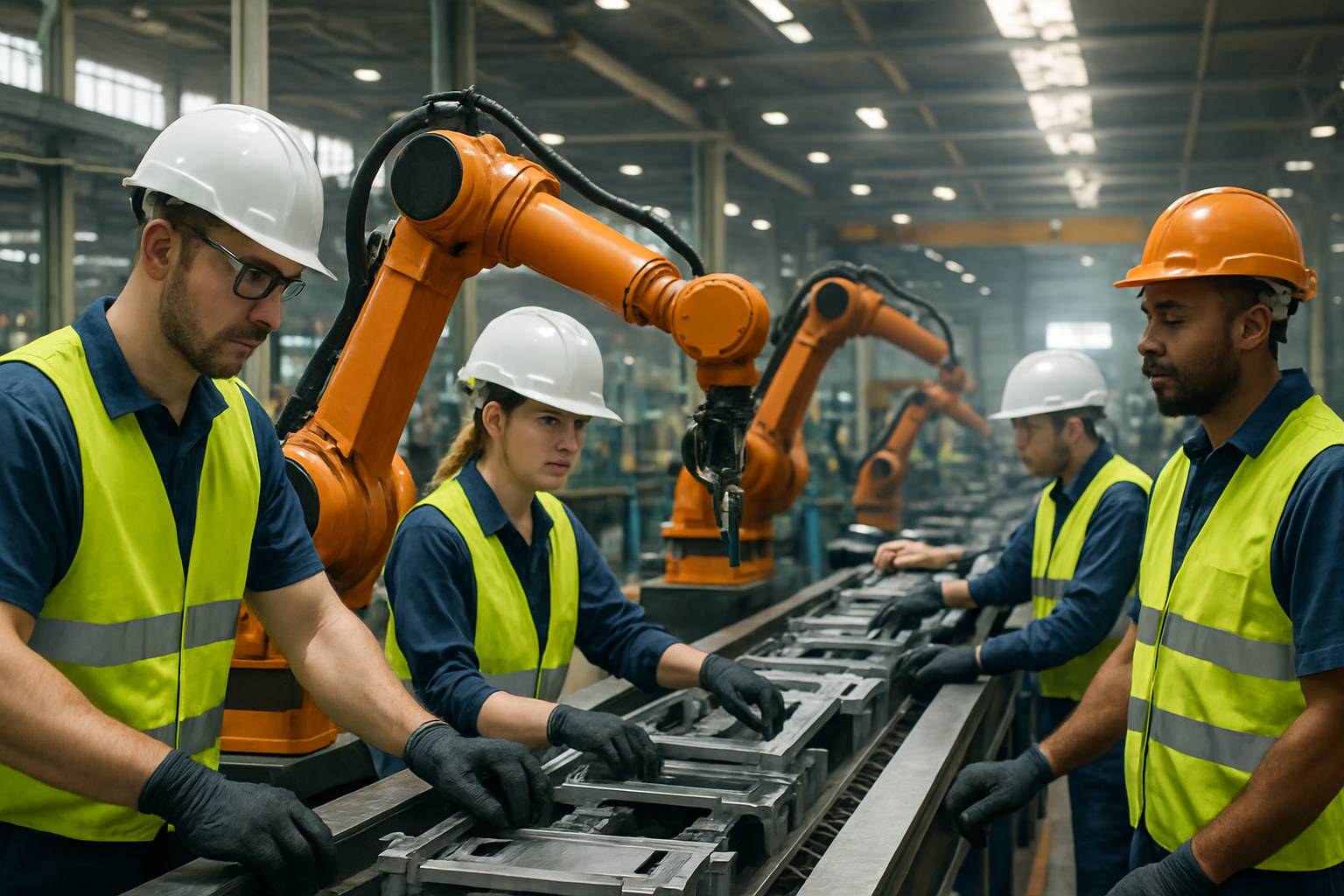
Manufacturing faces deep automation of routine assembly yet gains new maintenance roles.
Healthcare, meanwhile, expects augmentation through diagnostics rather than wholesale job loss.
Creative industries confront generative tools that accelerate content cycles yet threaten junior copywriters.
Additionally, finance software now automates clerical reconciliation while raising demand for oversight and risk specialists.
Across sectors, AI Labor Displacement interacts with skill levels, regulation, and capital intensity.
Sector dynamics highlight the importance of context when estimating job risk.
No single metric captures every nuance.
Attention now turns to how governments and institutions react.
Policy Response Momentum Builds
Governments increasingly publish guidance on transparency, worker consultation, and reskilling incentives.
OECD and ILO urge social partners to embed voice mechanisms during AI rollouts.
Consequently, policy aims to cushion AI Labor Displacement while preserving innovation incentives.
Several states tie tax relief to certified upskilling programs.
Professionals can boost expertise through the AI+ Security Level 1 certification.
Moreover, public funding increasingly supports micro-credential ecosystems.
Policy momentum is notable yet fragmented across jurisdictions.
Effective coordination could reduce unemployment shocks and skill mismatches.
Corporate agendas must align with these initiatives, as the next section explores.
Reskilling Imperative For Firms
Firms adopting AI report that skills gaps, not capital, now limit deployment.
Therefore, reskilling budgets shift from optional to strategic necessities.
WEF surveys show fifty-nine percent of workers need training before 2030.
Leading companies create internal academies covering data literacy, prompt engineering, and ethical AI governance.
In contrast, laggards risk higher turnover and prolonged unemployment costs.
Proactive training also mitigates AI Labor Displacement by unlocking augmentation benefits for existing staff.
Organizational learning accelerates competitive advantage in every economy.
Delayed action compounds talent deficits.
Our final section outlines practical steps executives should adopt now.
Strategic Actions For Leaders
Executives can follow a structured playbook.
First, map task exposure against skill inventories using up-to-date payroll and vacancy data.
Second, quantify potential AI Labor Displacement under optimistic and pessimistic adoption scenarios.
- Set measurable reskilling targets aligned with business strategy.
- Integrate human-centered design to maximize augmentation gains.
- Report AI workforce impacts in annual disclosures for transparency.
- Engage policymakers to shape balanced incentives across industry.
These steps translate uncertainty into manageable roadmaps.
Consequently, leadership vigilance tempers risk while capturing upside.
We close with key reflections and next moves.
Conclusion And Call-To-Action
AI Labor Displacement continues to unfold along uneven, sector-specific paths.
Yet aggregate job loss remains modest, even as automation accelerates.
Moreover, young workers and routine roles face outsized exposure, demanding rapid reskilling interventions.
Policy momentum, corporate academies, and trusted certifications provide actionable tools.
Therefore, leaders who experiment, measure, and communicate will protect competitiveness and reduce unemployment fallout.
Act now to audit skills, deploy training, and leverage certifications that future-proof teams.
Start by enrolling key staff in the AI+ Security Level 1 course today.


