

AI CERTS
3 months ago
Time-Aligned Captions Boost Video Generation AI
This temporal conditioning promises sharper adherence to text while keeping characters and backgrounds stable. Moreover, the team released code, a synthetic dataset, and evaluation assets under open licenses. Industry developers already exploring Video Generation AI can test TALC today through GitHub and Hugging Face. Meanwhile, Google’s 2024 research roundup lists TALC among the year’s key breakthroughs. Therefore, analysts expect rapid experimentation across advertising, education, and short-form entertainment. The following report dissects the research, metrics, business implications, and remaining challenges. Readers will gain technical clarity and actionable context for upcoming product decisions.
Rise Of Script Control
Multi-scene scripts amplify narrative richness, yet they create alignment headaches for generators. Earlier systems either merge entire scripts into one prompt or stitch isolated clips afterward. Consequently, creators face broken temporal consistency, visual jumps, and wasted post-production hours.
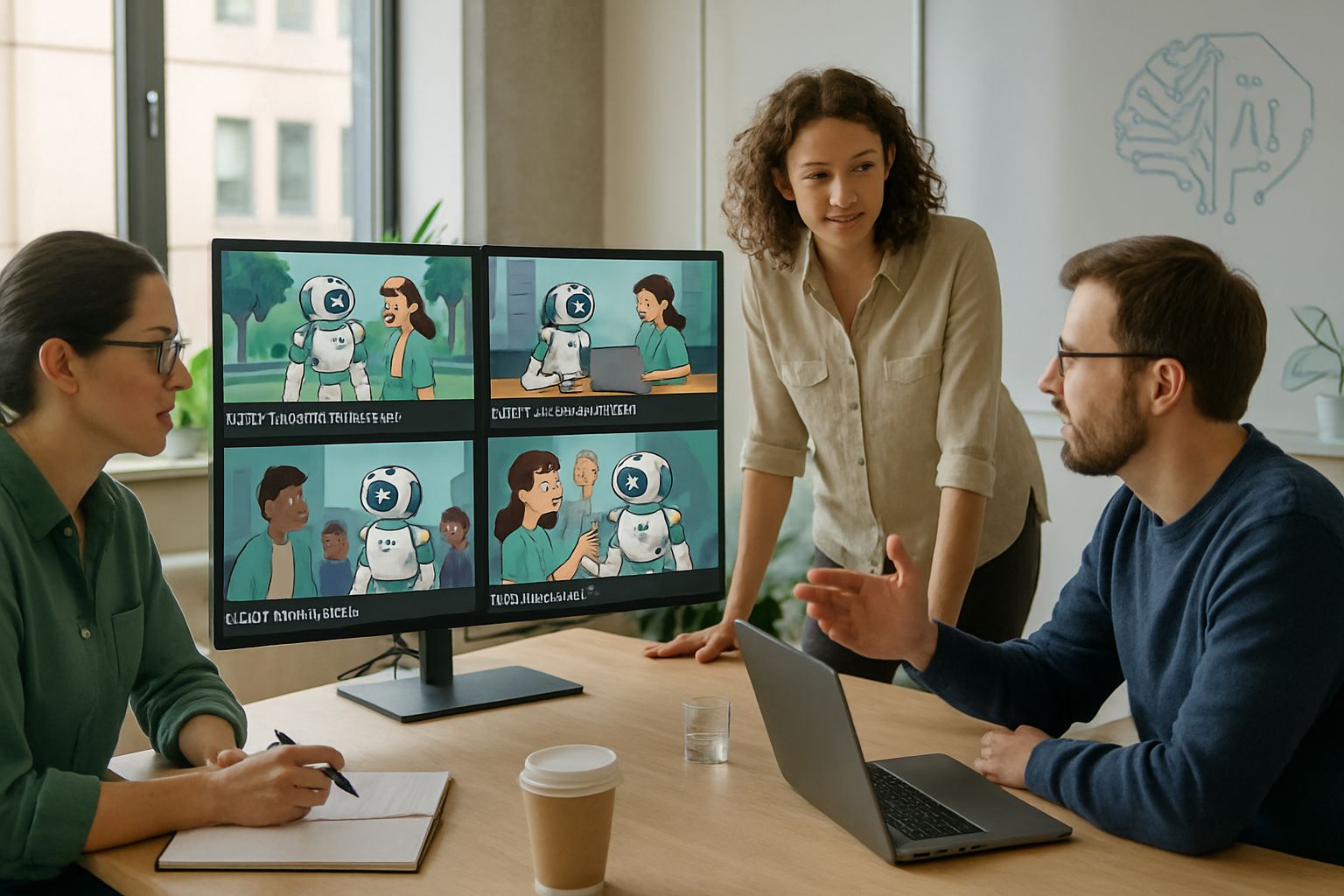
In contrast, TALC attacks the root cause by introducing explicit time awareness during sampling. Each caption segment guides only its assigned frame span, preventing cross-scene confusion. Therefore, storyboards emerge in a single coherent pass.
TALC sets the stage for controllable narratives without complex editing pipelines. Subsequently, we explore exactly how the mechanism functions under the hood.
How TALC Method Works
TALC modifies the cross-attention blocks inside a standard diffusion Video Generation AI backbone. During inference, the model receives a list of scene embeddings paired with precise frame indices. Moreover, a masking schedule ensures only the relevant text influences each timestep.
The approach remains architecture-agnostic, operating with ModelScope, Lumiere, and other diffusion variants. Additionally, developers may fine-tune checkpoints to strengthen alignment further. The multimodal context empowers richer correlations. Yet the core logic already works as a lightweight plug-in.
This elegant hook delivers significant control without retraining entire stacks. Consequently, technical adoption barriers stay minimal, encouraging broad pilot projects.
Key TALC Technical Details
Dataset quality often dictates generalization, so the researchers fabricated multi-scene supervision synthetically. They segmented YouTube videos with PySceneDetect and selected keyframes per scene. Gemini-Pro-Vision then produced descriptive captions, supplying multimodal grounding data.
Altogether, the public dataset covers about 20,000 scene captions, 73 percent being multi-scene. Furthermore, released checkpoints inherit the original diffusion model licenses. For Video Generation AI practitioners, such transparency reduces replication friction. This transparency supports reproducibility and academic scrutiny.
Under evaluation, TALC gained 15.5 points on the authors’ combined score for text fidelity and temporal consistency. Human annotators preferred TALC clips over baseline outputs in most trials. Nevertheless, the paper documents some failure cases, including color drift and minor object flicker.
This improvement stems from tighter text-to-frame synthesis control. These metrics validate the technical architecture and synthetic data pipeline. However, performance figures alone never guarantee commercial success, as we next examine.
Performance Gains Now Evident
Beyond numeric scores, qualitative comparisons reveal sharper scene boundaries and maintained character outfits. Observers noted smoother camera motion, underlining improved temporal consistency yet again. Moreover, entity re-identification errors decreased, easing downstream editing burdens.
- +15.5 point gain on overall human score
- 29% relative improvement versus stitched-clip baseline
- Single-pass generation preserves global lighting and background continuity
Meanwhile, execution time stayed comparable because the adjustment runs only during attention lookup. Therefore, users achieve higher quality without heavier compute bills.
Observed gains establish a practical upper bound for current diffusion pipelines. Subsequently, decision makers must map these benefits to real commercial value. Ultimately, Video Generation AI stands to gain unprecedented storytelling agility.
Practical Business Impact Ahead
Advertising teams can now storyboard 30-second spots from a single prompt list. Educational producers could craft step-by-step experiments while retaining uniform classroom settings. Additionally, social media platforms may auto-generate highlight reels with consistent branding overlays.
- In-house creative agencies seeking rapid concept testing
- Indie game studios prototyping cut-scene drafts
- Cloud SaaS vendors offering on-demand tutorial videos
Moreover, compliance staff will appreciate easier audit trails when scenes flow predictably. Professionals can gain expertise via the AI Security Level-1 certification.
These opportunities illustrate clear revenue channels tied directly to Video Generation AI innovations. Consequently, risk analysis becomes the next focal point.
Risks And Core Limitations
Synthetic labels may embed biases from Gemini-Pro-Vision, limiting generalization to niche domains. In contrast, real cinematic datasets remain scarce because manual captioning is expensive. Moreover, governance teams worry about misuse for misinformation or copyright infringement.
TALC does not inherently block deepfake attempts or remove protected trademarks. Therefore, organizations deploying Video Generation AI must layer policy filters and watermarking. Additionally, the license terms of base models still apply, influencing downstream liability.
These caveats demand risk mitigation strategies alongside technical rollouts. Nevertheless, strong safeguards can coexist with experimental creativity, as future work demonstrates.
Future Research Directions Ahead
Researchers intend to collect human-curated multi-scene datasets for stronger benchmarks. Subsequently, integrating audio tracks could push toward fully synchronized, multimodal storytelling. Better perceptual metrics for temporal consistency also remain open challenges.
Cross-model reuse of scene embeddings may unlock rapid style transfer and interactive editing tools. Furthermore, merging TALC with controllable video synthesis primitives promises granular frame-level commands. Industry voices will monitor whether Google product teams integrate these advances into consumer workflows.
Continued collaboration between academia and industry should accelerate responsible Video Generation AI progress. Consequently, stakeholders gain clearer roadmaps for capability rollouts.
Time-Aligned Captions marks a decisive step for multi-scene control. The framework injects time awareness while preserving diffusion efficiency. Consequently, narrative fidelity, temporal consistency, and brand continuity improve markedly. Business teams can already prototype campaigns, while researchers refine datasets and metrics. Nevertheless, ethical safeguards and license clarity remain essential companions. Developers evaluating Video Generation AI should download the code, run tests, and report findings. Meanwhile, aspiring specialists may pursue the linked AI Security Level-1 certification to deepen governance skills. Engage now, experiment responsibly, and help shape the next era of creative synthesis.


