

AI CERTS
3 hours ago
Ancestry’s AI-Powered Record Digitization Signals Why AI Training Is Becoming Essential for Training Partners
For AI training partners, this development is more than an inspiring technology story. It demonstrates how organizations across industries are investing in AI to solve complex business challenges, creating an urgent demand for professionals who understand how to implement, manage, and optimize AI solutions. As enterprises continue integrating AI into their workflows, the need for structured AI education is growing just as rapidly.
AI Is Redefining Data-Intensive Industries
Ancestry has spent decades building one of the world's largest collections of historical records, including birth certificates, census data, marriage licenses, immigration documents, and handwritten family archives from dozens of countries. Traditionally, digitizing and indexing these records involved extensive manual transcription, validation, and organization, making the process both time-consuming and expensive.
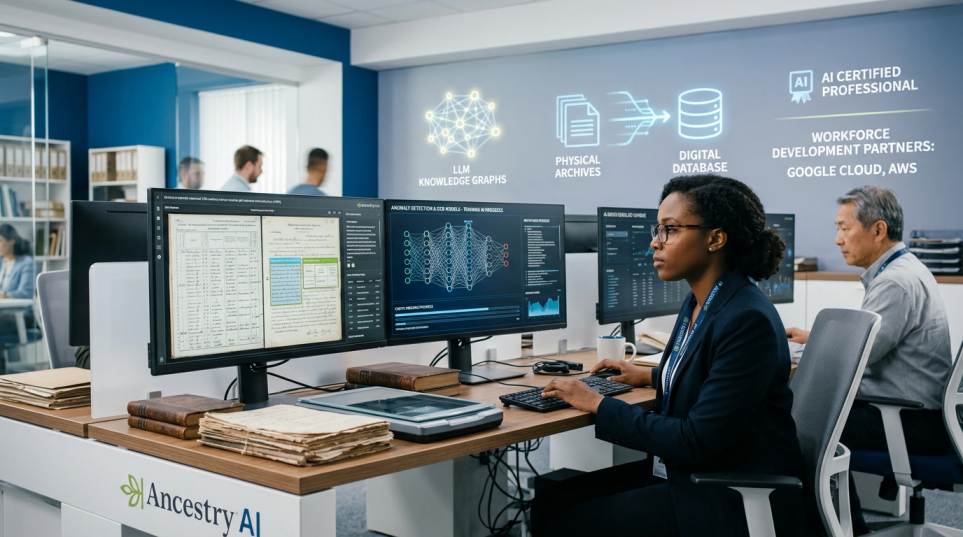
The company's AI journey began years ago with proprietary machine learning models and computer vision systems designed to recognize handwritten documents. As natural language processing advanced with models like BERT and later with generative AI, Ancestry expanded its capabilities to automate record extraction, multilingual transcription, facial recognition for historical photographs, and AI-generated family stories. By the end of 2025, more than half of its published historical records were AI-generated, dramatically increasing the speed and scale of digitization while maintaining human oversight for quality assurance.
This evolution illustrates that AI adoption is rarely a single technology implementation. Instead, it combines multiple AI disciplines working together to solve real-world operational challenges.
The Bigger Lesson for Businesses
Ancestry's success highlights an important shift occurring across industries. Organizations are increasingly using AI to enhance existing processes rather than simply automate isolated tasks. AI is helping businesses extract value from massive amounts of unstructured data, improve customer experiences, reduce operational bottlenecks, and unlock insights that were previously inaccessible.
Whether it is healthcare digitizing patient records, financial institutions processing compliance documents, manufacturers analyzing inspection images, or retailers personalizing customer interactions, the underlying AI technologies remain remarkably similar. Computer vision, natural language processing, predictive analytics, and generative AI are becoming foundational capabilities across sectors.
This means employers are searching for professionals who understand not only AI concepts but also how these technologies can be responsibly integrated into business operations.
Why AI Training Has Become a Strategic Priority
As enterprise AI adoption accelerates, organizations face a growing skills gap. Purchasing AI tools is only one part of digital transformation. Companies also need professionals who can evaluate AI use cases, prepare quality data, oversee model performance, understand ethical considerations, and ensure successful implementation.
Training therefore becomes a strategic investment rather than a technical exercise. Professionals equipped with practical AI knowledge can identify opportunities for automation, improve operational efficiency, and support innovation initiatives across departments.
For training providers, this represents a significant opportunity. Businesses are increasingly seeking trusted learning partners who can deliver structured AI education aligned with real industry applications instead of theoretical knowledge alone. The demand extends across executives, managers, technical teams, educators, consultants, and working professionals looking to remain competitive in an AI-driven economy.
What Training Partners Can Learn from This Development
Ancestry's AI transformation demonstrates that successful AI adoption depends on long-term capability building rather than quick technology deployments. The company invested in proprietary machine learning, continually refined its models with human validation, embraced newer LLMs as they matured, and expanded AI into customer-facing products over time.
Training partners can draw an important lesson from this approach. Organizations value learning programs that explain how AI technologies work together, how to evaluate suitable business use cases, and how to implement AI responsibly while maintaining accuracy, governance, and human oversight.
As AI becomes embedded in every industry, businesses will increasingly rely on knowledgeable training partners to prepare their workforce for evolving technologies and emerging job roles.
Building the Future with AI Education
The Ancestry story reinforces a broader trend shaping the global economy. AI is helping organizations process complex information faster, deliver richer customer experiences, and scale operations that once depended entirely on manual effort. These innovations are expanding across industries at a rapid pace, creating continuous demand for professionals with practical AI expertise.
For organizations and professionals alike, staying competitive will depend on continuous AI learning. This creates an ideal opportunity for training partners to deliver industry-relevant certifications and workforce development programs that address real business needs.
Becoming an Authorized Training Partner with AI CERTs enables organizations to offer globally recognized AI certification programs, expand their training portfolio, and support enterprises in building future-ready AI talent. As demand for AI education continues to rise, the AI CERTs Authorized Training Partner program provides the resources, curriculum, and industry alignment needed to help learners and businesses succeed in the evolving AI landscape.
Disclaimer: Some content may be AI-generated or assisted and is provided ‘as is’ for informational purposes only, without warranties of accuracy or completeness, and does not imply endorsement or affiliation.


