

AI CERTS
3 hours ago
Industrial Automation Accelerates in 2026 as AI Humanoids and Smart Factories Rise Highlighting the Growing Need for AI Training
This shift signals an important reality for manufacturers, system integrators, technology professionals, and business leaders. AI success will depend as much on skilled people as it does on advanced machines. As organizations invest heavily in intelligent automation, AI training is becoming the foundation that enables businesses to unlock the full value of these technologies.
Industrial Automation Is Entering a New Era
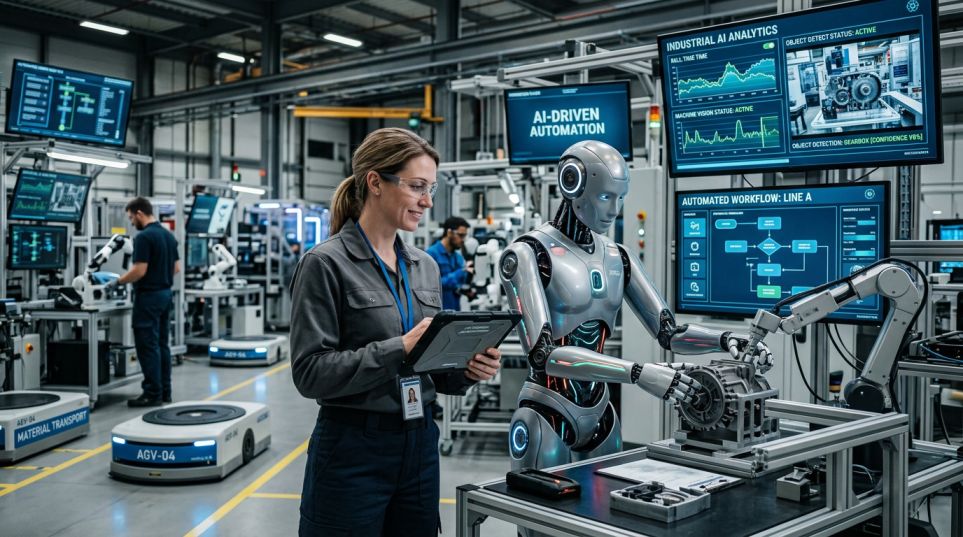
Across industries, AI is moving beyond software applications into physical environments. Manufacturers are integrating intelligent robots into production lines, while AMRs are transforming warehouse logistics and material handling. Facility upgrades are also becoming a strategic priority as organizations modernize factories to support connected machines, Industrial IoT, and AI-powered decision-making.
One notable development involves AI-enabled apparel manufacturing, where intelligent robotics is beginning to tackle production processes that have historically been difficult to automate due to the complexity of handling flexible fabrics. At the same time, automotive manufacturers are expanding the deployment of autonomous mobile robots to improve workplace safety and optimize internal logistics. These examples demonstrate that AI is no longer limited to repetitive industrial tasks but is evolving into a core driver of operational excellence across diverse manufacturing sectors.
The convergence of robotics, AI, advanced sensors, and modern manufacturing infrastructure is laying the groundwork for highly intelligent factories capable of making real-time operational decisions with minimal human intervention.
Technology Alone Cannot Deliver Business Value
While AI capabilities continue to evolve rapidly, organizations face a more practical challenge—operational readiness. Many manufacturers possess large volumes of production data but struggle with fragmented systems, inconsistent processes, weak cybersecurity, or insufficient governance structures. Without addressing these foundational issues, even the most sophisticated AI solutions may fail to deliver measurable business outcomes.
Successful AI adoption requires professionals who understand far more than automation hardware. Teams must know how AI models interact with industrial data, how machine learning improves predictive maintenance, how cybersecurity protects operational technology environments, and how AI-driven insights support better production decisions.
This is where workforce capability becomes a competitive differentiator.
Why AI Training Has Become a Business Imperative
As factories become increasingly intelligent, every department is affected. Operations managers must interpret AI-driven recommendations. Engineers need to understand machine learning applications. Plant supervisors must collaborate with AI-powered systems, while executives require strategic knowledge to make informed technology investments.
Organizations that invest in AI training gain more than technical knowledge. They develop teams capable of identifying automation opportunities, reducing implementation risks, improving collaboration between IT and operational technology, and accelerating digital transformation initiatives.
AI education also helps employees understand responsible AI deployment, data governance, model monitoring, and continuous improvement practices that are essential for long-term success.
Rather than viewing AI as a replacement for human expertise, leading manufacturers are using training to create professionals who can work alongside intelligent systems and maximize their potential.
Lessons Businesses Can Learn from the Latest Industry Developments
The latest developments in industrial automation highlight several important lessons for organizations planning their AI journey. The first is that infrastructure investments must be accompanied by investments in people. Smart factories cannot operate efficiently without skilled professionals capable of managing AI-powered systems.
The second lesson is that AI adoption should be approached strategically rather than experimentally. Businesses need structured roadmaps, governance frameworks, and cross-functional collaboration to achieve sustainable results.
Finally, organizations should recognize that AI capabilities will continue evolving. Continuous learning enables professionals to remain current with emerging technologies such as digital twins, autonomous robotics, predictive analytics, generative AI, and intelligent manufacturing systems. Companies that prioritize ongoing AI education will be better positioned to adapt as industrial innovation accelerates.
Preparing the Workforce for the Future of Manufacturing
Industrial automation is evolving from isolated automation projects into enterprise-wide AI ecosystems. As humanoid robots, intelligent machines, and connected factories become increasingly common, organizations need professionals who understand both the technology and the business strategy behind AI adoption.
This transformation creates significant opportunities for manufacturers, technology providers, consultants, engineers, and operational leaders willing to develop AI expertise. The organizations that combine advanced technology with a well-trained workforce will be best positioned to improve productivity, enhance safety, optimize costs, and remain competitive in an increasingly AI-driven industrial landscape.
Conclusion
As industrial automation continues to accelerate, businesses need more than cutting-edge technology—they need knowledgeable professionals who can deploy, manage, and scale AI solutions effectively. Becoming an AI CERTs Authorized Training Partner enables organizations to deliver globally recognized AI education, empower professionals with industry-relevant certifications, and build the skilled workforce required to support the next generation of intelligent manufacturing. By bridging the gap between innovation and practical expertise, Authorized Training Partners help organizations confidently navigate the future of AI-powered industry.
Disclaimer: Some content may be AI-generated or assisted and is provided ‘as is’ for informational purposes only, without warranties of accuracy or completeness, and does not imply endorsement or affiliation.


