

AI CERTS
3 hours ago
AI in Higher Education Is Accelerating Why AI Training Is Becoming Essential for Educators and Institutions
AI is a transformative force that requires educators, administrators, and institutions to develop new skills and strategies. The discussions reinforced that successful AI adoption depends not only on technology but also on people who know how to use it responsibly and effectively.
AI Adoption in Education Is Moving Beyond Experimentation
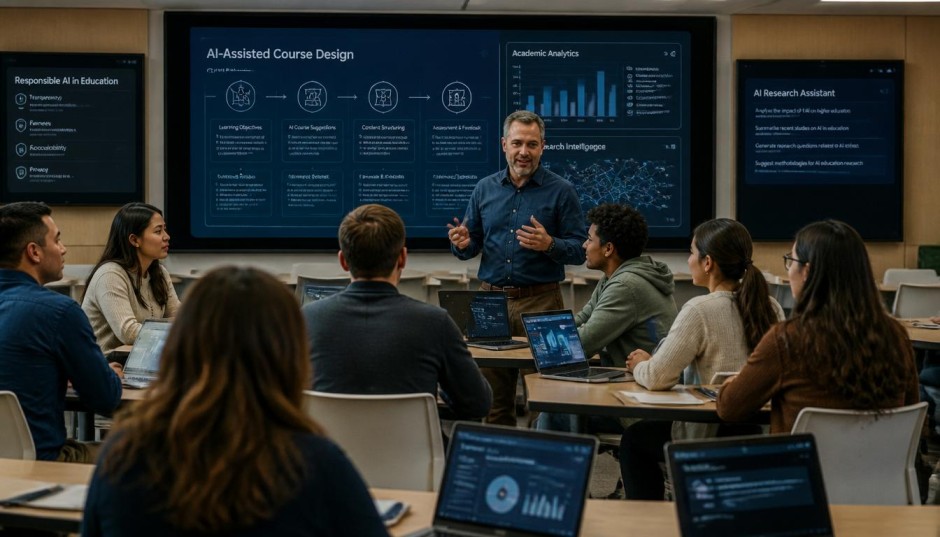
Educational institutions are entering a new phase of AI implementation where the focus has shifted from curiosity to practical application. During the conference, faculty members, academic leaders, and technology experts explored how AI can improve course design, student engagement, research, administrative efficiency, and academic advising while maintaining ethics, critical thinking, and human creativity at the center of every decision. Rather than viewing AI as a replacement for educators, participants emphasized its role as an intelligent assistant that enhances productivity and enables educators to dedicate more time to meaningful interactions with students.
This reflects a broader trend across higher education. Institutions are actively exploring responsible AI governance, personalized learning experiences, and data-driven decision-making to improve educational outcomes. However, adopting AI successfully requires much more than simply introducing new software into classrooms. It demands professionals who understand AI capabilities, limitations, governance principles, and ethical implementation.
Human Expertise Remains the Competitive Advantage
One of the strongest messages emerging from the conference was that AI delivers its greatest value when paired with human judgment. Speakers and participants discussed how AI can automate repetitive tasks, accelerate research, organize information, and support instructional design while leaving creativity, empathy, strategic thinking, and decision-making in human hands.
This perspective offers an important lesson for educational institutions and organizations in every industry. AI should be viewed as a collaborative technology rather than a substitute for expertise. Professionals who understand how to evaluate AI-generated outputs, identify bias, protect privacy, and make informed decisions will remain indispensable in an AI-driven workplace.
The workforce of the future will therefore require a combination of technical AI literacy and strong human skills such as critical thinking, ethical reasoning, communication, and leadership.
Why AI Training Has Become a Strategic Investment
As AI becomes embedded into teaching, research, and institutional operations, organizations need structured learning pathways instead of informal experimentation. Employees who rely solely on trial and error often miss opportunities to maximize AI's value while exposing organizations to unnecessary risks related to compliance, data security, and responsible AI usage.
Professional AI training helps bridge this gap by equipping learners with practical knowledge that can immediately be applied within their roles. Whether someone is an educator, administrator, business leader, or technology professional, structured training builds confidence in selecting the right AI tools, creating effective workflows, understanding governance frameworks, and implementing AI responsibly.
The conference also highlighted that AI adoption is becoming a collaborative effort across departments rather than remaining confined to technology teams. This makes organization-wide AI literacy an essential component of long-term digital transformation.
Lessons Organizations Can Learn from Higher Education
The conversations taking place within universities offer valuable insights for businesses and training providers alike. Organizations should place equal importance on AI skills and ethical decision-making, encourage continuous professional development instead of one-time training initiatives, and build a culture where employees feel confident experimenting with AI while understanding its limitations.
Equally important is maintaining a human-centered approach. AI can generate content, analyze data, and automate workflows, but people remain responsible for interpreting results, making strategic decisions, and ensuring fairness and accountability. Institutions that invest in both technology and workforce capability will be better positioned to adapt as AI continues to evolve.
Building an AI-Ready Workforce Through Authorized Training Partners
The rapid evolution of AI demonstrates that technology alone cannot drive transformation. Skilled professionals who understand how to implement AI responsibly are the real catalyst for innovation.
Organizations looking to prepare their workforce can benefit from partnering with an AI CERTs Authorized Training Partner. Through globally recognized AI certification programs, Authorized Training Partners help businesses, educational institutions, and professionals develop practical AI skills across multiple roles and industries. These structured learning pathways enable learners to build confidence in applying AI, strengthen responsible AI practices, and create a workforce equipped to lead successful AI transformation initiatives.
Learn more about becoming or working with an Authorized Training Partner by visiting AI CERTs Authorized Training Partner.
Disclaimer: Some content may be AI-generated or assisted and is provided ‘as is’ for informational purposes only, without warranties of accuracy or completeness, and does not imply endorsement or affiliation.


