

AI CERTS
3 hours ago
Investors Fuel Space AI Compute Ambitions
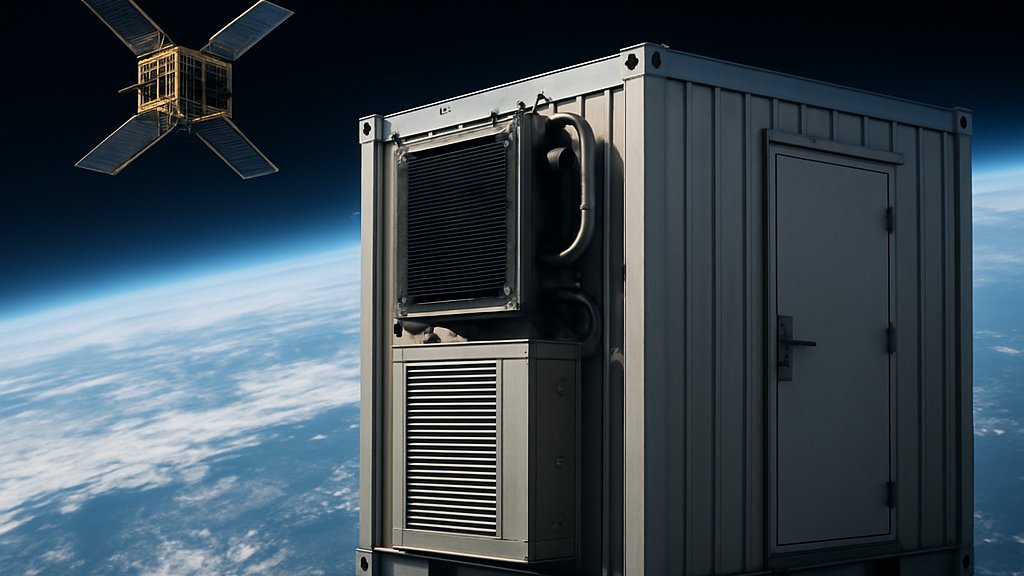
Consequently, policy makers, chip designers, and cloud architects now monitor every orbital manifest.
This article examines funding flows, early deployments, engineering hurdles, and strategic implications for enterprise planners.
Furthermore, it dissects market forecasts, separating solid numbers from speculative hype.
Readers will also find certification paths to upskill before extraterrestrial workloads arrive.
Funding Push Gains Momentum
Venture capital surged into orbital ambitions during the past year.
Moreover, Starcloud’s Series A valued the young company at roughly $1.1 billion.
Aetherflux followed with a reported $275 million Series B to bankroll its “Galactic Brain” program.
In contrast, newcomer Orbital raised a modest $5 million pre-seed for a 2027 demonstration mission.
Collectively, these rounds signal that startup funding for space hardware is moving beyond proof-of-concept satellites.
Earlier venture notes reveal startup funding for in-orbit hardware grew ninefold since 2024.
Consequently, analysts now compare investment velocity to the early reusable-launch boom pioneered by SpaceX.
Key recent deals include:
- Starcloud: $170 million Series A, first H100 satellite launched.
- Aetherflux: $275 million Series B, power-beaming demo planned 2026.
- Orbital: $5 million pre-seed, Orbital-1 mission targeted 2027.
These figures highlight widening capital access.
However, generous checks do not guarantee operational success.
Cost overruns, launch delays, and radiation surprises still threaten investor returns.
Rising investment momentum remains undeniable.
Nevertheless, early hardware results will determine whether cash continues flowing upward into orbit.
Early Orbital Deployments Rise
Teams are already testing orbital data centers in real space environments.
Starcloud launched an Nvidia H100 aboard its Pathfinder satellite in November 2025.
Additionally, Crusoe says it will route GPU workloads to that hardware and offer limited capacity by 2027.
Google’s secretive Project Suncatcher and Nvidia’s Space-1 modules reportedly completed vacuum chamber trials this spring.
Meanwhile, Aetherflux promises a Q1 2027 node powered by laser-delivered energy.
Such milestones transform press releases into tangible proof points, inspiring further compute expansion planning sessions.
Yet, most missions currently host only a single GPU or small Jetson derivative.
Therefore, the industry still lacks a multi-rack cluster operating reliably beyond the magnetosphere.
Space AI Compute experiments on these small platforms will inform future constellation architectures.
Early flights validate basic thermal and power models.
Consequently, attention now shifts toward energy economics, the next critical hurdle.
Energy And Cooling Economics
Energy drives 30-60 percent of terrestrial data-center operating costs.
Moreover, near-continuous solar exposure in orbit offers tempting reductions.
Industry studies suggest five-to-ten-fold energy yield advantages when panels avoid atmospheric scattering.
Vacuum conditions also enable efficient radiative cooling, eliminating chiller plants and water usage.
However, the radiators themselves add mass, which inflates launch cost models.
Researchers at ESA estimate radiator area grows linearly with thermal load, hampering aggressive compute expansion targets.
In contrast, some vendors propose modular cold plates that double as structural panels, trimming weight.
Consequently, consensus remains elusive on whether space saves money after factoring launches, shielding, and deorbit plans.
Terrestrial hyperscalers argue energy arbitrage disappears once total lifecycle emissions are counted.
Nevertheless, Aetherflux counters that power-beaming can also offset ground grids, improving overall AI infrastructure sustainability.
Energy math continues to divide stakeholders.
Therefore, networking constraints now demand equal scrutiny.
Network And Scale Hurdles
Training frontier models requires thousands of tightly coupled GPUs with microsecond latency budgets.
Free-space optical links promise gigabit interconnects between satellites but still face alignment and reliability issues.
Furthermore, ground-to-space hops add latency that complicates interactive workloads and real-time inference.
AWS CEO Matt Garman stressed that current architectures cannot support petascale clusters in orbit.
Consequently, most firms target inference workloads first, deferring large-scale training until link maturity improves.
Space AI Compute at training scale demands rock-solid optical fabrics linking hundreds of satellites.
Starcloud’s CEO Philip Johnston even labels his approach an “energy play,” not a training competitor.
Meanwhile, Nvidia’s Jensen Huang reminds audiences that commercial GPUs remain vulnerable to cosmic radiation flips.
Radiation-hardened variants exist, yet performance trade-offs threaten AI infrastructure parity with Earth-bound clusters.
Moreover, proximity processing could free scarce cloud capacity for heavier training bursts on Earth.
Networking and radiation challenges slow aggressive road-maps.
Nevertheless, bullish forecasts keep emerging, warranting closer examination.
Market Forecasts Face Skepticism
Vendor reports peg in-orbit compute at $39 billion by 2035, implying 67 percent annual growth.
However, independent academics call those timelines optimistic, citing uncertain launch pricing trends.
ResearchAndMarkets assumes rapid payload mass reductions and steady reusable-rocket cost curves.
In contrast, recent Starship flights slipped schedules, reminding observers that hardware reality dictates adoption.
Moreover, several life-cycle assessments suggest launch emissions could offset orbital energy gains for decades.
Therefore, investors now demand clearer unit-economics before backing large compute expansion constellations.
Still, the prospect of sovereign orbital data centers entices governments worried about supply-chain resilience.
Limited terrestrial cloud capacity during energy crunches pushes CIOs to evaluate space alternatives.
Analysts warn that indiscriminate startup funding could inflate valuations ahead of technical proof.
Without credible cost curves, Space AI Compute adoption could stall despite technical victories.
Forecast debates illustrate the field’s volatility.
Consequently, organizations must build flexible strategies that can pivot with new data.
Space AI Compute Outlook
How many satellites will actually host Space AI Compute clusters by 2030 remains contested.
Analysts now predict a tiered market blending on-orbit inference with terrestrial training, optimizing cloud capacity across domains.
Furthermore, Crusoe plans to lease idle orbital cycles to terrestrial clients during off-peak utilization windows.
Such hybrid models could stretch scarce AI infrastructure without massive new power plants.
Additionally, power-beaming demonstrators may unlock fully renewable micro-grids supporting continuous computation.
Professionals can enhance their expertise with the AI Architect™ certification.
Such credentials prepare teams for specialized thermal, networking, and radiation design reviews.
Moreover, certification programs increasingly include modules focused on Space AI Compute best practices.
Meanwhile, governments craft export-control rules that will shape market access and talent requirements.
Sustained startup funding also underwrites scholarship programs that train future orbital engineers.
Therefore, continuous learning remains essential for engineers eyeing extraterrestrial careers.
Skill development complements capital and engineering progress.
Next, leadership teams must link technical shifts to broader enterprise value.
Strategic Implications For Enterprises
CIOs already juggle energy budgets, latency targets, and carbon reporting mandates.
Space AI Compute introduces a new architectural tier that could relieve congested regions and capex pressures.
However, orbital data centers also add geopolitical, legal, and security variables unfamiliar to most procurement teams.
Consequently, pilot engagements should focus on non-critical inference workloads, such as satellite imagery preprocessing.
In contrast, regulated industries may wait for hardened compliance frameworks before shifting sensitive datasets skyward.
Furthermore, thoughtful workload placement across ground and space could unlock elastic cloud capacity without breaching on-prem limits.
Startups promise pay-as-you-go models, yet service-level guarantees remain unproven.
Therefore, contract language must address deorbit clauses, debris liability, and radiation-induced failure rates.
Boards should also monitor compute expansion trajectories to avoid stranded capital if economics sour.
Strategic planners face both opportunity and exposure.
Nevertheless, early experiments can yield insights that inform long-term AI infrastructure road-maps.
Space AI Compute is moving from science fiction toward operational reality, yet hurdles remain formidable.
Funding flows, prototype launches, and power-beaming tests all point to a dynamic, uncertain decade ahead.
Moreover, contrasting forecasts remind decision-makers to vet assumptions on launch costs, networking reliability, and radiation resilience.
Consequently, enterprises should track engineering milestones and pursue small pilots that limit downside while building internal expertise.
Stakeholders watching orbital data centers should track debris regulations alongside payload economics.
Professionals can enroll in the AI Architect™ program to master orbital design essentials.
Act now to place your team ahead in Space AI Compute’s unfolding renaissance.
Disclaimer: Some content may be AI-generated or assisted and is provided ‘as is’ for informational purposes only, without warranties of accuracy or completeness, and does not imply endorsement or affiliation.


