

AI CERTS
5 hours ago
Rising Healthcare Data Breaches Highlight the Growing Need for AI Training in Cybersecurity and Healthcare Operations
As cyber threats become more sophisticated, artificial intelligence is emerging as a critical defense mechanism, making AI training an essential investment for healthcare professionals and organizations alike.
Healthcare Data Breaches Continue to Reach Alarming Levels
Recent healthcare data breach statistics show that healthcare remains one of the most targeted industries for cyberattacks. According to the latest industry data, healthcare data breaches have followed a long-term upward trend, with large-scale breaches affecting millions of individuals. While the number of reported incidents showed some moderation during portions of 2025, the overall impact of breaches remains significant due to the growing size and complexity of cyberattacks. In 2024 alone, more than 289 million individuals were affected by healthcare data breaches, largely driven by several mega-breach incidents involving millions of patient records.
The statistics also reveal that hacking and IT-related incidents continue to be the dominant causes of healthcare breaches. As healthcare organizations adopt more digital tools and interconnected systems, attackers are increasingly exploiting vulnerabilities through ransomware, phishing campaigns, credential theft, and unauthorized access. The consequences extend far beyond regulatory penalties, impacting patient trust, operational continuity, and organizational reputation.
Why Healthcare Has Become a Prime Target
Healthcare data is among the most valuable forms of personal information available on the black market. Unlike credit card information, medical records contain a combination of personal identifiers, insurance details, treatment histories, and financial information that can be exploited for years. This makes healthcare organizations attractive targets for cybercriminal groups seeking financial gain.
The challenge is further compounded by the complexity of healthcare ecosystems. Hospitals, clinics, insurance providers, laboratories, and third-party vendors all exchange sensitive information daily. A single vulnerability within this network can expose millions of records. Recent healthcare cybersecurity analyses indicate that phishing attacks, social engineering schemes, backup failures, and weak data governance remain some of the leading contributors to major cyber incidents.
The Growing Role of AI in Healthcare Cybersecurity
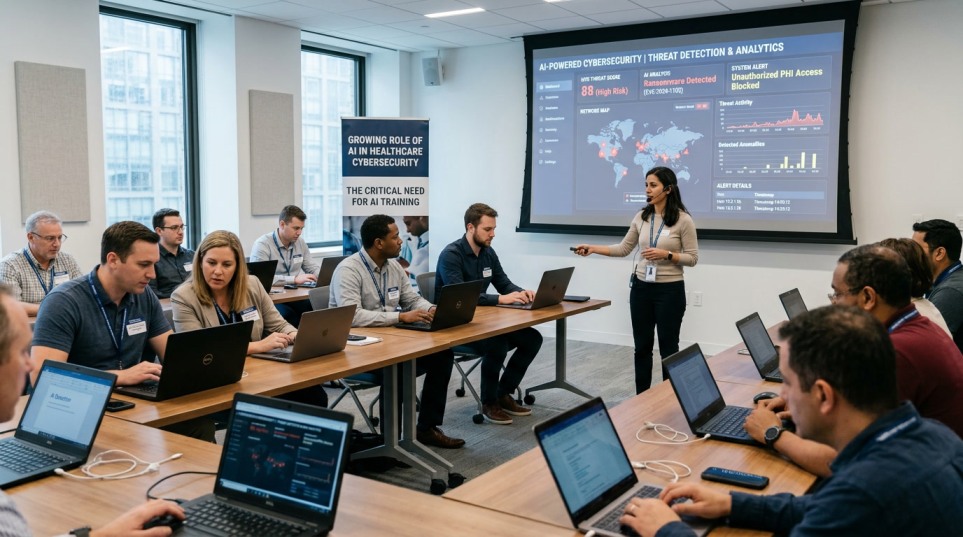
Artificial intelligence is becoming a powerful tool in the fight against healthcare cyber threats. AI-powered systems can analyze massive volumes of network activity, identify suspicious behavior, detect anomalies, and respond to threats far faster than traditional security methods. Unlike manual monitoring processes, AI can continuously learn from evolving attack patterns and provide real-time threat intelligence.
Healthcare organizations are increasingly exploring AI-driven security solutions to strengthen breach detection, automate incident response, and improve risk management. AI can help security teams identify unusual login patterns, detect insider threats, monitor access to patient records, and predict vulnerabilities before attackers exploit them. These capabilities are becoming increasingly important as cybercriminals use advanced technologies to launch more targeted and sophisticated attacks.
However, AI tools are only as effective as the people managing them. Without a workforce that understands AI technologies, organizations may struggle to maximize the value of their cybersecurity investments.
The Critical Need for AI Training
The healthcare data breach landscape offers an important lesson: technology alone cannot solve cybersecurity challenges. Organizations need professionals who understand how to implement, manage, and optimize AI-powered security systems. This is where AI training becomes essential.
Healthcare leaders, IT professionals, compliance officers, cybersecurity specialists, and operational teams must develop a strong understanding of AI fundamentals, machine learning applications, data governance, automation, and ethical AI practices. AI training equips professionals with the skills needed to interpret AI-generated insights, improve decision-making, and build resilient cybersecurity strategies.
As healthcare organizations continue integrating AI into patient care, diagnostics, administration, and security operations, the demand for AI-literate professionals will continue to grow. Organizations that prioritize AI education today will be better prepared to address emerging cyber risks while maintaining regulatory compliance and patient trust.
Lessons Organizations Can Learn from Current Breach Trends
One of the most important lessons from the latest breach statistics is that cybersecurity must be treated as a continuous process rather than a one-time initiative. Organizations need proactive threat detection, stronger governance frameworks, and continuous workforce development. AI can significantly enhance these efforts, but success depends on having trained professionals who can effectively manage and interpret AI systems.
Another key lesson is the importance of combining technological innovation with human expertise. While AI can identify risks faster than traditional systems, human oversight remains essential for strategic decision-making, compliance management, and incident response. Organizations that invest in both advanced technologies and workforce training will be in a stronger position to mitigate future threats.
Conclusion
As healthcare data breaches continue to challenge organizations worldwide, AI is becoming an increasingly valuable tool for strengthening cybersecurity and protecting sensitive patient information. However, successful AI adoption requires skilled professionals who understand how to apply these technologies effectively. Working with an authorized training partner can help organizations bridge this skills gap through industry-recognized AI education, practical learning experiences, and workforce development programs. To prepare teams for the future of AI-powered healthcare security, explore training opportunities through the AI CERTs Authorized Training Partner program: https://www.aicerts.ai/authorized-training-partner/
FAQs
Why are healthcare organizations frequently targeted by cybercriminals?
Healthcare organizations store highly valuable patient data that can be used for identity theft, insurance fraud, and other malicious activities, making them attractive targets for attackers.
How can AI help reduce healthcare data breaches?
AI can detect unusual activities, identify threats in real time, automate security monitoring, and improve incident response capabilities, helping organizations respond to risks faster.
What types of cyberattacks commonly affect healthcare organizations?
Common threats include ransomware attacks, phishing campaigns, credential theft, unauthorized access incidents, and social engineering attacks.
Why is AI training important for healthcare professionals?
AI training helps professionals understand how to use AI tools effectively, interpret insights accurately, strengthen cybersecurity strategies, and support responsible AI adoption.
How can organizations prepare for the future of AI-driven cybersecurity?
Organizations can invest in AI education, strengthen data governance practices, adopt AI-powered security solutions, and partner with trusted training providers to build AI-ready teams.
The statistics and trends in this blog are based on recent healthcare breach data and cybersecurity analyses.
Disclaimer: Some content may be AI-generated or assisted and is provided ‘as is’ for informational purposes only, without warranties of accuracy or completeness, and does not imply endorsement or affiliation.


