

AI CERTS
1 day ago
Microsoft Build 2026 Highlights the Future of Reasoning AI and Reinforces the Growing Need for AI Training
As organizations worldwide accelerate AI adoption, these developments are reinforcing a critical reality: the future belongs to professionals and businesses that invest in AI skills and training today.
Microsoft has consistently positioned itself at the center of the AI revolution through its investments in generative AI, cloud infrastructure, enterprise AI solutions, and productivity platforms. Expectations surrounding Build 2026 suggest a strong emphasis on more capable reasoning models that can move beyond simple content generation and provide deeper analytical, problem-solving, and decision-support capabilities. Such advancements represent an important step in AI's evolution from a productivity assistant to a strategic collaborator capable of supporting complex business and operational tasks.
The Rise of Reasoning AI
Generative AI transformed the way people create content, analyze information, and automate routine tasks. However, the next stage of innovation focuses on reasoning AI. These systems are designed to process information more intelligently, evaluate multiple possibilities, understand context more effectively, and provide responses that support decision-making.
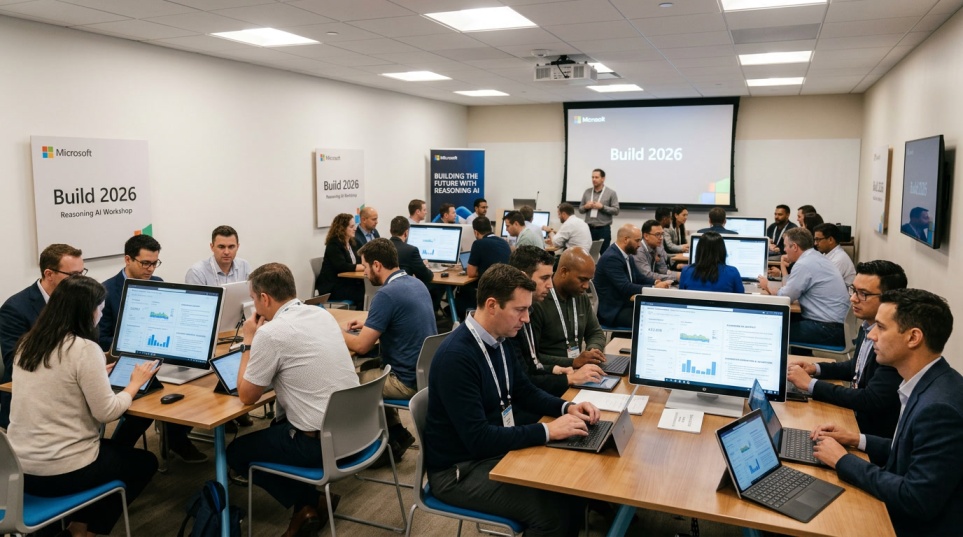
For businesses, reasoning AI has the potential to improve strategic planning, financial forecasting, risk assessment, customer service, healthcare diagnostics, supply chain optimization, and countless other functions. As AI systems become more capable of reasoning through complex scenarios, organizations will increasingly rely on them to augment human expertise rather than simply automate repetitive tasks.
Microsoft's expected focus on reasoning models reflects a broader industry trend. Technology leaders are racing to develop AI systems that can think through challenges more systematically and deliver more accurate, context-aware outputs. This shift is creating new opportunities for businesses while simultaneously increasing the need for professionals who understand how these advanced systems work.
AI-Powered Computing Is Entering a New Era
Another area attracting attention ahead of Microsoft Build 2026 is the possibility of new AI-enhanced hardware innovations, including next-generation Surface devices. The growing integration of AI directly into computing devices signals an important transformation in how technology will be used in workplaces and educational environments.
AI-powered hardware can process tasks more efficiently, support intelligent assistants, enhance productivity, and deliver personalized experiences. As AI becomes embedded into everyday computing platforms, users will interact with intelligent systems more frequently than ever before. This means that AI literacy will become as essential as digital literacy.
Organizations that understand how to leverage AI-powered devices, software ecosystems, and intelligent workflows will gain significant competitive advantages. Employees who possess AI skills will be better equipped to maximize the value of these technologies and contribute more effectively to business growth.
What Businesses Can Learn from Microsoft's AI Strategy
The anticipated announcements at Build 2026 highlight an important lesson for organizations across industries. AI innovation is not slowing down. Instead, it is becoming more sophisticated, more accessible, and more deeply integrated into business operations.
Companies that delay AI adoption risk falling behind competitors that are already using intelligent systems to improve efficiency, enhance customer experiences, and accelerate innovation. However, technology investments alone do not guarantee success. Many AI initiatives struggle because organizations focus heavily on tools while overlooking workforce readiness.
The true value of AI emerges when employees understand how to use these technologies responsibly and effectively. Training enables professionals to interpret AI-generated insights, evaluate outputs critically, identify limitations, and apply AI strategically within their roles. Without these capabilities, even the most advanced AI systems may fail to deliver meaningful business outcomes.
Why AI Training Has Become a Business Imperative
As reasoning AI becomes more advanced, the skills required to work alongside these technologies are evolving as well. Professionals must develop a strong understanding of AI fundamentals, machine learning concepts, prompt engineering, data analysis, AI ethics, governance frameworks, and practical implementation strategies.
Organizations across sectors such as healthcare, finance, manufacturing, retail, education, cybersecurity, and government are actively seeking talent with AI expertise. The demand extends beyond technical specialists. Managers, executives, analysts, marketers, and operational leaders increasingly need AI knowledge to make informed decisions and lead digital transformation initiatives.
The developments expected at Microsoft Build 2026 serve as a reminder that AI is becoming a foundational business capability. Companies that prioritize AI education today will be better positioned to adapt to future innovations and capitalize on emerging opportunities.
Bridging the Gap Between AI Innovation and Workforce Readiness
Technology conferences often generate excitement about new products and capabilities, but successful AI adoption depends on people as much as technology. Every advancement in reasoning models, intelligent software, and AI-powered hardware increases the need for skilled professionals who can implement and manage these innovations effectively.
Organizations must focus on building AI-ready workforces that can translate technological potential into measurable business value. This requires structured learning pathways, industry-recognized certifications, and practical training programs that align with real-world business needs.
As AI continues to reshape industries, workforce development will become one of the most important factors determining organizational success. Businesses that invest in AI training today will be better prepared to navigate future technological shifts and maintain long-term competitiveness.
Conclusion
Organizations and professionals looking to stay ahead in the rapidly evolving AI landscape can benefit from partnering with an Authorized Training Partner through the AI CERTs ecosystem. Through comprehensive AI education, industry-recognized certifications, and practical skill development, ATPs help bridge the gap between emerging AI innovations and workforce readiness, enabling individuals and businesses to confidently embrace the future of artificial intelligence.
FAQs
What is reasoning AI?
Reasoning AI refers to advanced artificial intelligence systems designed to analyze information, evaluate different possibilities, understand context, and support complex decision-making processes beyond simple content generation.
Why is Microsoft Build 2026 important for AI professionals?
The event is expected to showcase advancements in reasoning AI, intelligent computing, and AI-powered devices, providing insights into the future direction of artificial intelligence and enterprise technology.
How can businesses benefit from reasoning AI?
Businesses can use reasoning AI to improve forecasting, decision-making, customer experiences, operational efficiency, risk management, and strategic planning across various functions.
Why is AI training important as AI technologies advance?
AI training helps professionals understand how to use AI effectively, interpret outputs accurately, manage risks responsibly, and apply AI solutions to real-world business challenges.
How can an Authorized Training Partner support AI learning?
Authorized Training Partners provide structured learning programs, certifications, and practical training that help individuals and organizations develop the skills needed to succeed in an AI-driven economy.
Disclaimer: Some content may be AI-generated or assisted and is provided ‘as is’ for informational purposes only, without warranties of accuracy or completeness, and does not imply endorsement or affiliation.


