

AI CERTS
2 hours ago
AI Chips, Oil Markets, and Emerging Economies Are Reshaping Global Finance and Why AI Training Is Becoming a Business Necessity
This transformation is creating opportunities across industries, but it is also exposing a major gap: the shortage of AI-ready talent.
As organizations race to adapt to this AI-powered economy, one thing is becoming increasingly clear. Companies do not just need AI tools. They need professionals who understand how AI impacts business strategy, infrastructure, operations, governance, and market dynamics.
The AI Boom Is Expanding Beyond Technology Companies
For years, AI conversations revolved around software platforms and chatbots. Today, the conversation is shifting toward infrastructure, energy, and global supply chains.
Chipmakers are driving a new wave of market growth as AI demand accelerates globally. Semiconductor companies in the United States and Asia are seeing record demand because AI systems require enormous computing power for training and inference workloads.
At the same time, AI’s growth is increasing pressure on electricity grids and energy markets. Analysts are now calling energy companies one of the biggest long-term beneficiaries of AI expansion because AI data centers consume massive amounts of power.
This shift proves that AI is not simply a software trend anymore. It is becoming an economic infrastructure layer that influences manufacturing, commodities, energy, finance, and global trade.
Emerging Markets Are Becoming Major AI Players
Another major trend reshaping global markets is the rise of emerging economies in the AI supply chain.
Countries like Taiwan and South Korea are becoming essential to AI infrastructure because of their dominance in semiconductor manufacturing. Their stock markets have surged as investors recognize their role in powering global AI systems.
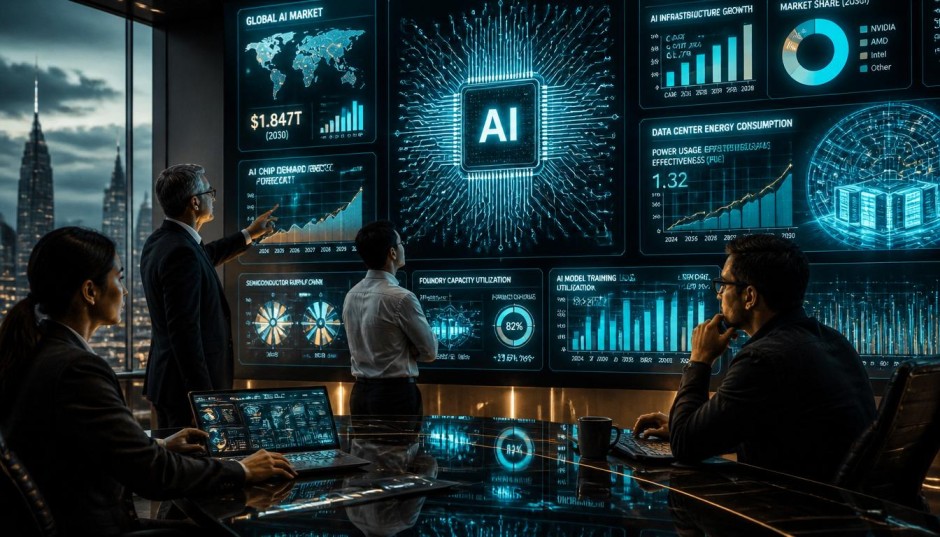
This creates a broader economic impact. AI is redistributing global value creation toward countries and companies capable of supporting compute infrastructure, hardware manufacturing, and energy production.
Businesses operating in emerging markets now face both opportunity and pressure. Organizations that understand AI’s economic implications can position themselves for growth. Those that fail to build AI capabilities risk falling behind competitors who are adapting faster.
AI Infrastructure Is Creating a Massive Workforce Shift
The AI economy is also transforming workforce demand.
While automation is replacing some traditional roles, AI infrastructure growth is creating demand for skilled professionals in areas like data centers, cloud systems, AI operations, cybersecurity, analytics, and infrastructure management.
This workforce transition is happening faster than many organizations expected. Businesses are investing billions into AI systems, but many employees still lack the practical knowledge required to work effectively with AI technologies.
According to research on AI workforce preparedness, organizations that combine AI investment with workforce development and governance are more likely to sustain long-term success.
That is why AI training is becoming one of the most critical business priorities of this decade.
Why AI Training Has Become Essential for Modern Organizations
The rapid expansion of AI is creating a knowledge gap across industries.
Executives need to understand AI strategy and governance. Managers need to understand AI-driven operations. Technical teams need expertise in AI systems, data handling, and infrastructure. Even non-technical professionals must learn how AI is changing workflows and customer expectations.
Without proper training, organizations risk making poor technology decisions, misusing AI tools, and falling behind competitors who are building AI-ready teams.
The challenge is not only adopting AI. It is understanding how to use it responsibly, strategically, and efficiently.
This is especially important as AI infrastructure becomes more complex. Experts now emphasize that the future of AI depends not only on intelligence but also on energy efficiency, sustainable systems, and workforce readiness.
Organizations that invest in AI education today are building the foundation for long-term adaptability.
AI Literacy Will Define Future Business Leaders
One of the biggest lessons from the current AI market surge is that AI literacy is becoming a competitive advantage.
Businesses are no longer competing only on products or pricing. They are competing on how effectively they can integrate AI into decision-making, operations, and innovation.
This requires professionals who can bridge the gap between technology and business outcomes.
As AI continues reshaping industries, organizations will increasingly seek employees who understand AI strategy, ethics, infrastructure, automation, and emerging technologies.
The companies that thrive in the next decade will not necessarily be the ones spending the most on AI. They will be the ones developing the strongest AI-capable workforce.
Conclusion
As AI transforms chip markets, energy infrastructure, and emerging economies, the need for skilled AI professionals is growing rapidly. Businesses need structured learning pathways that help teams understand AI technologies, real-world applications, governance, and strategic implementation.
The AI CERTs Authorized Training Partner Program helps organizations, institutions, and training providers deliver industry-relevant AI education designed for the evolving demands of the global workforce. By enabling scalable AI learning and certification opportunities, ATP programs can help bridge the growing AI skills gap and prepare professionals for the future economy.
FAQs
1. Why are AI chips becoming so important in global markets?
AI systems require enormous computing power for training and inference tasks. Semiconductor companies producing advanced AI chips are becoming critical to the global AI economy.
2. How is AI impacting the energy sector?
AI data centers consume large amounts of electricity, increasing demand for energy infrastructure, grid expansion, and sustainable power solutions.
3. Why is AI training important for businesses?
AI training helps organizations understand how to use AI strategically, improve operations, reduce risks, and stay competitive in rapidly changing markets.
4. Which industries need AI-skilled professionals the most?
Technology, finance, healthcare, manufacturing, energy, logistics, cybersecurity, education, and retail are among the industries actively seeking AI-capable talent.
5. How can AI CERTs ATP help organizations?
The AI CERTs ATP program enables organizations and training providers to deliver structured AI education and globally recognized certifications that support workforce transformation and AI readiness.
Disclaimer: Some content may be AI-generated or assisted and is provided ‘as is’ for informational purposes only, without warranties of accuracy or completeness, and does not imply endorsement or affiliation.


