

AI CERTS
2 hours ago
WIRobotics’ $68M Bet Accelerates Embodied AI Humanoids
The company claims an edge by harvesting motion data from more than 3,000 wearable exos. Moreover, it plans to convert that dataset into fine motor control for its ALLEX humanoid. Industry observers now ask whether cash, data, and partnerships will translate into factory-ready robots. This article unpacks the raise, strategic context, and looming hurdles. Along the way, it shows how Embodied AI is maturing from concept to commerce.
Meanwhile, global competitors such as Figure AI and Tesla Optimus intensify the narrative and investor appetite. In contrast, WIRobotics emphasizes measured scaling milestones rather than headline-grabbing pilot claims. Subsequently, analysts will track whether this discipline delivers sustainable margins.
Series B Milestone Details
JB Investment led the KRW 95 billion, or USD 68 million, Series B for the Seoul robotics upstart. InterVest, Hana Ventures, Smilegate Investment, and several others joined the round. Consequently, WIRobotics secured its largest funding tranche since inception.
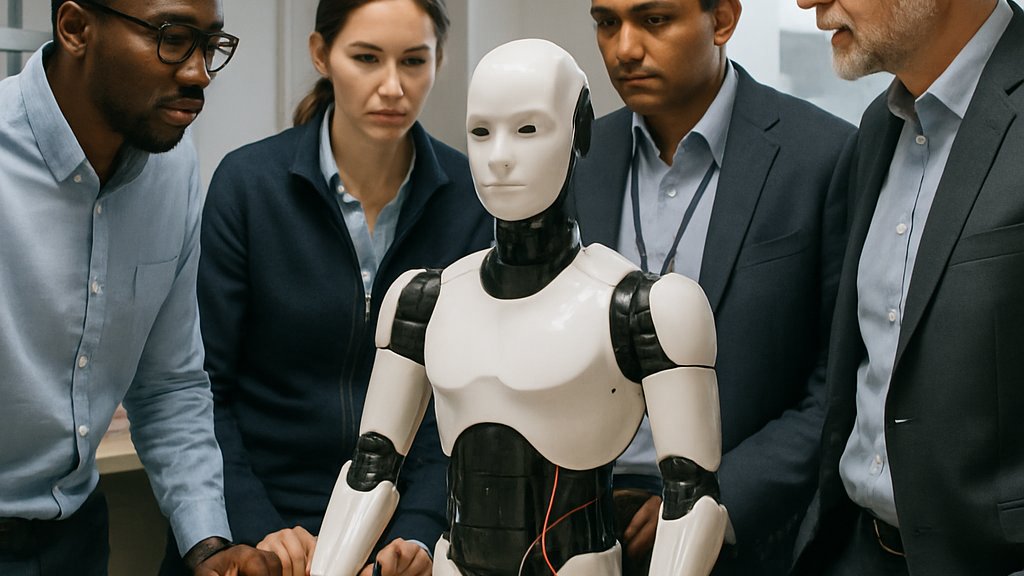
Company filings suggest earlier Series A supporters returned, signalling confidence in progress. Moreover, the capital will bankroll Mobile ALLEX pilot builds and expansion of the WIM wearable line. The management team has earmarked resources for global supply-chain tooling and safety validation.
Key participants included:
- JB Investment (lead)
- InterVest
- Hana Ventures
- Smilegate Investment
- SBVA
- NH Investment & Securities
- Company K Partners
- GU Investment
- FuturePlay
The oversubscribed round underscores renewed investor enthusiasm for hardware anchored Embodied AI ventures. However, market conditions remain selective, pushing founders to evidence near-term revenue. Those signals set the stage for broader market analysis.
Humanoid Robot Market Context
Market intelligence firm Kings Research projects humanoid robot revenue could hit USD 30 billion by early 2030s. Furthermore, analysts expect compound annual growth rates above 25 percent through 2029. Demand drivers include aging populations, labor shortages, and rising e-commerce fulfillment needs. Global robotics spending already tops USD 200 billion, yet humanoids claim only a fraction.
In contrast, sceptics highlight slow production yields and high component costs. Nevertheless, every major industrial hub now funds at least one humanoid program. Tesla, Figure AI, Agility, and UBTech all chase similar customer segments.
Therefore, WIRobotics faces global competition but also benefits from rising category awareness. Several buyers will likely evaluate multiple vendors before locking long-term contracts.
The macro outlook remains bullish for Embodied AI despite manufacturing headwinds. Consequently, any startup that proves reliability first could dominate share. Next, we explore how data may strengthen that proof.
Real Data Driven Advantage
WIRobotics sells the WIM wearable walker to rehabilitation centers and eldercare facilities. More than 3,000 units gather daily gait, torque, and balance streams. Moreover, engineers convert those streams into motor primitives for ALLEX joints.
Yeonbaek Lee argues this closed-loop approach cuts simulation time and improves safety margins. Additionally, real feedback helps refine force control under variable payloads. Embodied AI experts often cite credible data as the scarcest resource in humanoid development.
Consequently, investors viewed the wearable portfolio as both revenue stream and knowledge generator. Revenue climbed from KRW 560 million in 2023 to KRW 2.79 billion in 2025. Meanwhile, first-quarter 2026 sales already outpaced full-year 2024 figures. Industry watchers view the wearable robotics revenue as rare evidence of traction.
These metrics support the thesis that data begets differentiation. However, technical partnerships also matter. That reality leads to WIRobotics’ fellowship with global compute giants.
Physical AI Fellowship Partnership
AWS, Nvidia, and MassRobotics created the Physical AI Fellowship to accelerate Embodied AI platforms. Selected startups receive cloud credits, Isaac Sim licenses, and mentorship on scalable architectures. WIRobotics joined the inaugural cohort shortly before closing the Series B.
Furthermore, Nvidia researchers will advise on perception stacks optimized for real-time force estimation. Meanwhile, AWS engineers plan to streamline simulation pipelines across hundreds of GPUs. Consequently, the startup hopes to shorten iteration cycles between digital twins and physical prototypes.
MassRobotics will also broker pilot discussions with manufacturing and logistics operators in Boston. Such introductions could deliver early reference customers outside Asia.
Partnerships add credibility while distributing Embodied AI engineering risk. Nevertheless, scaling remains difficult even with premium compute. Therefore, potential obstacles warrant attention.
Critical Scaling Risks Ahead
Producing a humanoid at automotive costs demands breakthroughs in actuators, batteries, and lightweight materials. In contrast, current prototypes still rely on expensive harmonic drives and custom boards. Consequently, even well-funded startups predict years before breakeven.
Regulatory scrutiny also rises as Embodied AI robots leave labs. Additionally, Fortune’s 2025 investigation into overhyped deployments sharpened media vigilance. Buyers now request proof of sustained uptime and safety certifications.
Financial exposure remains another risk. If global liquidity tightens, robotics ventures may face down-rounds despite technical progress.
These challenges highlight critical gaps. However, the company outlines a phased roadmap that could mitigate some pressure. The final section reviews that timetable.
Strategic Outlook Toward 2027
Management targets research Mobile ALLEX deliveries during 2026. Subsequently, mass-production readiness is penciled in for late 2027. Moreover, the team plans to localize component supply to reduce tariff exposure.
Commercial pilots will focus on repetitive warehouse tasks and hazardous inspection routes. Consequently, early configurations emphasize upper-body manipulation over full dynamic sprinting. Professionals can enhance their expertise with the AI+ Human Resources™ certification.
Furthermore, executives hint at automotive collaborations that could absorb high initial unit costs. Embodied AI must still demonstrate multi-shift durability to win such deals. Nvidia leadership will watch outcomes closely as proof of scalable compute demand.
The staged roadmap offers measurable checkpoints. Therefore, forthcoming milestones will confirm whether capital and data converge into sustainable growth.
WIRobotics’ Series B marks another inflection point for Embodied AI ambitions. Moreover, real deployment data, reputable investors, and Nvidia compute support create a compelling blend. Nevertheless, cost, regulation, and competition could still stall progress. Analysts will watch the 2026 Mobile ALLEX shipments for concrete signals. Subsequently, supplier audits and pilot metrics should clarify scalability by 2027.
For practitioners, continuous learning remains vital as machines and policies evolve. Consider deepening human-machine leadership skills through the AI+ Human Resources™ certification. Consequently, your teams can better translate frontier research into operational resilience. Stay tuned as data, capital, and talent converge to decide the next chapter.
Disclaimer: Some content may be AI-generated or assisted and is provided ‘as is’ for informational purposes only, without warranties of accuracy or completeness, and does not imply endorsement or affiliation.


