

AI CERTS
5 hours ago
Pearson’s AI-Driven Education Growth Signals Why AI Training Has Become Essential for the Future Workforce
This shift is far bigger than one company’s growth story. It reflects a larger reality unfolding across industries: organizations are actively investing in AI-driven education ecosystems because traditional learning models are struggling to keep pace with technological change. As AI reshapes jobs, workflows, and business operations, the demand for professionals with practical AI skills is growing rapidly.
Pearson’s recent outlook highlights this clearly. The company continues to expand in areas such as virtual learning, enterprise workforce training, AI-powered assessments, and adaptive learning technologies. Its leadership has repeatedly emphasized that technology investment alone is not enough. The real competitive advantage comes from building a workforce capable of understanding, applying, and working alongside AI tools effectively.
That insight is becoming increasingly important for businesses globally.
AI Is Reshaping the Learning Economy
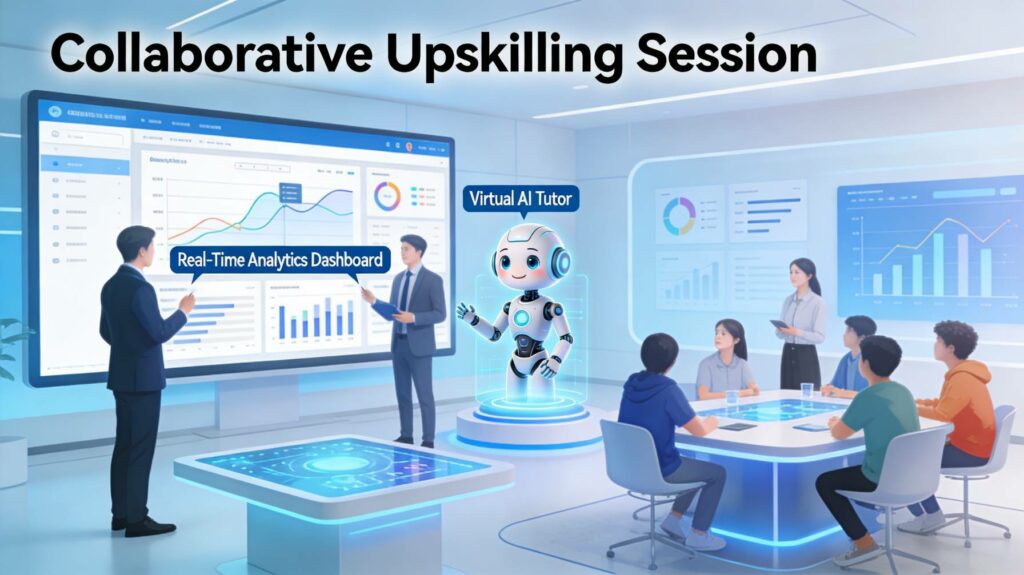
The rise of AI is changing how people learn, teach, and work. Educational institutions are investing heavily in AI-powered learning systems, while employers are prioritizing AI readiness when hiring talent. According to Pearson’s recent AI readiness research, universities worldwide are increasing investments in AI-driven learning infrastructure, but there remains a significant gap between institutional preparedness and workforce expectations.
This gap is creating a new challenge for both professionals and organizations.
Companies are adopting AI rapidly, but many employees still lack the confidence and skills needed to use these technologies effectively. At the same time, educators are trying to integrate AI into learning environments while balancing ethics, governance, and practical application. Pearson’s own reports show that educators are willing to embrace AI, but they need structured training and support to make AI integration successful.
As a result, AI literacy is becoming as important as digital literacy once was.
Professionals who understand AI concepts, automation workflows, prompt engineering, data interpretation, and ethical AI implementation are gaining a major advantage in today’s evolving workplace. Businesses are also recognizing that AI adoption without workforce readiness can reduce productivity instead of improving it.
Why AI Training Is Becoming a Business Priority
Pearson’s recent performance also highlights another important trend: organizations are increasingly prioritizing workforce upskilling. The company has stated that learning speed is becoming one of the most critical skills in the AI era.
This reflects a broader transformation happening across industries.
AI is no longer limited to technology companies. Healthcare, finance, education, marketing, cybersecurity, logistics, retail, manufacturing, and customer service sectors are all integrating AI into daily operations. Employees are now expected to work with AI-powered systems, analyze AI-generated insights, and adapt to rapidly changing workflows.
However, many professionals still rely on generic AI usage without understanding how AI actually functions in business environments. Pearson itself has pointed out that specialized AI learning systems produce stronger educational outcomes than unstructured AI usage “in the wild.”
This is where structured AI training becomes essential.
Organizations need professionals who can move beyond experimentation and apply AI strategically, responsibly, and efficiently. Without proper training, businesses risk poor AI implementation, reduced productivity, ethical concerns, and skill gaps that slow digital transformation.
The Growing Need for Industry-Aligned AI Certifications
As AI adoption accelerates, employers are increasingly valuing industry-recognized certifications that validate practical AI skills. Businesses want professionals who understand real-world AI applications rather than just theoretical concepts.
This is creating strong demand for specialized AI certifications in areas such as:
- AI strategy and leadership
- Generative AI
- Prompt engineering
- AI security and cybersecurity
- AI ethics and governance
- Data analytics and machine learning
- AI-powered marketing and sales
- AI for business operations
The workforce of the future will not simply use AI tools. It will collaborate with AI systems, interpret AI-driven insights, and manage AI-powered workflows effectively.
That transition requires continuous learning.
Pearson’s focus on AI-powered education and workforce development reflects the same reality many organizations are now facing globally: success in the AI economy depends on how quickly people can adapt and learn.
Bridging the AI Skills Gap Through AI CERTs ATP
As businesses and educational institutions continue investing in AI transformation, the need for trusted AI training providers is becoming increasingly urgent.
This is where the AI CERTs Authorized Training Partner Program plays an important role.
The ATP program helps organizations, institutions, and training providers deliver industry-relevant AI certification programs that prepare professionals for real-world AI adoption. From generative AI and cybersecurity to leadership and business strategy, AI CERTs enables learners to gain practical, job-ready AI skills aligned with current industry needs.
In a world where AI is redefining the future of work, structured AI training is no longer optional. It is becoming one of the strongest drivers of career growth, workforce readiness, and business competitiveness.
FAQs
1. Why is Pearson focusing heavily on AI in education?
Pearson is investing in AI because the education industry is rapidly shifting toward personalized learning, workforce upskilling, virtual education, and AI-powered learning experiences that improve student outcomes and workforce readiness.
2. Why is AI training important for professionals today?
AI is transforming nearly every industry. Professionals with AI skills are better positioned to adapt to changing job roles, improve productivity, and stay competitive in the evolving workforce.
3. What industries require AI-skilled professionals?
Industries including healthcare, finance, cybersecurity, education, marketing, retail, manufacturing, and logistics are increasingly seeking professionals with AI expertise.
4. How do AI certifications help career growth?
AI certifications validate practical AI skills, improve employability, strengthen professional credibility, and help individuals stay aligned with industry demands.
5. How can AI CERTs ATP help organizations?
The AI CERTs Authorized Training Partner program enables organizations and training providers to offer industry-recognized AI certification programs that help professionals build job-ready AI skills for the future workforce.
Disclaimer: Some content may be AI-generated or assisted and is provided ‘as is’ for informational purposes only, without warranties of accuracy or completeness, and does not imply endorsement or affiliation.


