

AI CERTS
4 hours ago
SAP’s Autonomous AI Warehouse Signals Why AI Training Is Becoming Essential for the Future Workforce
This development is much bigger than warehouse automation. It represents a turning point in how businesses will operate, how employees will work, and why AI training is rapidly becoming a business necessity instead of a competitive advantage.
The Rise of Physical AI Is Reshaping Industries
For years, AI conversations focused heavily on chatbots, analytics, and software automation. What SAP and CyberWave have demonstrated is something far more transformational: AI systems capable of interacting with the physical world in real time.
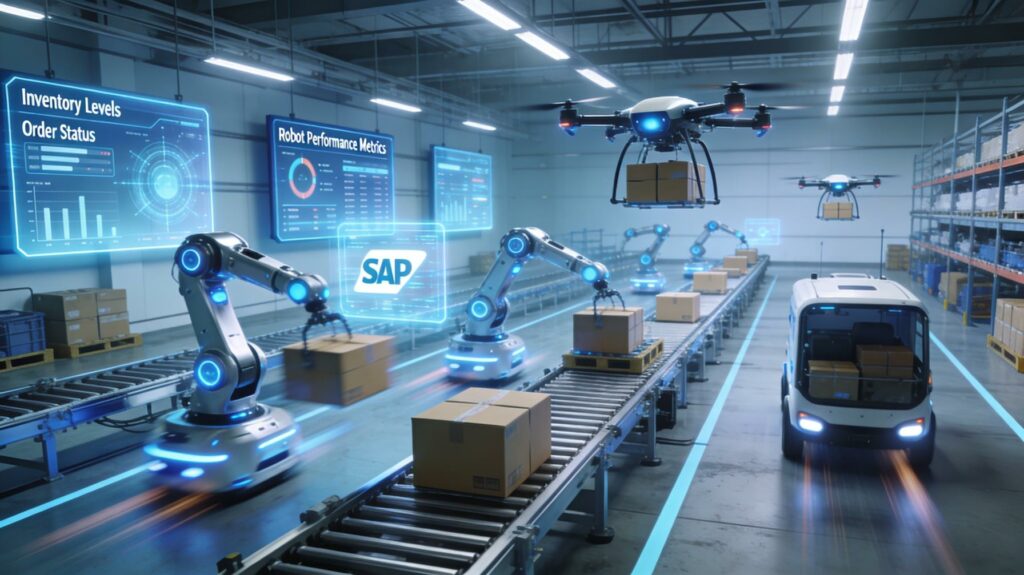
These autonomous robots are not simply following rigid instructions. They are learning, adapting, and executing operational tasks inside dynamic logistics environments. SAP’s cloud-native logistics execution solution, SAP Logistics Management (LGM), acts as the digital backbone enabling robotic orchestration through APIs and AI services.
This signals a major shift for industries such as manufacturing, retail, healthcare, transportation, and supply chain management. Businesses are moving from “AI-assisted workflows” toward “AI-driven operations.”
As organizations accelerate automation, they need professionals who understand how AI systems integrate with enterprise infrastructure, logistics ecosystems, robotics platforms, and business operations. That creates a growing demand for AI-skilled talent across every department, not just IT.
Automation Is Changing Jobs Faster Than Many Organizations Expected
One of the most important details from SAP’s deployment is that the robots are freeing workers from repetitive and physically demanding tasks.
This is where the workforce conversation becomes critical.
AI is not simply replacing jobs. It is redesigning workflows. Employees increasingly need skills related to AI oversight, automation management, AI ethics, data interpretation, process optimization, and human-machine collaboration.
The challenge is that many organizations are adopting AI technologies faster than they are preparing employees to work alongside them.
This creates a dangerous skills gap.
Companies that fail to train their workforce may struggle with implementation delays, operational inefficiencies, cybersecurity vulnerabilities, compliance risks, and employee resistance to transformation. At the same time, professionals without AI knowledge risk becoming disconnected from the evolving requirements of modern industries.
That is why AI education is becoming central to workforce resilience.
AI Adoption Without AI Literacy Creates Business Risk
The SAP-CyberWave deployment highlights how advanced AI systems are becoming deeply embedded inside enterprise environments. These systems rely on cloud infrastructure, machine learning models, APIs, real-time logistics coordination, and intelligent automation frameworks.
However, technology alone cannot guarantee success.
Organizations need leaders who understand AI strategy, teams capable of managing AI systems responsibly, and employees trained to adapt workflows around automation.
Without AI literacy, businesses face several challenges:
Operational teams may not understand how AI systems make decisions. Managers may struggle to align AI deployments with business objectives. Employees may resist automation due to uncertainty and fear. Leadership teams may fail to identify ethical, security, or governance risks associated with AI adoption.
AI training addresses these gaps by building technical understanding, strategic awareness, and confidence across the workforce.
The Demand for AI Skills Is Expanding Beyond Tech Teams
One of the most important lessons from this news is that AI is no longer limited to technology companies.
Warehouse workers, supply chain managers, operations leaders, HR teams, cybersecurity professionals, and executives are all being impacted by intelligent automation.
Research around Industry 6.0 and autonomous robotic ecosystems also points toward a future where AI-powered robots, generative AI systems, and enterprise automation work together as integrated ecosystems.
This means businesses will increasingly need cross-functional AI talent capable of understanding both business processes and intelligent systems.
The organizations that invest in AI training today are positioning themselves to adapt faster, innovate more effectively, and remain competitive in rapidly changing markets.
Why Businesses Need Structured AI Training Programs
As AI technologies become more operationally embedded, organizations need structured pathways for AI education. Random experimentation with AI tools is not enough for enterprise-scale transformation.
Businesses need workforce development frameworks that help professionals understand:
AI fundamentals and applications, enterprise AI strategy, automation workflows, AI governance, cybersecurity considerations, ethical AI implementation, data-driven decision-making, and AI-powered operational optimization.
This is where training ecosystems become incredibly important.
Organizations looking to scale AI readiness across teams increasingly require trusted certification pathways, practical learning environments, and globally recognized AI education frameworks.
How AI CERTs ATP Can Help Organizations Prepare for the AI Future
As companies worldwide accelerate AI adoption, training providers play a vital role in helping businesses prepare their workforce for this transition.
The AI CERTs Authorized Training Partner Program helps organizations deliver globally recognized AI certification programs designed to build real-world AI capabilities across industries.
By becoming an Authorized Training Partner, businesses, educators, and institutions gain access to structured AI learning pathways, updated curriculum resources, and industry-aligned certification programs that help professionals stay prepared for the future of intelligent automation.
As SAP’s autonomous warehouse deployment demonstrates, AI is rapidly transforming how industries operate. The organizations that succeed in this new era will not simply adopt AI technologies. They will invest in building AI-ready workforces capable of working alongside them.
FAQs
1. What is Physical AI?
Physical AI refers to AI systems that interact with the physical world through robotics, sensors, automation systems, and intelligent machines capable of performing real-world tasks autonomously.
2. Why is SAP’s autonomous warehouse deployment important?
It demonstrates that AI-powered robotics are moving from research environments into live enterprise operations, showing how automation is transforming logistics and supply chains.
3. Will AI-powered robots replace human workers?
AI is more likely to reshape jobs than eliminate them entirely. Workers will increasingly need skills related to AI oversight, process optimization, analytics, and human-AI collaboration.
4. Why is AI training important for businesses?
AI training helps organizations reduce skill gaps, improve AI adoption, strengthen governance, increase operational efficiency, and prepare employees for evolving workplace demands.
5. How can organizations start building AI-ready teams?
Organizations can partner with recognized AI education providers and certification programs such as the AI CERTs Authorized Training Partner Program to build structured AI learning pathways for employees and professionals.
Disclaimer: Some content may be AI-generated or assisted and is provided ‘as is’ for informational purposes only, without warranties of accuracy or completeness, and does not imply endorsement or affiliation.


