

AI CERTS
3 months ago
Murata’s Demand Surge Lifts AI Hardware Stocks Outlook
This article explains the revised forecast, explores capacity plans, and outlines what it means for AI Hardware Stocks again. Additionally, readers will find actionable insight and certification resources to deepen commercial expertise. Meanwhile, supply constraints, margin volatility, and currency movements create risks that warrant close monitoring. Nevertheless, the strategic context remains favorable for players positioned along the AI hardware value chain. Therefore, understanding Murata’s latest signals enables better timing across both component suppliers and AI Hardware Stocks portfolios.
Surging AI Server Demand
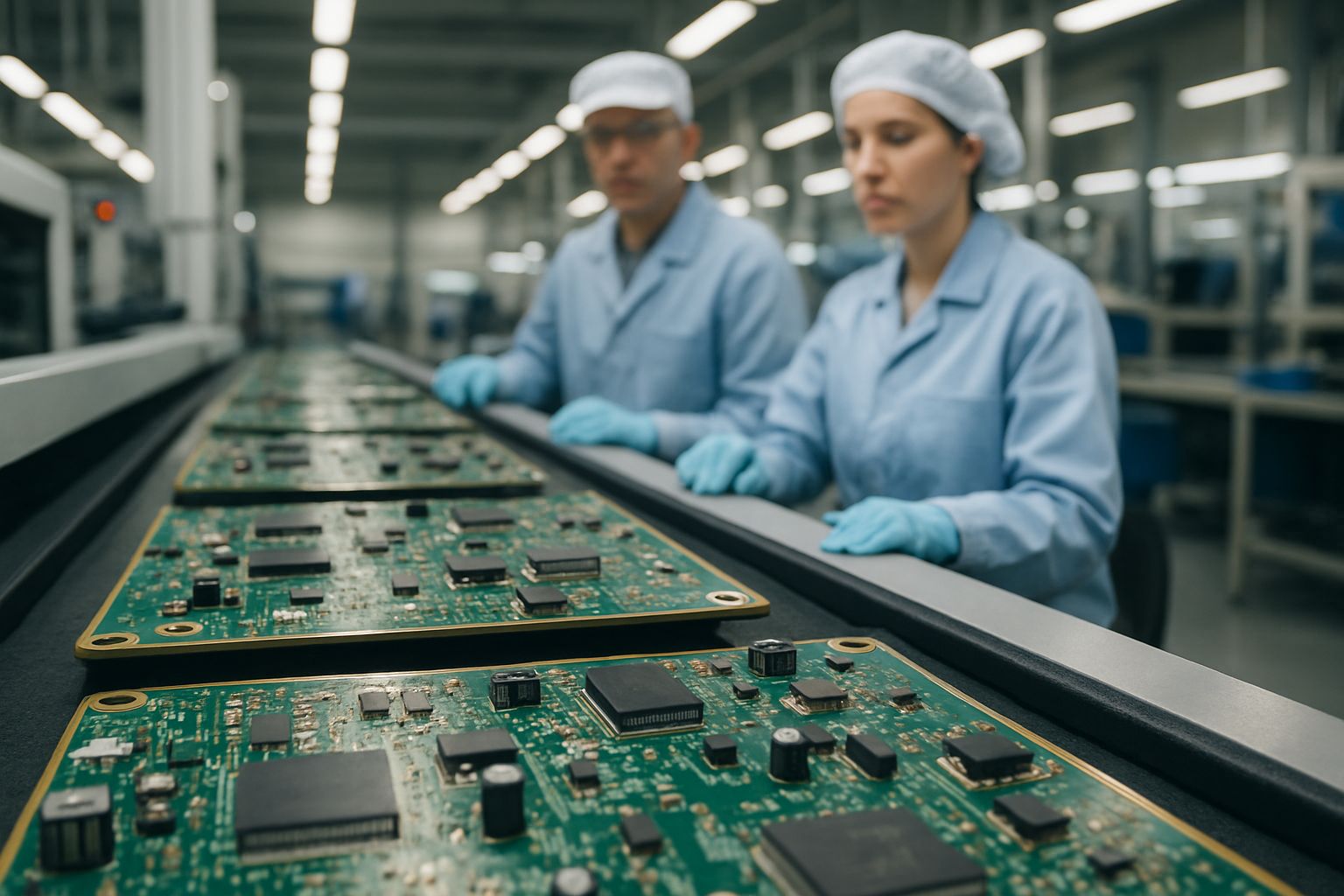
Murata’s February revision added ¥60 billion to revenue guidance, citing stronger component demand from AI servers. Company executives said MLCC orders for those platforms now run roughly twice available supply. In contrast, traditional server configurations require far fewer capacitors per board. Consequently, hyperscalers are racing to secure allocations before new manufacturing lines ramp. TrendForce estimates MLCC content in an AI rack can be several times that in earlier generations. Moreover, appetite is spilling into related power modules, sensors, and filters, amplifying revenue upside.
The order backlog underscores a genuine structural demand surge. However, elevated demand also creates financial and operational complexities explored next.
Revenue Up, Profit Down
Murata now expects ¥1.80 trillion in fiscal 2026 revenue, a 3.4% uplift over the previous forecast. Operating profit, however, was trimmed to ¥270 billion because of a SAW filter impairment. Currency headwinds added further pressure on reported earnings. Nevertheless, management stressed that core MLCC margins remain resilient thanks to premium mix gains. Moreover, potential price increases could offset part of the impairment hit. Analysts consider the revised outlook a net positive, given limited visibility only months earlier.
Revenue strength validates the AI expansion thesis despite profit noise. Consequently, Murata’s next moves on capacity warrant close scrutiny.
Capacity Expansion Strategy Details
Murata is accelerating MLCC production by building new lines and reallocating existing ones toward high-end server parts. Additionally, the company announced dedicated buildings for automotive and AI module manufacturing. Utilization rates already hover between 85% and 95%, according to management disclosures. Therefore, incremental capacity should come online gradually through fiscal 2027. Meanwhile, Murata evaluates price elasticity to decide whether capacity alone can balance spikes. Executives also flagged material cost inflation as a gating factor for expansion speed.
Expanded output supports clients yet may lag peak periods. Nevertheless, the cost side also shifts, leading to pricing questions ahead.
Pricing And Margin Pressures
Trade outlets report Murata weighing selective price hikes for premium MLCCs starting in April 2026. Subsequently, competitors Yageo and Taiyo Yuden signaled similar intentions. In contrast, major smartphone OEMs favor stable pricing to protect their margins. Moreover, hyperscalers might accept higher prices given urgent timelines for AI infrastructure rollouts. Analysts suggest every 1% ASP increase could lift Murata operating profit by roughly ¥2 billion. However, foreign exchange volatility can dilute those gains if the yen strengthens.
Pricing power may cushion margins but introduces fresh negotiation dynamics. Therefore, broad market modeling requires granular demand and price data, discussed next.
Market Size And Forecast
Independent research places the global MLCC market between USD 14 billion and USD 32 billion for 2025-2026. MarketsandMarkets expects multi-percent CAGR through 2030, driven by automotive electrification and AI computing. Consequently, passive components enjoy a rare structural tailwind amid cyclical electronics swings. Murata’s upgraded forecast aligns with these industry projections. Furthermore, the company’s internal models assume AI server demand doubling MLCC content per rack. That multiplier could translate into billions in incremental addressable revenue over several years.
The forecast backdrop underpins optimism across AI Hardware Stocks and suppliers. However, competitive dynamics also influence outcomes, as the next section details.
Competitive Landscape Snapshot Analysis
Murata leads MLCC share, yet Samsung Electro-Mechanics, Yageo, and Taiyo Yuden pursue rapid capacity adds. Additionally, Chinese entrants target mid-range segments with aggressive pricing. Nevertheless, high-end server requirements favor suppliers offering reliability credentials and tight tolerances. Consequently, Murata’s engineering advantages remain persuasive for hyperscaler qualification. Analysts warn that unexpected yield improvements at rivals could erode margins industry-wide.
- Patented dielectric materials boost capacitance while preserving reliability.
- Vertically integrated factories enable faster prototype-to-volume cycles.
- Diverse product catalog supports smartphones, cars, and servers concurrently.
- Long-term supply agreements stabilize pricing for strategic clients.
Competitive pressures persist, yet Murata’s moat in premium components appears durable today. Therefore, investors gauge positioning across AI Hardware Stocks with these dynamics in mind.
Investor Implications And Actions
Portfolio managers now recalibrate positions across AI Hardware Stocks following Murata’s upbeat signals. Moreover, balanced exposure to AI Hardware Stocks focused on power modules can hedge against component tightness. AI Hardware Stocks with robust cash flows could finance short-cycle capacity additions quickly. In contrast, overleveraged AI Hardware Stocks may struggle if pricing negotiations stall.
Consequently, professionals can gain insight through the AI Project Manager™ certification. Nevertheless, ongoing monitoring of currency risk remains essential for all AI Hardware Stocks investors. Therefore, maintain disciplined position sizing and revisit theses when Murata issues its next update.
Disclaimer: Some content may be AI-generated or assisted and is provided ‘as is’ for informational purposes only, without warranties of accuracy or completeness, and does not imply endorsement or affiliation.


