

AI CERTS
3 hours ago
AI Navigates Space but Talent Gap Holds Missions Back
The latest insights from Orbital Today highlight a fascinating contrast. On one hand, AI is already enabling autonomous navigation, real-time decision-making, and advanced data processing in space. On the other, companies rushing to adopt AI are often falling into predictable traps—overestimating capabilities, underinvesting in training, and misunderstanding operational realities.
When AI Works in Space It Works Brilliantly
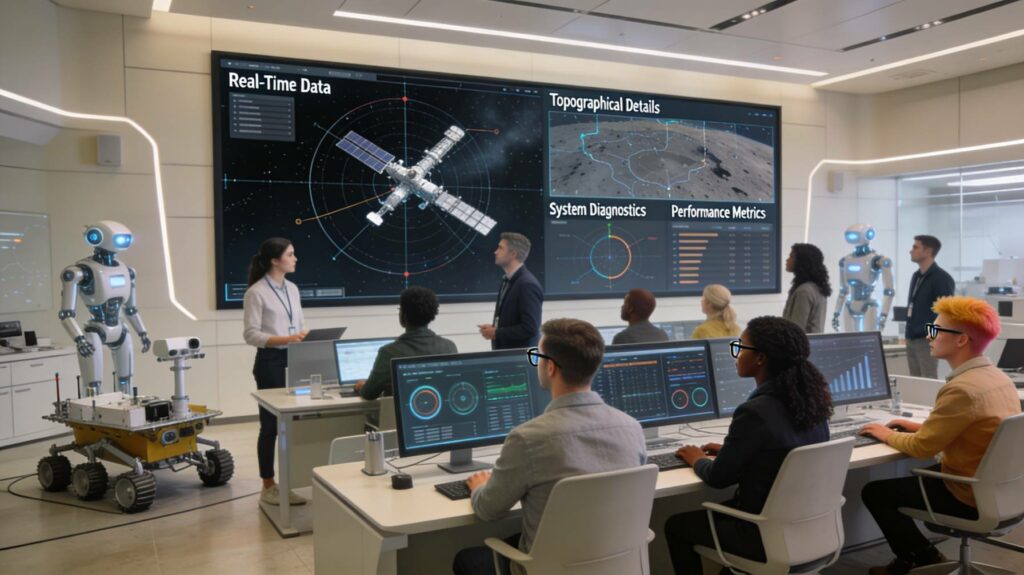
Consider NASA’s Perseverance rover. Despite running on hardware comparable to a late-1990s computer, it has autonomously completed over 90% of its 40-kilometer journey on Mars.
This is not just impressive—it is instructive. AI in space works best when it is purpose-built, tested rigorously, and aligned with mission-specific challenges. Autonomous navigation and collision avoidance are among the most successful applications today, allowing spacecraft to analyze terrain, avoid hazards, and optimize routes without human intervention.
The broader space industry is rapidly embracing such capabilities. AI is being used to analyze Earth imagery, detect anomalies, and even automate in-orbit operations.
In short, the promise is real. AI is not a futuristic concept in space—it is already operational and delivering measurable value.
Where Companies Are Getting It Wrong
Yet, despite these successes, many organizations are struggling to replicate such outcomes. The problem is not a lack of ambition but a mismatch between expectations and execution.
One major issue is the “hype-first” approach. Companies often treat AI as a plug-and-play solution, expecting immediate results without investing in the underlying systems, data pipelines, or expertise required to make it work.
Another critical mistake is ignoring constraints unique to space. Unlike Earth-based systems, space operations face extreme limitations—restricted computing power, latency challenges, radiation exposure, and limited opportunities for updates. AI models must be lightweight, reliable, and resilient, not just powerful.
Most importantly, many companies underestimate the human factor. AI systems are only as effective as the teams designing, deploying, and managing them. Without skilled professionals who understand both AI and aerospace engineering, even the most advanced algorithms fail to deliver.
The Real Bottleneck Is AI Skills
The space industry is entering a phase where AI is no longer optional—it is foundational. From satellite constellations to deep-space missions, AI will drive efficiency, safety, and scalability.
But here is the challenge: the demand for AI expertise is outpacing supply. Organizations are investing billions in AI-driven space technologies, yet many lack the trained workforce needed to operationalize these investments effectively.
This is where the conversation shifts from technology to training.
AI in space is not just about coding models. It requires interdisciplinary skills—machine learning, systems engineering, data analysis, and domain-specific knowledge of space environments. Without structured training, companies risk building systems that are either underutilized or unreliable.
Why AI Training Partnerships Are Becoming Essential
To bridge this gap, forward-thinking organizations are turning to structured AI training ecosystems. One such initiative is the AI CERTs Authorized Training Partner (ATP) Program.
The ATP model is designed to go beyond traditional learning. It equips organizations with ready-to-deploy AI training frameworks, standardized courseware, and scalable learning systems. This ensures that teams are not just aware of AI concepts but are capable of applying them in real-world scenarios—including complex domains like space operations.
In industries where precision and reliability are critical, such as aerospace, this kind of training is not a luxury—it is a necessity. Companies that invest in AI training partnerships are more likely to succeed because they build internal capability, not just external dependency.
The Future of AI in Space Depends on People
The space economy is projected to grow rapidly, with AI playing a central role in its expansion. From orbital data centers to autonomous satellite networks, the next decade will redefine how humanity operates beyond Earth.
But the winners in this new era will not be those with the most advanced algorithms alone. They will be the organizations that understand how to integrate AI effectively—technically, operationally, and strategically.
And that begins with people.
The lesson from today’s space industry is clear. AI can navigate Mars, detect anomalies in orbit, and process vast amounts of data in seconds. But without trained professionals to guide its implementation, even the most powerful technology will fall short.
FAQs
What is the role of AI in space operations today
AI is used for autonomous navigation, data analysis, collision avoidance, and real-time decision-making in satellites and rovers, helping reduce reliance on Earth-based control systems.
Why do many companies fail in implementing AI in space
Many organizations overestimate AI capabilities, underestimate space-specific constraints, and lack trained professionals to design and manage AI systems effectively.
How does AI improve satellite and mission efficiency
AI enables faster data processing, predictive maintenance, and autonomous operations, reducing delays and improving mission outcomes.
What skills are required for AI in space operations
Professionals need expertise in machine learning, aerospace systems, data engineering, and real-time decision systems tailored for extreme environments.
How can organizations build AI capability for space applications
They can invest in structured training programs like the AI CERTs Authorized Training Partner Program, which provides scalable and practical AI education aligned with industry needs.


