

AI CERTS
2 months ago
China’s Robot Trainers Are Shaping the Future of Work — But Are We Ready for the AI Skills Revolution?
A New Kind of Workforce Is Emerging
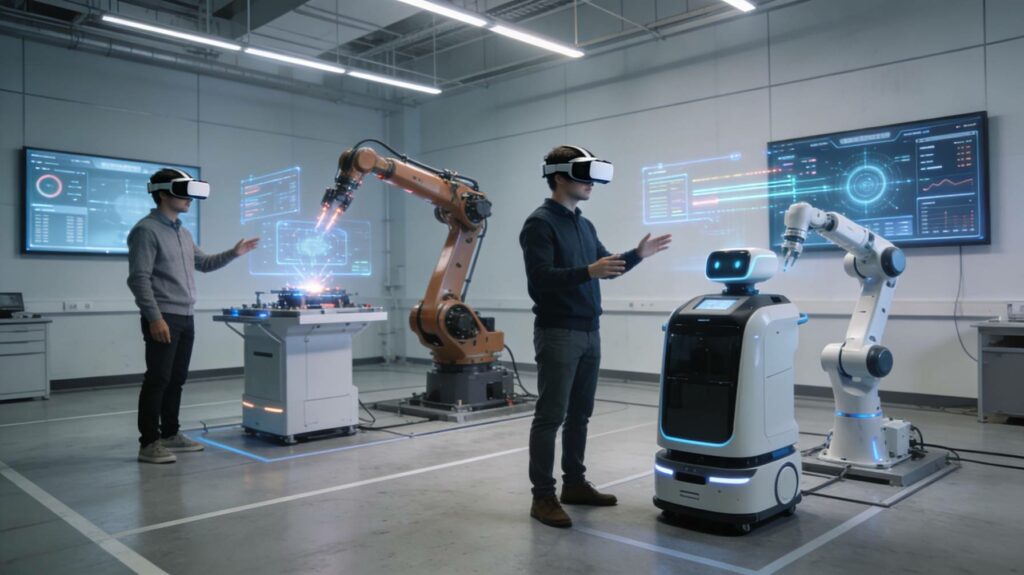
In eastern China’s Shandong province, cities like Jinan and Qingdao are becoming hubs for embodied AI innovation. Dedicated robot training centers now simulate real-world environments—from automotive factories to household settings—where human trainers teach robots how to perform everyday and industrial tasks.
These trainers, including data collectors and annotators, use advanced tools like VR devices to guide robots through precise actions such as identifying objects, navigating spaces, and executing repetitive tasks. Through thousands of iterations, robots learn from real-world data, becoming increasingly intelligent and adaptable.
This isn’t just automation—it’s collaboration between humans and machines at an unprecedented level.
The Rise of “Embodied AI” and Why It Matters
Unlike traditional AI systems that operate in digital environments, embodied AI exists in the physical world. These robots are being trained to assist in industries such as manufacturing, logistics, retail, and even caregiving.
Imagine a robot that can stock shelves, assist elderly patients, or work alongside humans in factories. This shift marks a transition from software-based intelligence to real-world, physical intelligence—making AI more tangible, impactful, and deeply integrated into everyday life.
But here’s the catch: none of this works without skilled human intervention.
The Hidden Skill Gap Behind the AI Boom
While the world celebrates AI breakthroughs, a silent crisis is brewing—the shortage of trained professionals who can build, train, and manage these systems.
The emergence of roles like embodied AI trainers signals a larger trend. AI is no longer limited to engineers and data scientists. It now requires a diverse workforce trained in areas like data annotation, machine behavior modeling, human-machine interaction, and operational AI deployment.
China’s broader strategy reflects this urgency. The country is already pushing to integrate AI education across all levels, aiming to build a comprehensive AI-ready workforce by 2030.
The message is clear: AI adoption without AI education is a risk no economy can afford.
Why AI Training Is No Longer Optional
This transformation highlights a fundamental truth—AI is only as powerful as the people who understand it.
Organizations worldwide are investing heavily in AI tools, but many still struggle with implementation due to a lack of skilled talent. Without proper training, businesses face challenges in deploying AI effectively, ensuring ethical use, and achieving measurable ROI.
This is where structured AI training ecosystems become critical.
Programs like the AI CERTs Authorized Training Partner (ATP) Program are designed to bridge this exact gap. Unlike fragmented learning approaches, ATP provides a comprehensive framework that enables organizations and training providers to deliver industry-aligned AI education at scale.
It’s not just about learning AI—it’s about operationalizing it.
From Experimentation to Execution
The story unfolding in China is a preview of what’s coming globally. AI is moving from experimental labs to real-world deployment at speed. Robots are entering workplaces, AI is shaping decisions, and automation is redefining productivity.
But the real differentiator won’t be who adopts AI first—it will be who trains their people best.
Organizations that invest in AI training today will lead tomorrow. Those that don’t risk falling behind in a rapidly evolving digital economy.
The Bigger Picture: Human + AI Collaboration
What’s fascinating about this development is that it doesn’t eliminate human roles—it transforms them.
AI trainers, supervisors, and operators represent a new category of jobs that didn’t exist a decade ago. This reinforces a powerful idea: AI doesn’t replace humans; it amplifies human potential—if we are prepared.
The rise of embodied AI is not just a technological shift. It’s a workforce revolution.
And like every revolution, it demands readiness.
FAQs
What is embodied AI?
Embodied AI refers to artificial intelligence systems that operate in physical forms like robots, interacting with the real world rather than just digital environments.
What do embodied AI trainers do?
They teach robots how to perform tasks by guiding them through actions, collecting data, and refining machine behavior through repeated training.
Why is AI training important for businesses?
Without proper training, businesses struggle to implement AI effectively, leading to wasted investments and missed opportunities.
What industries will benefit most from embodied AI?
Manufacturing, logistics, healthcare, retail, and household services are among the key sectors expected to see significant transformation.
How can professionals prepare for the AI-driven future?
By upskilling through structured programs like AI certifications and training partnerships that focus on real-world AI applications and deployment.
Disclaimer: Some content may be AI-generated or assisted and is provided ‘as is’ for informational purposes only, without warranties of accuracy or completeness, and does not imply endorsement or affiliation.


