

AI CERTS
3 months ago
Europe’s AI Health Revolution Is Here But Without Training, It Could Become Its Biggest Risk
A Historic First Look at AI in European Healthcare
For the first time ever, WHO Europe has provided a comprehensive snapshot of how artificial intelligence is being used across all 27 EU member states. The findings are striking. Every single country recognizes AI’s potential to improve patient care, and most have already begun integrating AI tools into clinical environments.
The report, based on data collected between June 2024 and March 2025, highlights a region actively building the foundations for safe and responsible AI deployment. Governments are not just experimenting, they are institutionalizing AI through national strategies, regulatory frameworks, and investments in digital infrastructure.
What stands out is the scale and uniformity of adoption. This is not a fragmented digital transformation—it is a coordinated shift across an entire continent.
AI Is Already Diagnosing, Predicting, and Engaging Patients
The real headline, however, lies in how deeply AI is embedded in healthcare delivery. According to the report, 74% of EU countries are already using AI-assisted diagnostics, including applications in medical imaging, disease detection, and clinical decision-making.
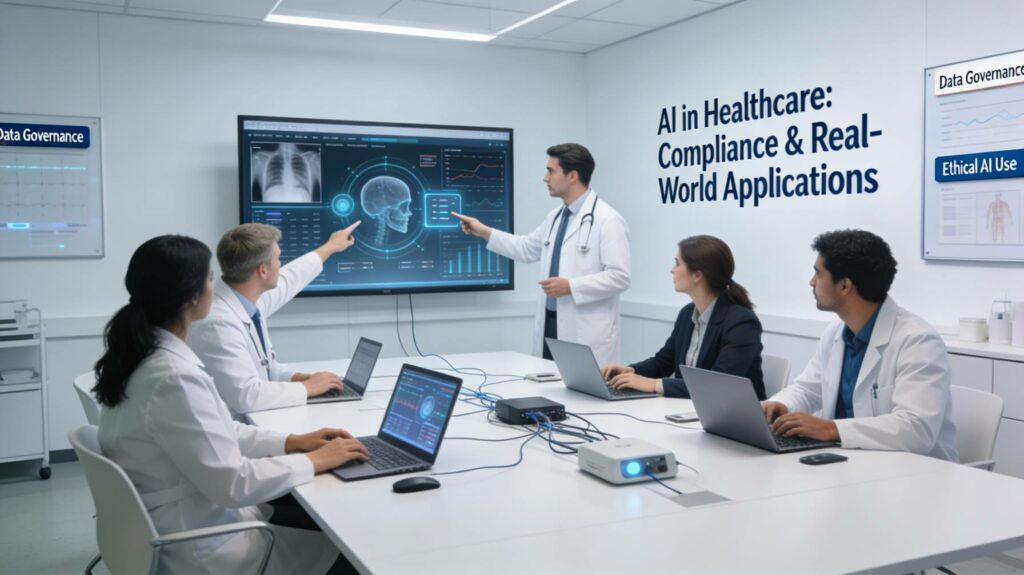
Additionally, 63% of countries are using AI-powered chatbots to enhance patient engagement, helping answer queries, manage appointments, and guide treatment pathways.
This means AI is no longer a back-end tool—it is directly interacting with patients and influencing clinical outcomes. Hospitals are leveraging AI to reduce diagnostic errors, speed up treatment decisions, and optimize workflows.
But as AI moves closer to the patient, the margin for error shrinks dramatically.
The Hidden Gap: Workforce Readiness and Training
While adoption is surging, the report highlights a less visible but far more urgent issue—workforce preparedness. Nearly half of EU countries have already created specialized roles in AI and data science within healthcare. Yet, many are still in the early stages of building structured training programs.
This gap is critical.
AI systems in healthcare are not like traditional software. They require an understanding of data quality, model behavior, bias detection, and ethical implications. Without proper training, even the most advanced AI tools can lead to misdiagnosis, compliance risks, and loss of patient trust.
WHO has also emphasized that responsible AI deployment depends on strong governance, ethical frameworks, and skilled professionals who can interpret and oversee AI systems.
In short, technology is advancing faster than human capability and that imbalance could define the next phase of healthcare transformation.
Regulation is Rising but Skills Must Catch Up
The European Union has already taken steps to regulate AI through initiatives like the AI Act, which classifies medical AI systems as “high-risk” and mandates strict requirements around transparency, data quality, and human oversight.
At the same time, WHO warns that safeguards are still lagging the pace of adoption.
This creates a complex environment where healthcare organizations must balance innovation with compliance. And compliance is not just about policies; it is about people. Professionals need to understand how AI systems work, how to audit them, and how to intervene when something goes wrong.
Without this capability, even well-regulated systems can fail in real-world scenarios.
Why AI Training Is No Longer Optional
The implications of this report extend far beyond Europe. As AI becomes a global standard in healthcare, the demand for skilled professionals will surge across regions, including India and the United States.
Training is no longer a “nice-to-have,” it is a strategic necessity.
Healthcare professionals must evolve from being users of technology to informed decision-makers who can collaborate with AI. Similarly, business leaders and policymakers must understand AI’s operational, ethical, and legal dimensions to make informed investments.
This is where structured programs like the AI CERTs Authorized Training Partner (ATP) Program come into play.
ATP is designed to bridge exactly this gap. It equips organizations and professionals with industry-aligned AI skills, covering not just technical knowledge but also governance, compliance, and real-world application. In a landscape where AI errors can cost lives, such training ensures that adoption is not just fast—but safe and scalable.
The Road Ahead: From Adoption to Mastery
The WHO Europe report makes one thing clear, AI in healthcare is no longer experimental. It is operational, widespread, and rapidly evolving.
But the next phase will not be defined by how many tools are deployed. It will be defined by how effectively they are used.
Countries that invest in workforce training, ethical frameworks, and governance will lead the AI-driven healthcare revolution. Those that don’t risk falling into a dangerous cycle of misuse, inefficiency, and regulatory backlash.
As AI continues to reshape healthcare, the real competitive advantage will not be technology, it will be talent.
And the race to build that talent has already begun.
FAQs
What is the key finding of the WHO Europe 2026 AI healthcare report?
The report reveals that all 27 EU countries are actively adopting AI in healthcare, with most already using it in clinical settings to improve patient care and operational efficiency.
How widely is AI used in healthcare across Europe?
AI is extensively used, with 74% of countries deploying AI-assisted diagnostics and 63% using AI chatbots for patient interaction and engagement.
What challenges does the report highlight?
The major challenges include lack of workforce training, gaps in governance frameworks, ethical concerns, and the need for better regulatory compliance.
Why is AI training important in healthcare?
AI systems require specialized skills to manage data, interpret outputs, and ensure ethical use. Without training, there is a risk of errors, bias, and compromised patient safety.
How can professionals prepare for AI-driven healthcare?
Professionals can upskill through structured programs like the AI CERTs ATP, which provide practical knowledge in AI implementation, governance, and real-world healthcare applications.
Disclaimer: Some content may be AI-generated or assisted and is provided ‘as is’ for informational purposes only, without warranties of accuracy or completeness, and does not imply endorsement or affiliation.


